
How to Source Restaurant Kitchen Equipment Parts Without Delays
Sourcing restaurant kitchen equipment parts quickly is critical for after-sales maintenance teams responsible for keeping commercial kitchens running without costly downtime. From identifying compatible components to choosing reliable suppliers and managing urgent replacements, every step affects service speed and customer satisfaction. This guide explains how to source restaurant kitchen equipment parts efficiently, reduce delays, and support stable kitchen operations.
Why do restaurant kitchen equipment parts cause so many delays?
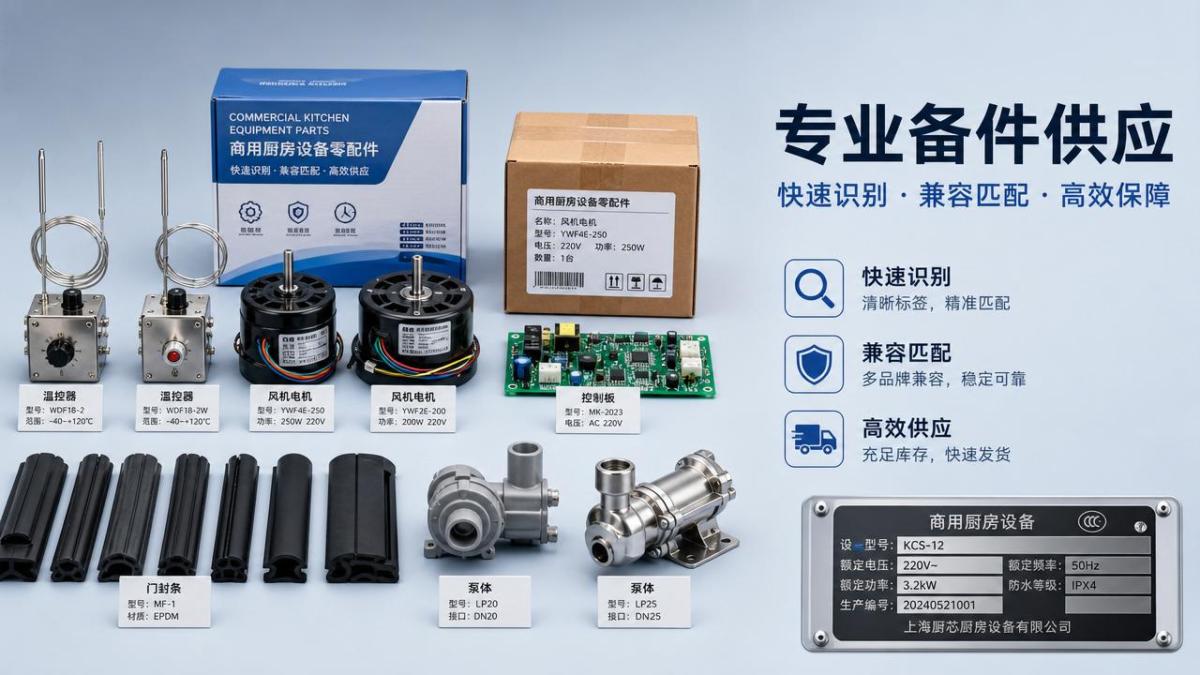
For after-sales maintenance personnel, the biggest challenge is rarely the repair itself. The delay usually starts earlier: missing model data, unclear part numbers, discontinued components, cross-border lead times, and uncertainty about compatibility. In a commercial kitchen, a failed ignition module, thermostat, fan motor, door gasket, control board, or pump can interrupt cooking, refrigeration, sanitation, or food holding within minutes.
The kitchen equipment industry is also becoming more complex. Traditional gas ranges and refrigeration units now coexist with smart combi ovens, sensor-driven fryers, automated dishwashing systems, and digitally monitored holding cabinets. That means restaurant kitchen equipment parts sourcing now requires both mechanical understanding and electrical or control-system awareness.
Globalized manufacturing adds another layer. Equipment may be assembled in one country, fitted with controllers from another, and distributed through regional agents. When maintenance teams need urgent replacement parts, they must judge not only the part itself, but also origin, compliance, stocking strategy, and whether an alternative part can safely restore operation.
- Incomplete equipment records make part identification slow and error-prone.
- Multiple suppliers may use different naming systems for the same component.
- Imported equipment often requires longer shipping times and customs coordination.
- Smart appliances can require firmware-matched or specification-matched replacements.
What should maintenance teams confirm before ordering parts?
Fast sourcing starts with disciplined identification. Before placing an order for restaurant kitchen equipment parts, the maintenance team should verify the equipment category, operating power, gas type if relevant, dimensions, connection type, and the exact failure symptom. A visual match is not enough. Many delays come from ordering a part that looks correct but fails on voltage, connector layout, sensor range, mounting orientation, or software compatibility.
The most practical approach is to create a standard information package for every service ticket. This package helps internal teams, suppliers, and technical support communicate faster and reduces back-and-forth emails.
Essential identification checklist for restaurant kitchen equipment parts
- Record the equipment nameplate details, including model, serial number, voltage, frequency, and manufacturing date.
- Photograph the failed part from multiple angles, including labels, terminals, and mounting points.
- Describe the failure mode clearly, such as no heat, intermittent shutdown, error code, leakage, abnormal noise, or temperature drift.
- Confirm whether the original part is OEM, third-party, or previously substituted.
- Check whether food-contact, heat-resistance, or electrical safety requirements apply.
The table below shows the minimum information that should be collected before sourcing restaurant kitchen equipment parts for urgent or planned maintenance.
This checklist turns reactive ordering into controlled sourcing. It also improves communication with overseas suppliers that may not have direct access to the equipment on site.
How to choose between OEM, compatible, and substitute parts
Not every repair requires the same sourcing strategy. Some restaurant kitchen equipment parts should be sourced as original manufacturer components, while others can be replaced with compatible industrial parts if specifications are carefully verified. The decision depends on safety, downtime cost, warranty impact, and the criticality of the equipment.
For example, a control board in a programmable combi oven carries more risk than a door handle, shelf support, or caster. Gas valves, high-limit thermostats, ignition systems, and food-zone seals also require stricter evaluation because they affect safety, sanitation, and regulatory compliance.
The comparison below helps maintenance teams select the right type of restaurant kitchen equipment parts according to urgency and operational risk.
A lower purchase price does not always reduce total repair cost. If a substitute part fails early or requires rework, labor, freight, and customer disruption can exceed the savings from the initial order.
When a substitute part makes sense
- The original part is obsolete and the supplier provides a documented cross-reference.
- The component is a standard industrial item such as a relay, bearing, switch, or seal.
- The equipment is out of warranty and the end user prioritizes lead time over brand continuity.
- Technical parameters, installation geometry, and safety requirements are fully confirmed.
Which suppliers reduce lead time most effectively?
The best source for restaurant kitchen equipment parts is not always the original factory. For after-sales maintenance teams, the right supplier is the one that can confirm compatibility quickly, communicate clearly, and deliver within the service window. In many cases, a hybrid sourcing network works better than relying on a single channel.
Common sourcing channels
- Original equipment manufacturer or authorized distributor: best for warranty-sensitive parts, software-linked modules, and safety assemblies.
- Specialized spare parts wholesalers: useful for broad stock coverage across refrigeration, cooking, and warewashing equipment.
- Industrial component suppliers: suitable for motors, switches, solenoids, thermostats, and standard electrical items.
- Manufacturing exporters in major supply countries: valuable for planned stock orders, private labeling, and cost control on recurring demand.
The table below compares supplier types for restaurant kitchen equipment parts from a maintenance response perspective.
For urgent repairs, local or regional stock often wins. For recurring maintenance, direct supply relationships can reduce cost and improve planning. Strong after-sales teams usually use both.
How to build a no-delay sourcing workflow
If your team regularly handles restaurant kitchen equipment parts, speed depends more on process than on luck. A repeatable workflow can shorten downtime, especially for restaurants, hotels, central kitchens, and food processing sites that operate extended hours.
Recommended service workflow
- Classify the equipment by criticality: cooking, refrigeration, sanitation, or support equipment.
- Create a parts history file for each installed unit, including previous substitutions and recurring failures.
- Set a fast-quote list with preapproved suppliers for common restaurant kitchen equipment parts.
- Maintain minimum stock for high-failure consumables and fast-moving components.
- Review failure data quarterly to identify which parts should be stocked locally and which should be ordered on demand.
This method is especially important in the modern kitchen equipment market, where smart systems, energy-efficient controls, and integrated devices increase dependence on timely spare parts support. As more kitchens adopt automation and digital monitoring, maintenance teams need sourcing records that are as organized as their service logs.
What standards and compliance points should not be ignored?
When sourcing restaurant kitchen equipment parts, compliance is not a paperwork issue alone. It affects safety, inspection outcomes, and liability. Replacement parts used in commercial kitchens may need to meet electrical, gas, thermal, hygiene, or material-related requirements depending on the application and local regulations.
- Electrical parts should match rated voltage, insulation requirements, and connection design.
- Gas components should only be replaced with properly specified items suitable for the fuel type and pressure conditions.
- Food-contact materials, seals, and surfaces should be appropriate for hygiene-sensitive environments.
- Heat-exposed parts should be selected based on operating temperature, not appearance alone.
If the equipment is installed in multiple markets, it is wise to ask suppliers what technical documents they can provide, such as specification sheets, material declarations, dimensional drawings, or test references. That helps the maintenance team make a defensible decision without overpromising unsupported claims.
Common mistakes that slow down restaurant kitchen equipment parts sourcing
Even experienced technicians can lose time through preventable sourcing habits. Most delays are not caused by rare failures, but by common workflow gaps.
Mistakes to avoid
- Ordering only by equipment brand without checking production revision or serial range.
- Assuming all thermostats, elements, probes, or switches with similar size are interchangeable.
- Choosing the cheapest part without considering labor repeat cost and downtime exposure.
- Ignoring shipping method, customs documentation, or local stock availability during urgent service.
- Replacing a failed component before confirming whether an upstream electrical or control fault caused the failure.
A disciplined sourcing process protects both service speed and repair quality. In a busy commercial kitchen, avoiding one wrong order can save an entire service cycle.
FAQ about sourcing restaurant kitchen equipment parts
How can I find restaurant kitchen equipment parts faster when the label is damaged?
Start with photos of the full machine, the failed part, connector positions, mounting points, and any control interface. Measure key dimensions and record power data from nearby wiring labels or manuals if available. A supplier with foodservice parts experience can often narrow options by equipment function, physical layout, and fault symptoms.
Should maintenance teams stock parts locally or order only when needed?
For high-use kitchens, local stock is recommended for fast-moving restaurant kitchen equipment parts such as door gaskets, thermostats, switches, pilot components, common sensors, and wear items. Low-frequency, high-value parts such as boards or specialized assemblies are usually better managed through supplier agreements and fast confirmation channels.
How long is a normal lead time for replacement parts?
Lead time varies by source and part type. Local stock can move within days, while imported OEM assemblies may take several weeks depending on factory availability and shipping mode. The key is to separate emergency parts from planned maintenance parts and assign different sourcing rules to each category.
What is the safest way to use compatible parts?
Use compatible parts only after checking electrical ratings, material suitability, operating temperature, pressure conditions, geometry, and connector details. For safety-related systems such as gas, high-limit protection, or electronic controls, ask for technical confirmation before installation.
Why choose a supply partner that understands after-sales maintenance?
A useful supplier does more than quote restaurant kitchen equipment parts. The right partner helps maintenance teams confirm specifications, compare OEM and alternative options, estimate delivery windows, and identify parts suitable for stock planning. This is especially important in a kitchen equipment market shaped by automation, intelligent controls, energy-saving designs, and globally distributed manufacturing.
If you are managing repairs for restaurants, hotels, central kitchens, or food processing sites, you can contact us for practical sourcing support. We can help with parameter confirmation, part selection, compatibility review, delivery cycle assessment, substitute part evaluation, certification-related document requests, sample support for recurring items, and quotation communication for planned or urgent orders.
When downtime is expensive, clear technical communication matters as much as price. A structured sourcing discussion today can prevent missed service windows, repeat orders, and unnecessary equipment shutdowns later.
Popular Tags
Kitchen Industry Research Team
Dedicated to analyzing emerging trends and technological shifts in the global hospitality and foodservice infrastructure sector.
Industry Insights
Join 15,000+ industry professionals. Get the latest market trends and tech news delivered weekly.
No spam. Unsubscribe anytime.

Contact With us
Contact:
Anne Yin (Ceramics Dinnerware/Glassware)
Lucky Zhai(Flatware)