
Restaurant Kitchen Equipment Repair Plans That Cut Downtime
Unexpected breakdowns in busy kitchens can quickly disrupt service, increase costs, and damage customer satisfaction. A well-structured restaurant kitchen equipment repair plan helps after-sales maintenance teams reduce downtime, improve response speed, and keep critical systems running safely and efficiently. This guide explores practical strategies to streamline restaurant kitchen equipment repair while supporting long-term equipment reliability.
For after-sales maintenance teams, the core search intent behind this topic is practical: how to build repair plans that reduce downtime, prioritize critical assets, and improve service outcomes in real operating kitchens. Readers are not looking for broad industry theory. They want a workable framework for faster diagnosis, smarter parts planning, clearer escalation, and fewer repeat failures.
The most important concerns are usually response time, first-time fix rate, technician coordination, spare parts availability, safety compliance, and the cost of unplanned shutdowns. What helps most is concrete guidance: which equipment to prioritize, how to classify faults, what a repair plan should include, how to track performance, and when preventive action is more cost-effective than repeated emergency repair.
Why downtime costs more than the repair itself
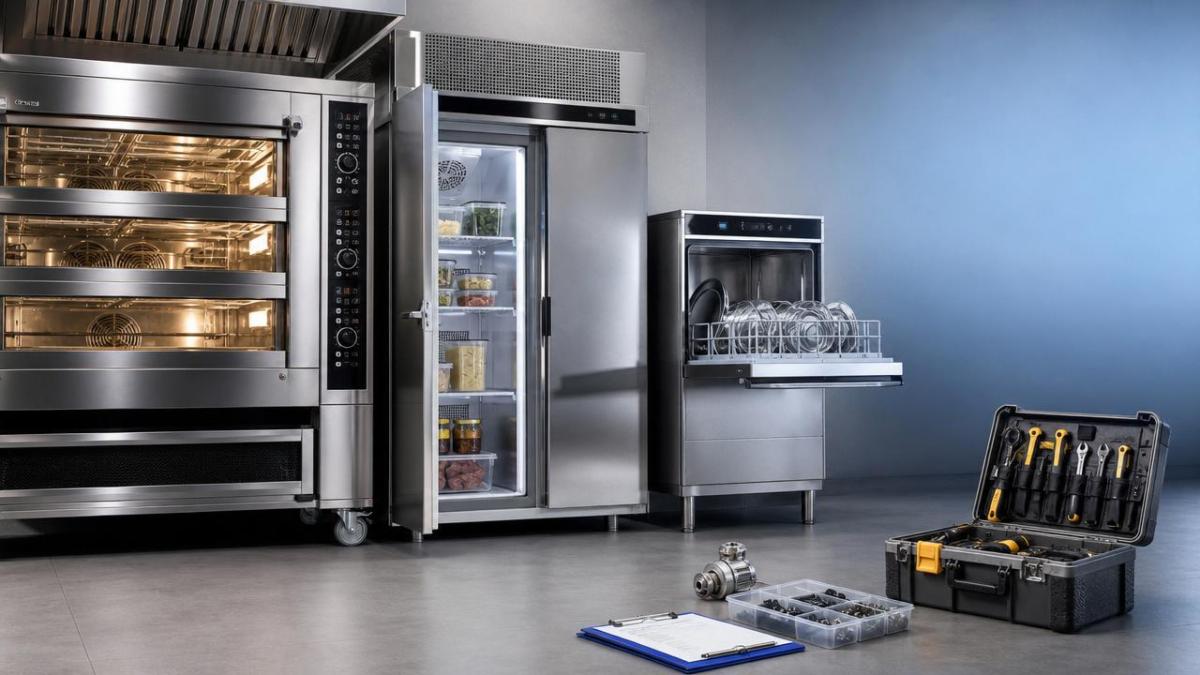
In commercial kitchens, equipment failure rarely affects only one machine. A failed combi oven can delay prep, service timing, food quality, and labor scheduling. A walk-in cooler issue can create food safety risk, inventory loss, and urgent operational disruption. That is why an effective restaurant kitchen equipment repair plan must be built around downtime reduction, not just technical troubleshooting.
For maintenance teams, the real cost of downtime includes lost sales, overtime labor, customer complaints, wasted ingredients, and reputational damage. In high-volume environments, even a short outage during lunch or dinner service can create a chain reaction across the kitchen line. The repair plan should therefore classify equipment by operational impact, not simply by asset type or replacement value.
A useful starting point is to separate kitchen assets into three levels: mission-critical, service-supporting, and non-critical. Mission-critical items include refrigeration, cooking lines, dishwashing systems, and ventilation components that directly affect safety or throughput. Service-supporting equipment may include prep devices or holding units with partial workarounds. Non-critical assets are those that can be temporarily bypassed without major service interruption.
What a repair plan must include to actually cut downtime
Many teams already have service procedures, but not all of them have a real repair plan. A true plan is more than a contact list or a reactive maintenance checklist. It should define responsibilities, response targets, diagnostic steps, spare parts strategy, escalation rules, communication methods, and documentation standards for each major class of restaurant equipment.
At minimum, the plan should include an asset register with model numbers, serial numbers, installation dates, warranty status, service history, common failure modes, and critical spare parts. This saves time during dispatch and troubleshooting. When technicians already know the equipment profile and known weak points, diagnosis becomes faster and repeat visits decrease.
The next essential element is fault prioritization. Not all service calls deserve the same response window. A freezer failing in peak service is not equivalent to a slicer with intermittent performance in a low-volume prep area. Maintenance teams should set target response times based on food safety exposure, service disruption, and backup availability.
Good repair plans also define what can be handled remotely, what requires an on-site visit, and when outside specialists must be engaged. This matters especially for smart kitchen systems, automated cooking equipment, and networked control platforms, where software, sensors, and controls may be part of the failure chain.
How to prioritize equipment for faster response and better planning
One of the most effective ways to improve restaurant kitchen equipment repair is to rank assets by business impact and failure probability. This simple discipline helps after-sales teams allocate technician time, spare inventory, and preventive resources where they matter most.
Start by asking five questions for each asset. Does failure stop food production? Does it create food safety risk? Is there a manual workaround? How long can operations continue before major disruption? Are parts readily available? Equipment that scores high on operational and safety impact should receive tighter inspection schedules, faster response targets, and stronger spare parts coverage.
For example, refrigeration units, fryers, ovens, steamers, ice machines, and dishwashers often deserve higher priority than small countertop equipment. However, the exact ranking depends on the kitchen format. In a bakery, proofing and baking systems may be highest priority. In quick-service environments, fryers and holding cabinets may drive the repair plan.
Once priority levels are defined, teams can create a practical service matrix. Level 1 equipment may require same-day response, pre-positioned consumables, and quarterly condition reviews. Level 2 equipment may follow standard next-day service. Level 3 assets may be serviced in grouped visits to improve route efficiency and reduce labor cost.
Build a troubleshooting workflow that reduces repeat visits
Repeat visits are one of the biggest hidden costs in field service. They increase downtime, inflate labor hours, and frustrate kitchen operators. A structured troubleshooting workflow can significantly improve first-time fix performance.
Before dispatch, collect basic failure information in a consistent format: equipment type, symptom, error code, duration of issue, recent cleaning or maintenance activity, power status, utility conditions, and whether the failure is complete or intermittent. Many delays happen because technicians arrive without enough context, or because the original problem description is too vague.
A standard diagnostic tree should be prepared for major equipment categories. For refrigeration, check power supply, thermostat signals, airflow restriction, condenser cleanliness, door gasket condition, refrigerant performance indicators, and controller alarms. For cooking equipment, focus on ignition, heating elements, gas flow, temperature sensors, safety cutoffs, and control board behavior.
Technicians should also document root cause, not just corrected symptom. Replacing a tripped switch or resetting a controller may restore function temporarily, but if the underlying issue is poor ventilation, overloaded circuits, scaling, blocked filters, or improper operator use, the same failure is likely to return. Reliable restaurant kitchen equipment repair depends on breaking the cycle of symptom-based fixes.
Spare parts planning is often the biggest downtime lever
Even highly skilled technicians lose time when common parts are unavailable. For many kitchens, the difference between a two-hour outage and a two-day outage is not diagnosis but parts access. That makes spare parts planning one of the strongest tools for reducing downtime.
After-sales teams should identify fast-moving parts by asset class and failure history. Common examples include thermostats, door gaskets, switches, igniters, sensors, contactors, relays, belts, pumps, filters, solenoids, and control knobs. Stocking every component is not realistic, but stocking the right components for high-priority equipment usually pays off quickly.
A practical method is to maintain three stock layers: technician van stock, local service hub stock, and central warehouse stock. Van stock supports fast first-time repairs for frequent faults. Hub stock covers medium-frequency parts for regional response. Central stock supports major assemblies and less common components. Review usage monthly so the parts mix reflects actual field demand instead of guesswork.
It is also important to align parts planning with supplier lead times and equipment age. Legacy equipment with declining parts support may require a different strategy, such as pre-buying critical components, identifying compatible substitutes, or advising customers on replacement before failures become operationally dangerous.
Preventive maintenance and repair planning should work together
Repair plans are strongest when they are connected to preventive maintenance. Emergency repair alone cannot sustainably reduce downtime if the same operational and wear-related issues keep recurring. Preventive inspections help catch deterioration before it turns into service interruption.
For high-priority kitchen assets, preventive visits should focus on the most failure-prone and downtime-sensitive conditions: temperature accuracy, burner performance, door seals, condenser cleanliness, electrical connections, filter condition, drainage, calibration, fan operation, and unusual vibration or noise. These checks are simple, but they often prevent the faults that create the most disruptive breakdowns.
Maintenance teams should use repair history to refine preventive schedules. If a fryer line repeatedly shows ignition failure after oil contamination, or if a dishwasher suffers from scale-related heating issues, the solution is not only faster repair. It may also require revised cleaning routines, operator guidance, or more frequent inspection intervals.
The connection between preventive work and reactive repair should be visible in one tracking system. When teams can see recurring faults by site, model, and component, they can move from constant firefighting to targeted reliability improvement.
How to improve communication between technicians and kitchen operators
Downtime is not only a technical problem. It is also a communication problem. Repair delays often grow because operators report symptoms unclearly, technicians do not explain interim risk, or service decisions are made without understanding kitchen workflow.
After-sales teams should standardize intake questions and train front-line contacts to gather usable information. Kitchen staff may not know technical terms, but they can often describe sounds, smells, timing, visible alarms, or whether the issue began after cleaning, loading changes, or a utility interruption. That information can dramatically improve dispatch quality.
On-site technicians should communicate in operational terms as well as technical terms. Instead of saying a unit has a control issue, explain whether the equipment can be used safely, whether output capacity is reduced, what temporary workaround is possible, and when full restoration is expected. This helps kitchen teams plan service continuity instead of waiting in uncertainty.
A clear closeout report is equally important. It should state the fault, root cause, action taken, parts used, safety observations, and recommended follow-up. Over time, these reports become a valuable knowledge base for improving restaurant kitchen equipment repair across multiple customer sites.
Metrics that show whether the repair plan is working
If a repair plan is meant to cut downtime, the results must be measurable. Many service teams track volume but not effectiveness. A better approach is to monitor a small set of operational metrics that connect service performance to kitchen continuity.
The most useful indicators usually include response time, time to restore operation, first-time fix rate, repeat failure rate, parts fill rate, emergency call frequency, preventive compliance, and mean time between failures for critical assets. These metrics reveal where the process is slowing down: dispatch, diagnosis, parts availability, technician skill, or customer-side operating conditions.
For example, a good response time with a poor first-time fix rate may point to weak troubleshooting or insufficient van stock. A high repeat failure rate on one equipment family may indicate poor root-cause analysis, design weakness, or improper usage patterns. A rising number of emergency refrigeration calls may signal gaps in preventive cleaning or aging fleet risk.
Metrics become more valuable when reviewed by equipment category, location type, and technician team. That level of detail helps maintenance leaders make practical decisions about training, inventory, standard procedures, and customer recommendations.
When repair planning should include replacement recommendations
Not every asset should remain in a repair cycle indefinitely. One sign of a mature maintenance program is knowing when to recommend replacement instead of repeated repair. This is especially important for older commercial kitchen equipment with high downtime impact, low energy efficiency, poor parts support, or recurring safety concerns.
Replacement should be considered when failure frequency rises, repair cost approaches a significant share of replacement value, downtime risk becomes unacceptable, or energy and utility losses undermine operating cost. For after-sales teams, this is not just a sales conversation. It is part of responsible service planning.
The recommendation should be evidence-based. Use service history, parts lead times, outage frequency, and operational impact to explain why continued repair may no longer be the best option. This builds trust and helps customers understand that the goal is not more service calls, but more reliable kitchen performance.
Practical implementation steps for after-sales maintenance teams
Teams that want immediate improvement do not need to redesign everything at once. Start with the assets that create the most disruption when they fail. Build equipment lists, define priority levels, prepare troubleshooting checklists, and identify essential spare parts for those categories first.
Next, standardize the intake and dispatch process. Make sure every service request captures model details, symptoms, urgency level, and site impact. Then train technicians to document root cause, not only repair action. These basic process changes often produce measurable downtime reduction within a short period.
Finally, review data monthly. Look for the machines with the highest repeat calls, the parts that most frequently delay repairs, and the sites where emergency visits cluster. Continuous adjustment is what turns a basic service procedure into a real downtime-reduction system.
Restaurant kitchen equipment repair plans work best when they combine fast response with good preparation. For after-sales maintenance teams, the biggest gains usually come from prioritizing critical assets, improving troubleshooting, stocking the right parts, linking repair data to preventive action, and communicating clearly with kitchen operators.
The goal is not simply to fix broken equipment faster. It is to restore kitchen continuity with fewer repeat failures, lower service friction, and better long-term reliability. A repair plan built around those priorities can cut downtime in a way that is measurable, practical, and valuable for both service teams and the kitchens they support.
Popular Tags
Kitchen Industry Research Team
Dedicated to analyzing emerging trends and technological shifts in the global hospitality and foodservice infrastructure sector.
Industry Insights
Join 15,000+ industry professionals. Get the latest market trends and tech news delivered weekly.
No spam. Unsubscribe anytime.


Contact With us
Contact:
Anne Yin (Ceramics Dinnerware/Glassware)
Lucky Zhai(Flatware)