
Restaurant Kitchen Equipment Ideas That Support Faster Prep
Looking for practical restaurant kitchen equipment ideas that help your team work faster without sacrificing food quality or safety? From smart prep stations and high-efficiency appliances to space-saving tools and automated solutions, the right equipment can reduce bottlenecks, improve workflow, and support consistent results in busy commercial kitchens.
Understanding restaurant kitchen equipment ideas in today’s foodservice environment
When operators search for restaurant kitchen equipment ideas, they are usually not looking for random gadgets. They want practical ways to shorten prep time, reduce wasted movement, improve station coordination, and maintain consistent output during peak service. In modern foodservice, prep speed is no longer only about staff effort. It is strongly shaped by equipment design, kitchen layout, automation level, and energy efficiency.
This matters across the broader kitchen equipment industry, which serves restaurants, hotels, central kitchens, food processors, and even households. As the sector evolves toward smart technology, integrated systems, and greener energy use, commercial kitchens are gaining access to equipment that supports both faster preparation and more reliable operating standards. For kitchen staff and frontline users, the most valuable solutions are often the ones that combine speed, safety, and simplicity.
Why faster prep has become a priority
Restaurants today work under constant pressure: tighter labor availability, rising ingredient costs, higher customer expectations, and stricter food safety requirements. In that environment, prep delays can affect the entire service cycle. If ingredients are not washed, cut, portioned, chilled, or transferred efficiently, every cooking station downstream feels the impact.
That is why strong restaurant kitchen equipment ideas focus on workflow support rather than isolated product features. A high-speed slicer helps, but it becomes even more valuable when paired with ergonomic tables, cold holding units, labeled storage, and easy-clean surfaces. The goal is not simply to buy more equipment. The goal is to create a kitchen system in which people can perform repetitive tasks faster with less strain and lower error rates.
Core equipment categories that support faster prep
The best restaurant kitchen equipment ideas usually fall into a few practical categories. Each one contributes to prep speed in a different way, and the right mix depends on menu type, service volume, and available space.
These categories show that good restaurant kitchen equipment ideas are often interconnected. Faster prep depends on movement between stations, access to ingredients, and the ability to standardize repeated tasks.
Smart prep stations and worktables
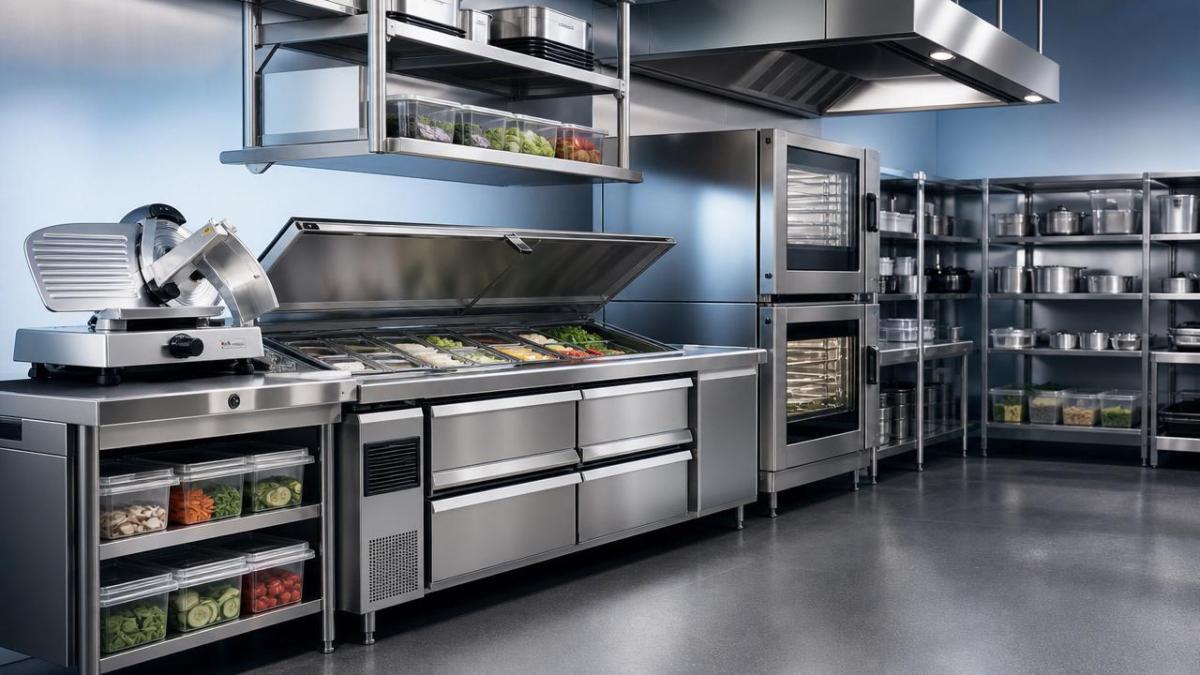
One of the most effective upgrades in a commercial kitchen is the use of dedicated prep stations designed around actual staff behavior. A prep table with refrigerated drawers underneath, integrated cutting surfaces, ingredient pans, and waste chutes can eliminate dozens of unnecessary steps per hour. For users and operators, this means less walking, fewer interruptions, and a cleaner work zone.
Stainless steel remains the industry standard because it is durable, hygienic, and easy to sanitize. However, layout is just as important as material. Operators should think in terms of reach zones: the most-used items should stay within immediate reach, secondary tools should be close but not cluttering the main surface, and backup inventory should be stored nearby without blocking workflow.
High-efficiency cutting and portioning tools
Manual knife work is essential in many kitchens, but excessive dependence on it slows prep and creates inconsistency. That is why many restaurant kitchen equipment ideas include vegetable cutters, commercial dicers, mixers, grinders, and portioning tools. These machines are especially useful in operations with repetitive volume, such as sandwich shops, hotel buffets, quick-service restaurants, and central kitchens.
The value is not only speed. Better portioning control helps reduce food waste, improve recipe consistency, and support predictable cooking times. For example, uniformly sliced vegetables cook more evenly, and accurate protein portions support both presentation and cost control. Users should choose equipment that is easy to disassemble and clean, because hard-to-clean machines often become underused over time.
Cold chain equipment that keeps prep moving
Cold storage is often overlooked in discussions about restaurant kitchen equipment ideas, yet it has a major impact on prep speed. Reach-in refrigerators, undercounter units, prep counters with refrigerated wells, and blast chillers help ingredients stay available at the right temperature and in the right place. When staff do not need to leave the station repeatedly to retrieve ingredients, production becomes smoother.
Blast chilling is particularly useful for kitchens that prepare sauces, proteins, grains, or soups in batches. It allows rapid cooling in line with food safety requirements and supports organized advance production. In operations with changing dayparts or high turnover, this can improve both speed and compliance.
Cooking equipment that reduces bottlenecks before service
Prep speed is not limited to raw ingredient handling. It also depends on how fast partially prepared items can be cooked, finished, or regenerated. Multifunction cooking systems such as combi ovens, rapid-cook ovens, induction units, and programmable griddles are increasingly important because they reduce equipment switching and simplify training.
For example, a combi oven can steam vegetables, roast proteins, and reheat prepared trays with controlled humidity and temperature settings. This not only saves time but also improves consistency across shifts. In a labor-constrained environment, one programmable unit can support less experienced staff without lowering output quality.
Space-saving and ergonomic equipment ideas
Many operators assume faster prep requires a bigger kitchen. In reality, some of the best restaurant kitchen equipment ideas are designed for space efficiency. Vertical storage racks, mobile ingredient bins, stackable containers, wall-mounted shelving, and compact multifunction appliances can free valuable work surfaces and reduce congestion.
Ergonomics also matters. Adjustable-height tables, anti-fatigue mat areas, easy-glide drawers, and well-positioned sinks support faster performance because they reduce physical strain. Over a long shift, even small design improvements can help staff maintain speed and accuracy. A comfortable kitchen is often a more productive kitchen.
Typical equipment priorities by kitchen type
Not every operation should invest in the same setup. Equipment choices should reflect production style, menu complexity, and service rhythm.
What operators should evaluate before adopting new equipment
Even the most promising restaurant kitchen equipment ideas can fail if they do not match the operation. Before introducing new tools or appliances, staff and managers should evaluate a few practical points:
- Actual prep bottlenecks: identify where time is really being lost.
- Cleaning and sanitation requirements: faster equipment must still be easy to maintain.
- Staff training level: programmable or automated systems should remain user-friendly.
- Energy use and operating cost: efficient machines can improve long-term value.
- Integration with existing workflow: equipment should support the line, not disrupt it.
This evaluation reflects a broader industry shift. As kitchen equipment manufacturers in major markets such as China, Germany, Italy, and Japan continue to innovate, buyers and users have more options than ever. The challenge is no longer access alone; it is selecting solutions that fit real production patterns.
The growing role of automation and intelligent kitchen systems
Automation is becoming more relevant across foodservice, especially in repetitive prep and monitoring tasks. Smart scales, programmable dispensers, sensor-based refrigeration alerts, and digital kitchen management tools can all support faster, more accurate prep work. These systems reduce manual tracking and help teams respond quickly when temperatures, inventory levels, or production timing shift.
For users, the key benefit is support, not replacement. Intelligent kitchen systems are most effective when they simplify routine actions, improve visibility, and make it easier to maintain standards during busy periods. In that sense, advanced restaurant kitchen equipment ideas are part of a larger move toward integrated and sustainable commercial kitchens.
Practical steps for building a faster prep environment
To turn restaurant kitchen equipment ideas into measurable results, start with observation. Track which stations cause delays, which tasks create the most repeated motion, and where food safety handling interrupts speed. Then match those findings to equipment upgrades with clear functional value. Sometimes the best improvement is a new refrigerated prep table; in other cases, it may be a better shelf layout, a compact cutter, or a programmable oven.
A strong approach is to combine three priorities: workflow efficiency, operator comfort, and consistent food quality. When these three align, kitchens can prep faster without increasing stress or compromising standards. That is the real purpose behind effective restaurant kitchen equipment ideas, and it is why thoughtful equipment planning remains essential in modern foodservice operations.
Popular Tags
Kitchen Industry Research Team
Dedicated to analyzing emerging trends and technological shifts in the global hospitality and foodservice infrastructure sector.
Industry Insights
Join 15,000+ industry professionals. Get the latest market trends and tech news delivered weekly.
No spam. Unsubscribe anytime.

Contact With us
Contact:
Anne Yin (Ceramics Dinnerware/Glassware)
Lucky Zhai(Flatware)