
Commercial Induction Cooker vs Gas for Busy Kitchens
Choosing between a Commercial Induction Cooker and gas equipment is a critical decision for busy kitchens where speed, safety, energy efficiency, and operational consistency all matter. For technical evaluators, this comparison goes beyond cooking performance to include installation requirements, maintenance demands, long-term operating costs, and compatibility with modern smart kitchen systems. This article explores the key differences to help identify the most practical solution for high-demand foodservice environments.
What makes a Commercial Induction Cooker so relevant in busy kitchens today?
A Commercial Induction Cooker has moved from being a niche product to a serious mainstream option because modern foodservice operations are under pressure to do more with less energy, less downtime, and tighter safety control. In restaurants, hotels, central kitchens, and catering facilities, cooking equipment is no longer judged only by flame strength or peak heat output. Evaluators now look at heat transfer efficiency, response time, ventilation impact, cleaning demands, and whether the equipment can support digital kitchen management.
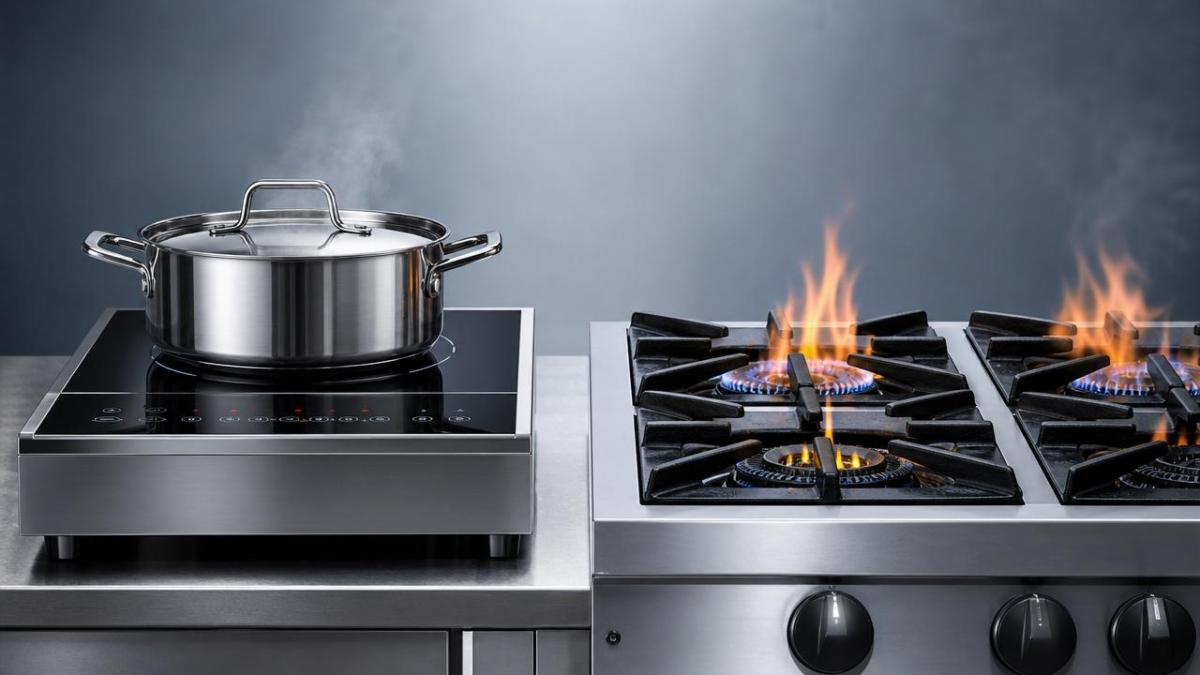
Induction technology works by generating heat directly in compatible cookware through electromagnetic energy, rather than heating a burner first and then transferring heat to the pan. This changes the performance profile of the cooking line. Instead of losing a large share of energy to ambient air, a Commercial Induction Cooker channels more usable heat into the vessel. In fast-moving kitchens, that can improve control, reduce wasted energy, and lower room heat load.
This matters especially in the kitchen equipment industry, where smarter and more energy-efficient systems are becoming a clear direction of development. Operators increasingly want appliances that support automation trends, sustainability goals, and safer working environments. That is why the comparison between commercial induction and gas is now a technical and operational decision, not just a traditional preference.
How does a Commercial Induction Cooker compare with gas in daily cooking performance?
This is usually the first practical question. Many chefs still associate gas with strong instant heat and visual control, while induction is often associated with precision and efficiency. In reality, both systems can perform well, but they excel in different ways depending on menu type and service rhythm.
A Commercial Induction Cooker is typically strong in rapid heat-up, fine temperature adjustment, and repeatability. Because the system responds quickly to power changes, it can maintain simmering, sauce reduction, and controlled sautéing with a high level of consistency. For standardized food production, this repeatability helps reduce operator variation. In kitchens with multiple shifts or frequent staff turnover, that consistency can be more valuable than tradition.
Gas still has advantages in some cooking styles. Open-flame wok cooking, char-focused preparation, and operations using legacy cookware or existing burner-based workflows may remain better aligned with gas. Some teams also prefer flame visibility for intuitive control during peak periods. However, technical evaluators should distinguish between user familiarity and measurable productivity. Familiarity can be trained; inefficiency and excess heat are harder to justify over time.
For busy kitchens handling soups, stocks, sauces, boiling, pan-frying, holding, and batch cooking, a Commercial Induction Cooker often delivers more stable results with less wasted heat. For mixed-menu operations, the best answer is not always all-induction or all-gas. In some projects, a hybrid line provides the most practical balance.
Which option is more energy efficient and cost-effective over the long term?
For technical assessment, energy efficiency should be evaluated at the system level, not only at the utility rate shown on monthly bills. A Commercial Induction Cooker generally converts a higher proportion of input energy into usable cooking heat than gas equipment. That means less heat is lost into the surrounding air, and more of the purchased energy supports actual production.
This efficiency can influence several cost categories at once. First, direct cooking energy use may decrease. Second, lower ambient heat can reduce the load on kitchen ventilation and air conditioning systems. Third, a cooler line may improve staff comfort, which can indirectly support labor productivity and reduce fatigue during long service periods.
Gas equipment sometimes appears less expensive at the initial purchase stage, and in certain regions gas pricing may still look favorable. However, technical evaluators should compare total cost of ownership rather than purchase price alone. A proper evaluation should include:
- Utility consumption by production volume
- Ventilation and exhaust requirements
- Cooling load impact on HVAC systems
- Cleaning labor and downtime
- Expected maintenance intervals and replacement parts
- Local energy tariffs, building codes, and incentive programs
In facilities with long operating hours, high throughput, or energy-efficiency targets, a Commercial Induction Cooker frequently shows a stronger life-cycle value proposition. In lower-volume sites with existing gas infrastructure and no major renovation plans, gas may still remain economically competitive. The conclusion depends on usage intensity, not just equipment category.
What should technical evaluators check before choosing between induction and gas?
The most common mistake is to compare equipment in isolation. A Commercial Induction Cooker should be assessed as part of the full kitchen system, including electrical capacity, cookware compatibility, ventilation design, production process, and digital integration needs.
Start with utility infrastructure. Induction requires adequate electrical supply, proper circuit planning, and confirmation that the building can support the load profile. Gas requires line availability, code compliance, combustion safety controls, and venting strategy. In retrofit projects, infrastructure readiness can change the business case dramatically.
Next, review cookware. A Commercial Induction Cooker requires induction-compatible pots and pans. If the operation uses specialized cookware that is not compatible, replacement costs should be added to the project budget. This sounds basic, but it is often overlooked in early-stage comparisons.
Then examine menu and workflow. If the kitchen runs highly repeatable dishes, controlled holding, or standardized production batches, induction often supports stronger process control. If the concept depends heavily on live-flame presentation or extreme wok techniques, gas may be more aligned. The key is not to generalize from one dish category to the entire operation.
Finally, consider future integration. As the kitchen equipment industry moves toward intelligent systems, a Commercial Induction Cooker may fit more naturally into digital monitoring, energy tracking, and smart kitchen platforms. For organizations investing in data-driven foodservice management, this can be a strategic advantage beyond immediate cooking performance.
What are the biggest safety, maintenance, and compliance differences?
Safety is one of the strongest reasons many operations evaluate a Commercial Induction Cooker. Since there is no open flame, the risk profile changes in meaningful ways. Surface temperatures around the cooking zone can still be hot due to residual heat from cookware, but the surrounding environment is usually safer and easier to control than a flame-based line. This can help reduce accidental burns, fire exposure, and heat stress in crowded kitchens.
Gas equipment requires careful attention to combustion, leaks, pilot systems where applicable, and ventilation performance. These are manageable risks, but they demand disciplined inspection and maintenance. In high-volume operations, grease accumulation and burner wear can also affect performance consistency.
A Commercial Induction Cooker is often easier to clean because flat surfaces reduce grease traps and food debris buildup. That can shorten daily cleaning time and improve hygiene control. However, induction units contain electronic components that require quality power supply conditions and trained service support. Maintenance is different, not nonexistent. Technical teams should verify spare parts access, diagnostic support, and service coverage before standardizing on any brand or platform.
From a compliance perspective, both systems must align with local electrical, fire, ventilation, and foodservice equipment regulations. Evaluators should not assume that lower flame risk automatically eliminates ventilation requirements; actual rules vary by region, kitchen layout, and cooking duty.
Is there a simple comparison table for fast decision-making?
Yes. The table below summarizes how a Commercial Induction Cooker and gas equipment typically compare in busy foodservice settings. It should be used as a screening tool rather than a final engineering conclusion.
What are the most common mistakes when comparing a Commercial Induction Cooker with gas?
One mistake is assuming induction is automatically better in every case. A Commercial Induction Cooker is highly effective, but the right answer depends on electrical capacity, menu type, cookware, and operator readiness. Another mistake is assuming gas is always more powerful because it has visible flame. Visible flame is not the same as better heat utilization.
A third mistake is ignoring secondary operating costs. Evaluators may compare equipment price but overlook ventilation energy, cooling load, cleaning hours, and maintenance disruption. Over years of service, those hidden factors can outweigh the difference in purchase cost.
Some buyers also fail to test actual production scenarios. The best way to compare a Commercial Induction Cooker and gas is to run a controlled evaluation using real menu items, actual cookware, realistic service timing, and measurable indicators such as boil time, recovery time, line temperature, and cleaning duration. Decisions based only on assumptions or showroom impressions often lead to poor fit.
So which option is the better fit for a high-demand kitchen?
For many modern operations, a Commercial Induction Cooker is the stronger choice when the goals are energy efficiency, safety improvement, repeatable cooking control, and alignment with smart kitchen development. It is especially attractive in facilities that run long hours, want lower ambient heat, or need a cleaner and more data-compatible equipment platform.
Gas remains relevant where flame-based cooking techniques, broad cookware flexibility, or existing infrastructure make it operationally efficient. In some commercial kitchens, the ideal answer is a mixed equipment strategy that places induction on precision and batch tasks while keeping gas for specialized cooking stations.
If you need to confirm a specific solution, the first questions to discuss are practical ones: What is the actual production volume? What utility capacity is available? Which cookware must be retained? How important are ventilation savings and worker comfort? Is smart monitoring required? What are the cleaning and maintenance priorities? By clarifying those points early, technical evaluators can determine whether a Commercial Induction Cooker, gas, or a hybrid setup offers the best long-term value for a busy kitchen.
Popular Tags
Kitchen Industry Research Team
Dedicated to analyzing emerging trends and technological shifts in the global hospitality and foodservice infrastructure sector.
Industry Insights
Join 15,000+ industry professionals. Get the latest market trends and tech news delivered weekly.
No spam. Unsubscribe anytime.


Contact With us
Contact:
Anne Yin (Ceramics Dinnerware/Glassware)
Lucky Zhai(Flatware)