
Why Restaurant Kitchen Equipment Dimensions Matter Early
In commercial kitchen projects, restaurant kitchen equipment dimensions influence far more than layout—they affect workflow, utility planning, installation efficiency, and long-term operating performance. For project managers and engineering leaders, addressing size requirements early helps prevent costly redesigns, compliance issues, and site coordination delays while ensuring the kitchen can support safety, productivity, and future equipment integration.
Why dimension decisions are moving earlier in commercial kitchen planning
A clear shift is happening across restaurant development, hotel F&B projects, central kitchens, and foodservice renovations: restaurant kitchen equipment dimensions are no longer being finalized late in procurement. They are being pulled forward into early design, engineering review, and cross-functional coordination. This change reflects how modern kitchens have become more integrated, more utility-dependent, and more sensitive to operational efficiency than in the past.
In earlier project models, teams often selected equipment after architectural layouts were already advanced. That approach is now creating too much risk. Equipment footprints affect aisle clearances, hood lengths, drainage positions, grease management, electrical loads, gas routing, water supply, ventilation balance, and maintenance access. When restaurant kitchen equipment dimensions are treated as a late-stage detail, project teams frequently discover conflicts between equipment, structure, MEP systems, and local code requirements.
This matters even more because the kitchen equipment industry is evolving toward automation, intelligent controls, energy efficiency, and integrated production lines. Newer cooking suites, combi ovens, blast chillers, dishwashing systems, and food processing units often have different dimensional and clearance needs than older equipment categories. As a result, project managers are being asked to judge dimensions not just by fitting products into rooms, but by understanding how size interacts with workflow, safety, serviceability, and future upgrades.
The trend signals project leaders should not ignore
Several practical signals explain why dimension planning has become an earlier-stage concern. First, restaurant operators want faster openings and tighter capex control. Second, consultants and contractors are under pressure to reduce rework. Third, local authorities and brand standards increasingly scrutinize circulation, hygiene separation, and safe operating clearances. Fourth, kitchen systems are becoming more modular, digital, and connected, which means size coordination now includes data ports, control panels, service gaps, and replacement space.
For project-based teams, these signals point to one conclusion: restaurant kitchen equipment dimensions have become a strategic coordination issue rather than a simple specification line. Dimensions influence whether a concept can scale across multiple sites, whether standard drawings remain usable, and whether a kitchen can absorb menu changes without major reconstruction.
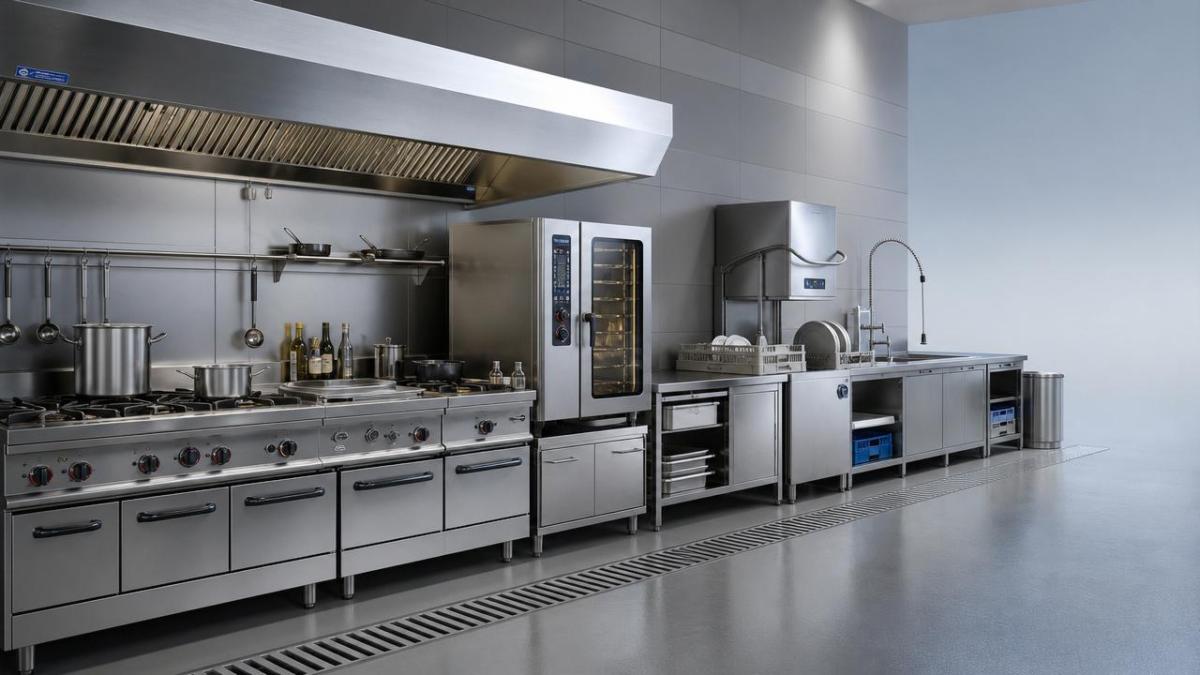
What is driving the change in restaurant kitchen equipment dimensions planning
The first driver is complexity. Commercial kitchens combine hot cooking, cold storage, prep, washing, waste handling, and delivery staging in increasingly compact spaces. If restaurant kitchen equipment dimensions are not aligned early, teams can lose critical aisle width, block door swing, interfere with fire suppression coverage, or create maintenance dead zones behind major appliances.
The second driver is utility density. Energy-efficient and automated equipment can reduce operating cost, but it also depends on precise service connections. A few inches of mismatch may force re-routing of gas, condensate, electrical conduit, or exhaust ducting. In high-cost urban projects, that dimensional error can quickly escalate into schedule and budget pressure.
The third driver is standardization. Multi-site restaurant groups increasingly want repeatable store formats. They need restaurant kitchen equipment dimensions that can be applied across different regions while still adapting to local codes and site constraints. That means dimensional data must be accurate enough to support both prototype design and site-specific engineering.
The fourth driver is lifecycle thinking. Engineering leaders are no longer asking only whether equipment fits on day one. They are also asking whether it can be delivered through doors, installed without structural changes, serviced safely, replaced at end of life, and integrated with future smart kitchen systems. Dimensions affect each of those questions.
How the impact spreads across project roles and business stages
The impact of dimension planning is not limited to designers. It reaches nearly every stakeholder in a foodservice project. For project managers, restaurant kitchen equipment dimensions shape coordination risk and change-order exposure. For engineering teams, they determine the accuracy of MEP layouts. For procurement teams, they influence vendor comparison, logistics, and substitution decisions. For operators, they affect labor flow, cleaning routines, and output consistency after opening.
This is why early size verification is becoming a management discipline, not just a technical check. The more complex the kitchen, the greater the value of dimensional certainty before detailed construction begins.
Why workflow and safety are now stronger decision drivers
One of the most important changes in the market is that equipment dimensions are increasingly evaluated through the lens of operating flow. A kitchen may appear efficient on paper, yet fail during live service if staff crossings are too frequent, prep and cooking zones are compressed, or cleaning access is blocked. In this environment, restaurant kitchen equipment dimensions directly support labor productivity and service speed.
Safety has also become a stronger driver. Tight spacing around fryers, ovens, ranges, and warewashing systems can raise burn risk, slip risk, and sanitation problems. For project leaders, the question is no longer “Can this machine fit?” but “Can this machine operate safely and be maintained consistently in the planned position?” That is a much higher standard, and it explains why early dimensional analysis is gaining attention.
This shift aligns with broader industry movement toward quality assurance, energy management, and digital control. Smart equipment may improve consistency, but if dimensions are poorly coordinated, teams lose many of those benefits through access problems, blocked sensors, awkward servicing, or constrained airflow.
How equipment innovation is changing dimensional expectations
The kitchen equipment sector is moving toward higher-performance, more connected systems. That trend changes how project teams should interpret restaurant kitchen equipment dimensions. It is no longer enough to capture only length, depth, and height. Teams also need to understand door opening arcs, control-side access, rear ventilation needs, filter removal space, cleaning pull-out distance, and interoperability with adjacent modules.
This is especially relevant in projects using combi ovens, multifunction cooking units, conveyor systems, blast chillers, and modular preparation lines. Such equipment may reduce footprint per output unit, but it often requires more disciplined planning around service clearance and workflow orientation. In other words, smaller equipment does not automatically mean easier integration.
At the same time, sustainability goals are influencing specification choices. Energy-efficient systems, induction cooking, water-saving warewashing, and heat recovery solutions can alter utility arrangement and installation geometry. Project teams that bring restaurant kitchen equipment dimensions into early sustainability review are usually better positioned to balance performance, compliance, and lifecycle cost.
What project managers should verify before design is locked
For engineering and project leadership, the main issue is not simply collecting dimension sheets. It is verifying which dimensions are critical to execution. Some projects fail because teams approve nominal equipment sizes without validating operating clearances, service zones, and installation tolerances. That gap becomes expensive once ceiling works, drainage, hoods, and wall finishes are already in place.
Before freezing layouts, teams should confirm several items. They should check actual operating footprint, not catalog body size alone. They should compare manufacturer tolerances across approved brands. They should review loading paths from delivery point to final position. They should test whether replacement access remains possible after the kitchen is fully built. They should also assess whether future menu changes could require larger or adjacent units in the same area.
These checks are increasingly valuable in mixed-use developments, hotel kitchens, airport catering, and high-volume urban restaurant projects, where service corridors and back-of-house areas are often constrained. In such environments, restaurant kitchen equipment dimensions can determine whether a project stays on schedule or enters a cycle of on-site compromise.
A practical judgment framework for the next phase of projects
Looking ahead, the most useful approach is to treat dimensions as an early decision framework with commercial, technical, and operational value. For project managers, this means creating a dimension review process at concept stage, schematic stage, and pre-procurement stage rather than relying on one late validation. The goal is to catch evolving conflicts as kitchen requirements mature.
Key signals to monitor as the market continues to evolve
Over the next few years, several signals will shape how restaurant kitchen equipment dimensions are judged. One is the continued rise of compact, high-output formats in urban retail and delivery-driven foodservice. Another is the spread of semi-automated and smart kitchen systems that increase dependence on disciplined equipment placement. A third is stronger focus on sustainability and retrofitting, which will push teams to integrate new equipment into older spaces with limited tolerance for error.
Project leaders should also watch for changes in local compliance enforcement, brand standardization strategies, and supplier documentation quality. Better dimensional data from manufacturers can improve early planning, but only if teams use it as part of coordinated decision-making rather than as isolated product information.
Conclusion: early dimensional judgment is becoming a competitive advantage
The larger industry direction is clear: as kitchens become smarter, denser, and more performance-driven, restaurant kitchen equipment dimensions matter earlier and more strategically than before. They influence not only layout efficiency, but also compliance confidence, utility coordination, installation speed, maintainability, and long-term adaptability.
For project managers and engineering leads, the practical takeaway is to move dimension review upstream, connect it to workflow and lifecycle thinking, and treat it as a cross-functional decision point. If a business wants to judge how this trend affects its own projects, it should confirm five questions early: Are actual operating clearances defined? Are utilities coordinated to real equipment sizes? Can the equipment be delivered and replaced? Does the layout support safe labor flow? And can the kitchen adapt to future menu or technology changes without major reconstruction?
Teams that answer those questions early are more likely to reduce risk, protect schedules, and build kitchens that perform well beyond opening day.
Popular Tags
Kitchen Industry Research Team
Dedicated to analyzing emerging trends and technological shifts in the global hospitality and foodservice infrastructure sector.
Industry Insights
Join 15,000+ industry professionals. Get the latest market trends and tech news delivered weekly.
No spam. Unsubscribe anytime.


Contact With us
Contact:
Anne Yin (Ceramics Dinnerware/Glassware)
Lucky Zhai(Flatware)