
Restaurant Kitchen Checklist Items That Are Often Missed
Even experienced project managers can overlook critical details when building or upgrading a commercial kitchen. A well-structured restaurant kitchen checklist helps prevent costly delays, compliance issues, and workflow inefficiencies before they affect daily operations. In this article, we highlight the checklist items that are often missed, so your kitchen project can achieve better safety, efficiency, and long-term performance.
Why missed checklist items vary by project scenario
A restaurant kitchen checklist is not a one-size-fits-all document. The risks in a quick-service kitchen are different from those in a hotel banquet operation, a central production kitchen, or a renovation inside an older building. For project managers and engineering leads, this matters because the most expensive mistakes usually come from assuming that standard equipment lists automatically cover workflow, utility loads, compliance details, and future operating demands.
In practical terms, missed items often sit in the gaps between design, procurement, installation, and operations. The chef team may focus on menu output, the contractor on construction milestones, and the purchasing team on equipment cost. Yet details such as floor slope near wet zones, grease waste routing, make-up air balance, digital monitoring points, or cleaning access behind cooklines can determine whether the kitchen performs well after handover.
That is why an effective restaurant kitchen checklist should be adapted to the application scenario, operating volume, service style, and expansion plan. The more complex the project, the more valuable it is to review often-missed items before installation starts.
Typical application scenarios and what they tend to miss
Different commercial kitchen environments create different blind spots. Before finalizing your restaurant kitchen checklist, it helps to identify which scenario is closest to your project and where oversight is most likely.
This scenario-based view makes the restaurant kitchen checklist more useful than a generic equipment schedule. It turns the checklist into a decision tool that reflects actual operational conditions.
Checklist items often missed in workflow-driven kitchen projects
1. Staff movement and cross-traffic
Many teams confirm equipment placement but forget to simulate people movement. A restaurant kitchen checklist should verify whether cooks, dish staff, porters, and service runners cross the same narrow points during peak periods. In high-volume environments, even a well-equipped kitchen can fail if clean and dirty traffic overlap or if hot food pickup cuts through prep workstations.
2. Landing zones around key equipment
Ovens, fryers, combi units, blast chillers, and refrigerators all need adjacent landing space. This is a classic missed item in a restaurant kitchen checklist because the equipment footprint is counted, but operator handling space is not. Without proper landing surfaces, safety declines and output slows.
3. Cleaning access and maintenance clearance
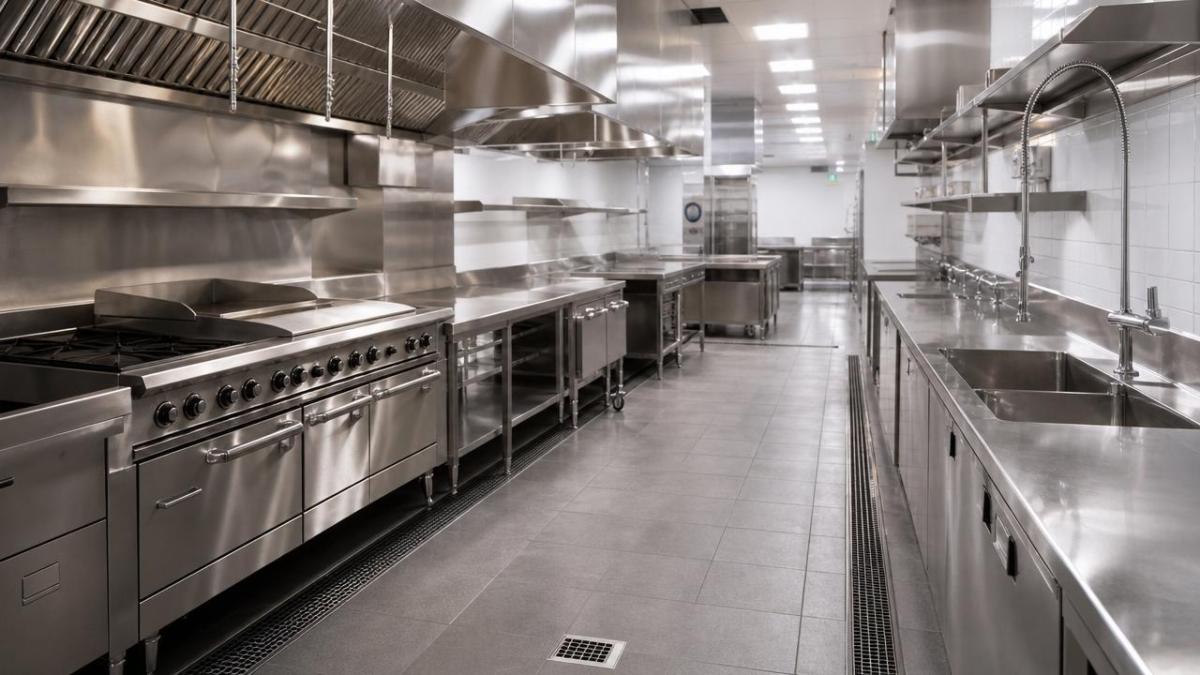
Equipment may fit perfectly on drawings while becoming impossible to clean behind or beneath after installation. Project managers should check removable panels, caster access, wall gaps, ceiling-mounted service space, and grease duct inspection points. This is especially important in facilities targeting long operating hours and strict hygiene standards.
Utilities and infrastructure gaps that delay handover
In many projects, the most damaging omissions in a restaurant kitchen checklist involve infrastructure rather than the visible cooking line. These issues usually surface late, when changing them becomes expensive.
Electrical load diversity and outlet placement
Do not only total nameplate power. Verify simultaneous demand, dedicated circuits, emergency shutdown logic, and outlet positions for mobile or countertop equipment. A prep kitchen may later add vacuum packers, slicers, induction units, or digital monitoring devices that were not included in the first design review. Future-ready capacity is often absent from a basic restaurant kitchen checklist.
Ventilation balance and make-up air
A hood schedule alone is not enough. One of the most overlooked checklist items is air balance between extraction and supply. Poor make-up air planning can create heat stress, unstable burner performance, door pressure issues, and unhappy operators. In open kitchens or mixed-use buildings, noise and guest comfort should also be reviewed early.
Drainage details in wet processing areas
Floor drains, slope direction, trench covers, and backflow prevention are frequently underestimated. In central kitchens, bakery operations, and heavy wash-down zones, poor drainage becomes both a sanitation and safety problem. A complete restaurant kitchen checklist should match drainage design to actual cleaning methods, not just architectural assumptions.
Water quality and treatment
Ice machines, steamers, dishwashers, and combi ovens are highly sensitive to water hardness and sediment. Water filtration or softening is often treated as optional, but in many regions it directly affects equipment life, warranty validity, and service frequency. For project leaders, this is a low-cost addition that prevents long-term operating headaches.
Food safety and compliance points that are commonly overlooked
Compliance is where a restaurant kitchen checklist becomes more than a purchasing document. It should support inspection readiness, safe food flow, and operational accountability.
Raw-to-cooked zoning
Projects serving multiple menu categories often fail to define clear separation between raw receiving, vegetable prep, meat processing, cooking, cooling, and packing. This matters most in hotel kitchens, institutional catering, and food processing-linked facilities. If the restaurant kitchen checklist does not map product flow, cross-contamination risk remains hidden until operation begins.
Temperature monitoring points
Cold rooms and freezers may be included, but data logging, alarm visibility, and calibration planning are often missing. For operations that depend on food traceability or multi-site consistency, digital monitoring should be considered part of the core kitchen system, not an afterthought.
Handwashing and sanitation station placement
The number of sinks is usually reviewed, but their exact location relative to work zones is often poorly judged. Staff will not follow ideal hygiene routines if handwashing points interrupt workflow. The restaurant kitchen checklist should confirm visibility, accessibility, soap and towel supply points, and separation from food-contact washing tasks.
How requirements differ by project type and scale
Project managers should also adapt the restaurant kitchen checklist to business scale. A single-site independent restaurant may prioritize budget control and operational simplicity, while a chain brand or central kitchen project should prioritize consistency, replicability, and data visibility.
Scenario-based recommendations for a stronger checklist
For new-build projects
Use the restaurant kitchen checklist early in schematic design, not only at procurement stage. Confirm utility reserves, ceiling service routes, exhaust strategy, and receiving-to-dispatch flow before construction documents are locked. New builds offer the best chance to optimize workflow, so missed coordination at this stage is particularly costly.
For renovation and retrofit projects
Place extra emphasis on site verification. Existing drain positions, slab conditions, gas pressure, column intrusions, and lift access for equipment delivery should all be physically checked. In retrofit scenarios, a restaurant kitchen checklist should include temporary operating plans and phased shutdown coordination if the business remains partially open.
For high-volume foodservice operations
Stress-test the kitchen for peak load rather than average volume. Review hot holding, pass-through refrigeration, batch cooking rhythm, waste handling frequency, and dishwashing turnaround. These are the points most likely to limit throughput even when the equipment list seems complete.
Common misjudgments that weaken project decisions
One common error is treating the restaurant kitchen checklist as a static form instead of a coordination tool. Another is focusing only on major equipment brands while ignoring accessories, interfaces, and supporting systems such as shelving, transport carts, temperature probes, filtration kits, and spare parts planning. These smaller items rarely attract attention in early meetings, but they strongly affect startup quality.
A second misjudgment is designing only for current menu needs. With smart kitchen technologies, energy-efficient appliances, and digital management systems developing quickly, many operators will update production methods within a few years. Leaving no flexibility for additional sensors, automation modules, or higher-capacity stations can shorten the useful life of the project.
A third issue is assuming compliance equals operational readiness. Passing inspection does not guarantee efficient service, easy maintenance, or low energy use. The best restaurant kitchen checklist should therefore cover compliance, workflow, lifecycle cost, and upgrade potential together.
FAQ: practical questions project managers often ask
When should a restaurant kitchen checklist be finalized?
It should start during concept planning and be updated through design, procurement, installation, and commissioning. Finalizing it too late reduces its value because many hidden coordination risks are already built in.
Who should review the checklist?
At minimum, involve operations, kitchen consultants or chefs, MEP engineers, contractors, procurement, and equipment suppliers. Cross-functional review is the best way to catch missed items.
How can the checklist support long-term performance?
Include energy efficiency, preventive maintenance access, digital monitoring, consumables planning, and future capacity allowances. This turns the restaurant kitchen checklist into a lifecycle management tool instead of a handover document.
Final action guide for your next kitchen project
If you are leading a restaurant, hotel, catering, or food production kitchen project, the smartest next step is to rebuild your restaurant kitchen checklist around actual application scenarios. Start with the service model, menu complexity, peak volume, site constraints, and expansion plan. Then verify the often-missed details: workflow intersections, utility reserves, drainage, ventilation balance, sanitation points, monitoring systems, and maintenance access.
In an industry moving toward intelligent, automated, and energy-efficient kitchen solutions, project success depends not only on choosing the right equipment, but also on matching that equipment to the right operational context. A scenario-based restaurant kitchen checklist gives project managers a more reliable framework for safer delivery, smoother commissioning, and stronger long-term performance.
Popular Tags
Kitchen Industry Research Team
Dedicated to analyzing emerging trends and technological shifts in the global hospitality and foodservice infrastructure sector.
Industry Insights
Join 15,000+ industry professionals. Get the latest market trends and tech news delivered weekly.
No spam. Unsubscribe anytime.


Contact With us
Contact:
Anne Yin (Ceramics Dinnerware/Glassware)
Lucky Zhai(Flatware)