
Why kitchen trade lead times still catch importers off guard
In kitchen trade, lead times often look predictable on paper but shift quickly once sourcing, production scheduling, compliance checks, and international logistics begin to overlap. For business evaluators, these delays can distort cost projections, launch plans, and supplier assessments. Understanding why kitchen trade timelines still catch importers off guard is essential for making more accurate purchasing decisions and reducing risk in a fast-changing global equipment market.
That risk is especially visible in commercial kitchen equipment, restaurant appliances, food processing machinery, and integrated smart kitchen systems, where delivery dates are influenced by both manufacturing complexity and border-crossing requirements. A fryer, combi oven, stainless preparation table, or automated processing line may all sit in the same supplier catalog, yet their real lead times can differ by 2 weeks, 8 weeks, or even 16 weeks depending on configuration, material availability, and certification status.
For evaluators comparing suppliers across China, Germany, Italy, Japan, and other export hubs, the main challenge is not simply asking for a quoted delivery window. The real task is to determine which part of that window is firm, which part is variable, and which part is omitted entirely. In kitchen trade, a supplier that promises 30 days on paper may still require another 10 to 25 days for testing, packaging, booking, or destination compliance adjustments.
Why kitchen trade lead times are more volatile than they appear
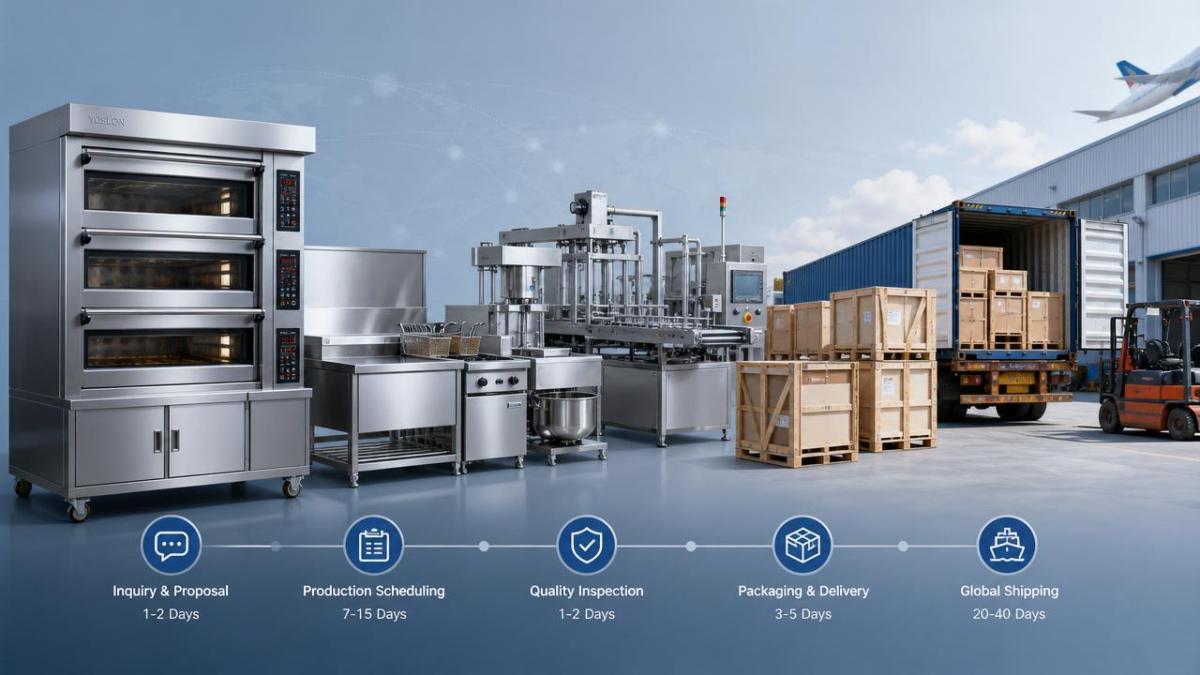
Kitchen trade lead times often seem straightforward because many quotations show only the production period. In practice, total delivery is usually the sum of 5 to 7 linked stages: specification confirmation, component sourcing, fabrication, testing, packing, export handling, and international transport. If only one stage slips by 3 to 5 days, the final arrival date can shift much more than expected.
This matters more in the kitchen equipment sector than in simpler consumer goods because many products combine metal fabrication, electrical parts, heating elements, refrigeration components, software modules, and safety labeling. A standard stainless sink may require a shorter cycle, but a customized cooking island or automated food processing unit may depend on multiple suppliers and two or three inspection points before shipment.
Quoted lead time vs. actual end-to-end delivery time
Many importers confuse factory lead time with landed lead time. Factory lead time may cover only assembly and internal inspection, while landed lead time includes export documents, port congestion, customs review, and last-mile delivery. In kitchen trade, the difference between those two measures is often 12 to 45 days, depending on product type, season, and route.
Business evaluators should therefore request at least 4 separate time stamps: order confirmation date, production completion date, ex-works date, and estimated arrival date. Without those checkpoints, it is difficult to compare two suppliers fairly, even if both quote the same overall timeline.
Customization increases uncertainty faster than buyers expect
In kitchen trade, customization rarely adds just a few extra days. A modified voltage, gas specification, control panel language, stainless grade, or workspace dimension can trigger new drawings, engineering review, component substitution, or packaging changes. For semi-custom products, the added time is commonly 7 to 21 days. For fully integrated kitchen systems, it can be 4 to 10 weeks.
This is one reason importers are caught off guard during restaurant openings, hotel renovations, and central kitchen upgrades. They assume a product is “standard” because it appears in a catalog, but the actual order may include region-specific power standards, ventilation compatibility, or HACCP-oriented workflow modifications that slow approval and production.
Common hidden variables in kitchen trade schedules
- Power conversion requirements such as 110V, 220V, 380V, single-phase, or three-phase adjustments
- Material changes, including 201 vs. 304 stainless steel or thicker worktop construction
- Compliance marking, user manual localization, and safety label revision
- Packaging upgrades for long-distance sea freight or pallet height restrictions
- Bundled procurement, where one delayed sub-item holds the full shipment
The table below breaks down where timing usually shifts in kitchen trade and what evaluators should verify before approving a supplier schedule.
The key takeaway is that the most unstable sections are often outside pure fabrication. A supplier can have strong manufacturing capability yet still miss the buyer’s target date if documentation, packaging, or freight booking is weak. In kitchen trade, timeline evaluation must therefore include operational discipline, not just workshop output.
The operational causes importers underestimate
Importers often focus on price, MOQ, and payment terms first. Those are important, but lead time reliability usually depends on less visible operating factors. In kitchen trade, a 5% lower unit price can easily be offset by higher project cost if the shipment arrives 3 to 6 weeks late and delays installation, staff training, or revenue start.
Production planning is not the same as production capacity
A factory may have enough machines and labor but still fail to deliver on time if its planning sequence is weak. Kitchen equipment suppliers often run mixed production across ovens, refrigeration units, preparation tables, and fabricated stainless modules. If the line is adjusted for one urgent project, another order may slip 5 to 12 days without early warning.
For business evaluators, the practical question is not “Can this factory produce 500 units a month?” but “How does it schedule varied products with different assembly times and purchased parts?” In kitchen trade, capacity without scheduling discipline is a poor predictor of on-time delivery.
Component dependency is a major timing risk
Commercial kitchen equipment increasingly depends on third-party components such as thermostats, burners, compressors, digital controllers, sensors, and safety switches. If even one critical part is delayed, the finished unit may remain incomplete. Lead times for common components can range from 3 days for stocked items to 30 days or more for imported or brand-specific parts.
The risk is higher for intelligent kitchen systems and automated food processing machinery because those products may require software setup, interface testing, and functional calibration. These are not always visible in a quotation, yet they can extend delivery by another 1 to 2 weeks.
Compliance and destination readiness are often treated too late
In cross-border kitchen trade, compliance is not only about final certification. It also affects labeling, manuals, electrical configuration, gas compatibility, plug type, and packing marks. When these items are checked after production instead of before order release, rework becomes more likely. Even a simple manual revision or nameplate correction can hold shipment for 2 to 5 days.
For food processing machinery and commercial cooking equipment, importers should confirm destination requirements during the quotation stage. Waiting until goods are nearly finished creates avoidable friction, especially when products are being consolidated into one container.
Four warning signs in kitchen trade supplier evaluation
- One fixed lead time is quoted for all products, regardless of complexity or customization.
- No milestone schedule is shared after deposit confirmation.
- Component sourcing responsibility is explained vaguely or only after order placement.
- Compliance preparation is handled as a shipping issue rather than a pre-production issue.
The next table shows how evaluators can compare supplier claims with operational evidence before committing to a kitchen trade purchase.
A useful pattern emerges here: reliable kitchen trade suppliers tend to answer with process detail, not just promises. When a vendor can explain where the order sits, which parts may constrain delivery, and what pre-shipment checks remain, the schedule becomes easier to trust and easier to compare across bids.
How business evaluators can reduce lead time surprises
Reducing uncertainty in kitchen trade does not require perfect forecasting. It requires a better evaluation framework. The most effective buyers break the timeline into decision gates and validate each one before moving forward. This approach improves budgeting, launch planning, and supplier scoring without adding unnecessary bureaucracy.
Use a stage-based timeline instead of one promised date
Ask suppliers to quote in stages rather than as a single number. A practical structure includes 6 checkpoints: technical approval, material readiness, production start, assembly completion, final inspection, and shipment departure. In kitchen trade, this creates early visibility and helps evaluators see whether delays are still recoverable or already structural.
For example, if material readiness slips by 4 days but final inspection is still on track, the order may recover. If production has not started by week 3 of a 5-week plan, however, the final date is likely at risk. Milestone logic is far more useful than a general promise of “delivery in 30 days.”
Segment orders by complexity and business criticality
Not all kitchen equipment should be sourced with the same risk tolerance. Standard utensils, preparation tables, and basic shelving can often be grouped into shorter-cycle purchasing. Ovens, refrigeration systems, automated kitchen modules, and food processing lines deserve a wider buffer, often 15% to 25% above the quoted manufacturing period.
A simple portfolio split can help:
- Category A: standard items with repeatable specifications and lower integration risk
- Category B: semi-custom items with moderate engineering or compliance variation
- Category C: critical or integrated systems that affect opening dates or production throughput
In kitchen trade, Category C purchases should receive the deepest schedule review, because a delay in one combi line or refrigeration bank can affect installation sequencing across the full site.
Build lead time questions into supplier scorecards
Many sourcing scorecards still overweight unit price and underweight delivery reliability. For a better kitchen trade evaluation model, assign a measurable score to 4 areas: timeline transparency, component control, customization handling, and logistics readiness. Even a 20-point lead time reliability section can expose important differences between suppliers that otherwise appear equal.
Useful questions include: How many long-lead components are involved? How often are schedule updates sent? What is the standard inspection-to-shipment interval? How are mixed-product orders consolidated? These questions create a practical basis for prediction rather than relying on broad assurances.
A workable 5-step review process
- Confirm final specifications before deposit, including power, dimensions, and material grade.
- Identify critical components and ask whether they are stocked, reserved, or purchased after order confirmation.
- Require a milestone schedule with at least 4 dated checkpoints.
- Verify compliance items before production, not before shipment.
- Match freight planning to factory completion instead of waiting until goods are packed.
Allow realistic buffers for modern kitchen equipment projects
As the industry moves toward smart kitchen technologies, digital controls, and integrated energy-efficient systems, delivery planning needs more realism. A standard imported kitchen equipment project may still move within 30 to 50 days end to end, but a customized, compliance-sensitive, multi-item project can reasonably require 60 to 90 days. Evaluators who model both scenarios will make better purchasing decisions than those who plan around only the best case.
This is especially relevant for restaurants, hotels, central kitchens, and food processing facilities that cannot open or ramp up operations until installation is complete. In those environments, the cost of delay is not just freight or storage. It can include contractor idle time, postponed revenue, retraining schedules, and procurement rework.
Questions evaluators should ask before approving a kitchen trade order
A strong supplier may still be the wrong choice if the order structure is not clear. Before approval, evaluators should test whether the proposed timeline reflects real operational conditions. In kitchen trade, the right questions often prevent larger disputes later.
Checklist for pre-order review
- Is the quoted lead time factory time only, or door-to-port or door-to-door time?
- Which items in the order have the longest production or sourcing cycle?
- Are there any custom electrical, gas, software, or dimensional requirements?
- Will one incomplete item delay the entire container or project shipment?
- What is the normal period between final inspection and vessel departure?
- What documents, labels, and manuals must be ready before dispatch?
Common buyer mistake
A frequent mistake is treating kitchen trade lead time as a negotiation target rather than an operating reality. Pressuring a supplier from 45 days to 30 days may change the quotation, but it does not automatically change material lead times, line availability, or shipping schedules. A compressed promise without a revised execution plan often increases risk instead of reducing it.
Kitchen trade remains full of growth opportunities driven by foodservice expansion, automation, and energy-efficient upgrades. Yet those same trends also make procurement more interconnected. The buyers who perform best are not the ones who assume the shortest schedule is the safest choice. They are the ones who evaluate how the schedule is built, where it can fail, and how quickly the supplier can respond when conditions change.
If you are assessing suppliers for commercial kitchen equipment, food processing machinery, restaurant appliances, or integrated smart kitchen systems, a more disciplined lead time review can improve both cost control and project certainty. To explore a sourcing strategy, compare delivery structures, or get a tailored procurement checklist for your next kitchen trade project, contact us today to discuss your requirements and obtain a customized solution.
Popular Tags
Kitchen Industry Research Team
Dedicated to analyzing emerging trends and technological shifts in the global hospitality and foodservice infrastructure sector.
Industry Insights
Join 15,000+ industry professionals. Get the latest market trends and tech news delivered weekly.
No spam. Unsubscribe anytime.



Contact With us
Contact:
Anne Yin (Ceramics Dinnerware/Glassware)
Lucky Zhai(Flatware)