
Kitchen tools for schools that are easier to sanitize
Choosing the right kitchen tools for schools is not just a purchasing decision. For quality control and safety management teams, it directly affects cleaning efficiency, cross-contamination control, audit readiness, and the long-term reliability of foodservice operations. In most school kitchens, the easiest tools to sanitize are those with simple structures, non-porous surfaces, minimal joints, and materials that tolerate frequent washing, disinfecting, and heavy daily use.
That overall judgment matters because school foodservice environments are different from many other kitchens. They must prepare meals at scale, work within tight time windows, manage rotating staff, and maintain strict hygiene standards for children and teenagers. Tools that are difficult to clean may appear acceptable during procurement, but they often create hidden sanitation risks, increase labor time, and make compliance harder to sustain.
This article looks at how quality control personnel and safety managers can evaluate sanitation-friendly school kitchen tools in a practical way. Rather than focusing on product marketing claims, it examines the features, materials, design details, and operational considerations that actually affect hygiene performance in real school kitchens.
What quality and safety teams really need from kitchen tools for schools
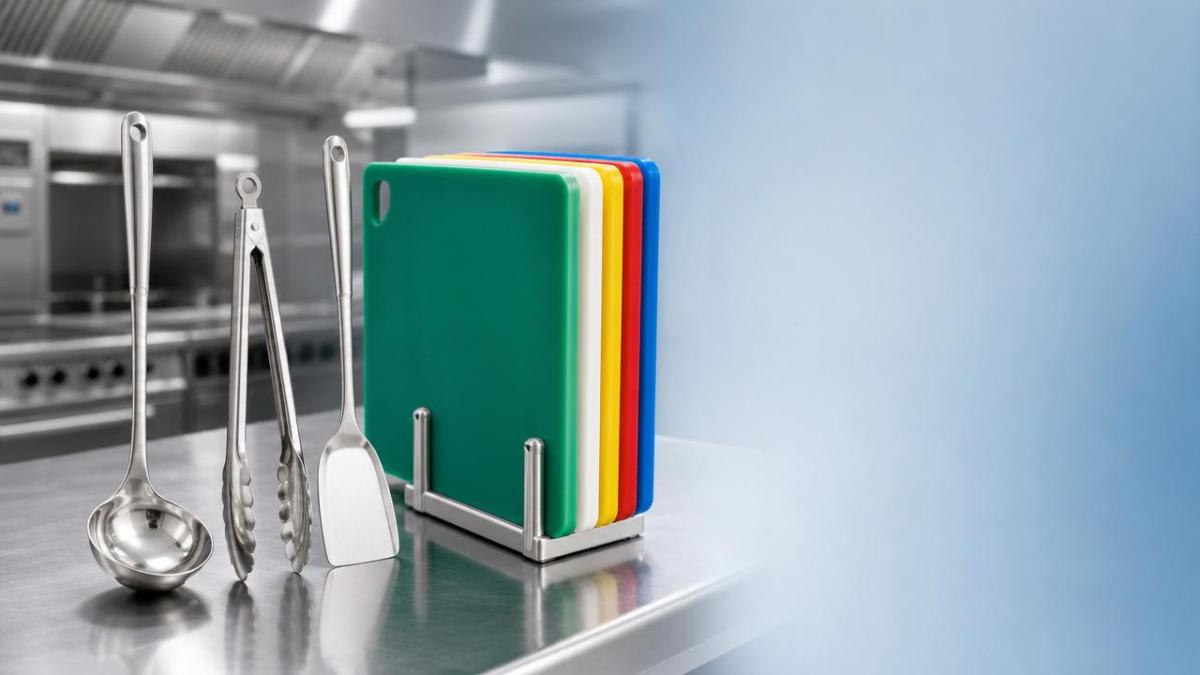
When users search for kitchen tools for schools that are easier to sanitize, their core intent is usually not to find a generic list of utensils. They want tools that reduce contamination risk, support food safety procedures, and make routine cleaning more consistent across shifts and staff members. In other words, they are looking for a safer and more manageable system, not just better individual products.
For school kitchen quality control teams, the most important questions are highly practical. Is the tool easy to fully wash and inspect? Can food residue hide in seams, handles, hinges, or textured surfaces? Will the material withstand repeated sanitizing chemicals and hot-water cleaning? Does the design support separation between raw and ready-to-eat food handling? These are the issues that drive real purchasing value.
Safety managers are also concerned about standardization. A tool may be technically washable, but if it takes too long to clean correctly or requires special handling, sanitation compliance can become inconsistent. In school kitchens, ease of cleaning is closely tied to whether staff can repeat the correct process every day under time pressure.
This is why the best sanitation-friendly tools are usually not the most complex. They are often the ones with fewer parts, smoother surfaces, stronger material stability, and a design that allows quick visual verification after cleaning. If a supervisor cannot easily tell whether a tool is clean, that tool is already creating unnecessary risk.
Which design features make school kitchen tools easier to sanitize
The easiest tools to sanitize generally share a small group of design characteristics. First, they have smooth, non-porous surfaces that do not trap moisture, grease, starch, protein, or fine debris. Stainless steel and selected food-grade polymers are common choices because they allow efficient cleaning and resist microbial buildup better than rough, absorbent, or damaged materials.
Second, sanitation-friendly tools have minimal seams, joints, and crevices. Every connection point creates a potential harbor area for food residue and microorganisms. A one-piece ladle, scraper, or serving spoon is usually easier to sanitize than a multi-part design with rivets, screws, or detachable decorative components. The fewer the hidden spaces, the easier the cleaning verification.
Third, edge design matters more than many buyers expect. Sharp internal corners, deep grooves, embossed branding, textured grips, and poorly finished welds can all trap residue. Rounded corners, continuous welds, and polished surfaces improve both washability and inspection. For QC teams, these small physical details often separate a tool that supports hygiene from one that creates recurring cleaning failures.
Fourth, heat and chemical resistance are essential. School kitchens often rely on repeated cleaning cycles involving hot water, sanitizing solutions, and mechanical washing. If a tool warps, cracks, fades, peels, or becomes sticky after repeated exposure, sanitation effectiveness drops over time. A tool that is easy to clean on day one but degrades after several weeks is not a good sanitation investment.
Finally, ergonomic simplicity has hygiene value. Complicated shapes may look modern, but they can slow cleaning, increase handling points, and create more surfaces for contamination transfer. For schools, practical geometry usually wins: straight lines, open access to all surfaces, and designs that can be cleaned quickly without disassembly.
Best materials to prioritize when selecting sanitation-friendly school kitchen tools
Material selection should be one of the first filters in procurement. For many school applications, high-grade stainless steel remains a preferred option because it is durable, corrosion-resistant, non-porous, and compatible with frequent cleaning. It performs especially well for mixing tools, serving tools, prep utensils, scoops, tongs, and other high-contact items used repeatedly throughout the day.
However, stainless steel is not always the only answer. Food-grade polypropylene, silicone, and other commercial-grade polymers can also be suitable when they are designed for institutional use. These materials are often lighter, less noisy in operation, and useful in color-coded systems. The key is to verify that the product is durable enough for repeated sanitizing, resistant to cracking, and smooth enough to avoid residue retention.
Wood is usually a weak choice for school environments where sanitation control is a priority. Even when treated, wood can absorb moisture, develop surface wear, and become harder to sanitize consistently over time. It may still appear in some specialty uses, but for most school kitchen workflows, non-absorbent alternatives provide better hygiene control and easier compliance management.
Rubberized parts also deserve careful review. Soft-touch grips may improve handling, but some lower-quality materials degrade faster under chemical exposure and frequent washing. If handles begin to split or separate, they quickly become contamination risk points. Quality control teams should evaluate not only the base material but also how multiple materials are joined together.
In practice, the best procurement standard is to ask whether the material supports the cleaning method the school already uses. A tool should fit the sanitation system, not force the operation to create a special cleaning exception for one item category.
Which types of kitchen tools for schools usually create sanitation problems
Some tool categories consistently create avoidable hygiene issues in school kitchens. Tools with hollow handles are a common example. If moisture enters and cannot be removed or inspected, internal contamination can develop unnoticed. Sealed handles may be acceptable only when the sealing quality is robust and verified for commercial foodservice use.
Another problem category includes tools with riveted or layered handle construction. Rivets and gaps can trap grease, batter, vegetable fragments, and proteins, especially in high-volume prep settings. These designs may still be common in retail consumer products, but they are often less suitable for institutional kitchens where deep, repeated sanitization is necessary.
Textured cutting tools, heavily grooved spatulas, mesh items that are hard to inspect, and utensils with decorative openings also deserve caution. These features may not seem significant during purchase evaluation, yet they often increase cleaning time and inspection difficulty. If residue cannot be seen clearly, it cannot be reliably controlled.
Tools with detachable small parts can also become weak points. In theory, removable components can aid deep cleaning. In reality, they may be lost, reassembled incorrectly, or skipped during rushed cleaning cycles. For school kitchens with staff turnover or limited sanitation time, simpler integrated designs are usually safer.
Even color coding can create problems when poorly executed. Painted surfaces, low-quality coatings, or labels that peel during washing can leave residues or create damaged surfaces. If color coding is needed for allergen control or raw-versus-ready-to-eat separation, it should come from durable material construction rather than surface treatments that wear off easily.
How to evaluate sanitation performance before buying
For quality and safety teams, choosing the right kitchen tools for schools should involve a structured evaluation process. Product catalogs and supplier claims are useful starting points, but they are not enough. A better approach is to assess tools against the actual risks and workflows in the school kitchen.
Start with a physical cleanability review. Ask staff to identify every area where food could collect: seams, joints, fasteners, grip transitions, corners, handle ends, and surface textures. Then compare how quickly each candidate tool can be washed, rinsed, sanitized, dried, and visually inspected. This exercise often reveals that apparent product differences are operationally significant.
Next, review material compatibility. The tool should tolerate the kitchen’s standard sanitizers, water temperatures, and dishwashing procedures without distortion or surface breakdown. If possible, request technical specifications or compliance documentation from the supplier covering food-contact suitability and cleaning durability.
A trial period is highly valuable. Before placing a large order, test selected tools in normal kitchen conditions for several days or weeks. Observe whether residue remains after standard cleaning, whether surfaces scratch easily, and whether staff members actually find the tools easy to clean. Procurement decisions should be based on use evidence, not assumptions.
Inspection efficiency should also be measured. A strong sanitation tool is not only easy to clean; it is easy to verify as clean. This distinction matters for school kitchens, where supervisors may need to check many utensils quickly during shift changes or audit preparation. Easy visual confirmation saves time and reduces uncertainty.
Finally, calculate labor impact. A tool that costs slightly more but reduces cleaning time, rewash frequency, and contamination risk may deliver a far better total value than a cheaper alternative. For institutions, sanitation labor and risk exposure often outweigh the initial purchase price.
Operational benefits beyond hygiene: compliance, labor, and risk reduction
Sanitation-friendly tools create value well beyond basic cleanliness. One of the biggest benefits is better process consistency. When tools are easier to wash and inspect, staff are more likely to follow the correct cleaning steps without shortcuts. This improves day-to-day discipline and reduces variation between shifts, kitchens, or temporary personnel.
They also strengthen compliance readiness. Schools may face internal inspections, local health authority reviews, and strict expectations around child food safety. Tools with simple, cleanable designs help documentation match reality. It becomes easier to demonstrate that the operation has selected equipment that supports hygiene by design, not just by corrective effort.
Labor efficiency is another major factor. In high-volume school foodservice, even a small reduction in cleaning time per tool can translate into meaningful savings across a week, month, or academic year. Fewer difficult-to-clean items mean less rework, less end-of-shift pressure, and more time for proper sanitation of high-risk surfaces and equipment.
There is also a risk management advantage. Hard-to-sanitize tools can contribute to microbial growth, allergen cross-contact, and incomplete cleaning validation. For safety managers, replacing problematic utensils is often a relatively low-cost intervention with a strong preventive effect. It addresses risk at the source rather than relying entirely on staff vigilance.
In this sense, selecting better kitchen tools for schools is part of a preventive control strategy. It aligns procurement, sanitation, and operational design around the same outcome: safer food handling with fewer opportunities for failure.
Practical categories to prioritize in school kitchen upgrades
If a school is not replacing all utensils at once, it makes sense to prioritize the categories that combine high contact frequency with higher contamination potential. Serving spoons, tongs, ladles, spatulas, prep knives, cutting boards, scoops, mixing paddles, and food containers often deserve first review because they move through multiple tasks and staff hands every day.
Cutting boards are especially important. Even though they are often discussed separately from hand tools, they are central to school kitchen sanitation control. Boards should be non-porous, easy to resurface or replace, and suitable for color-coded separation where needed. Deep knife scoring can quickly turn a board into a sanitation weakness, so replacement schedules matter as much as initial selection.
Tongs and serving utensils should preferably have simple spring mechanisms or one-piece construction where feasible. Complex hinge assemblies can trap residue and become difficult to inspect. Scrapers and spatulas should avoid handle-blade gaps where moisture and food particles can accumulate.
Food storage bins, ingredient scoops, and measuring tools should also be included in sanitation reviews. These items are often used repeatedly throughout service and may be overlooked because they seem low risk. In reality, frequent hand contact and repeated ingredient exposure can make them significant contamination pathways if the design is poor.
By focusing first on high-use, high-risk categories, safety teams can improve outcomes quickly without requiring a full kitchen replacement project. This staged approach is practical for school budgets while still delivering measurable hygiene improvements.
A simple checklist for choosing easier-to-sanitize tools
For day-to-day procurement decisions, a short checklist can help standardize evaluation. The tool should have a smooth, non-porous food-contact surface. It should contain as few joints, fasteners, and hidden spaces as possible. All surfaces should be reachable during normal cleaning, and the design should allow quick visual inspection after washing.
The material should withstand repeated exposure to heat, moisture, detergents, and sanitizers without cracking, pitting, warping, or separating. If multiple materials are used, the connection points should be robust and hygienic. Any color coding should be integral to the material rather than surface paint or coating that may degrade.
Staff usability should be reviewed as well. If the tool is awkward to handle, difficult to store dry, or prone to damage during normal use, sanitation performance will decline in practice. Good hygiene design always interacts with real workflow conditions.
It is also wise to establish rejection criteria. Tools with hollow unsealed sections, peeling coatings, inaccessible internal mechanisms, rough welds, absorbent materials, or visible damage should be screened out early. This prevents avoidable sanitation challenges from entering the operation.
When this checklist becomes part of standard purchasing policy, schools move from reactive replacement to preventive selection. That is a stronger long-term model for both safety and cost control.
Conclusion: better sanitation starts with better tool design
For quality control personnel and safety managers, the best kitchen tools for schools are not defined by appearance or low unit cost. They are defined by how reliably they support hygiene under real working conditions. Tools that are easier to sanitize reduce hidden contamination points, shorten cleaning time, improve inspection confidence, and strengthen overall food safety performance.
The most effective choices usually share the same traits: smooth non-porous materials, simple one-piece or low-seam construction, durability under repeated sanitizing, and designs that are easy to inspect. In school kitchens, where volume, compliance, and child safety all matter, those characteristics are far more valuable than extra features that complicate cleaning.
If schools want safer and more efficient kitchen operations, tool selection should be treated as part of the sanitation system itself. Choosing well-designed, easy-to-clean utensils is one of the most practical steps an institution can take to reduce risk and build a stronger, more manageable food safety environment.
Popular Tags
Kitchen Industry Research Team
Dedicated to analyzing emerging trends and technological shifts in the global hospitality and foodservice infrastructure sector.
Industry Insights
Join 15,000+ industry professionals. Get the latest market trends and tech news delivered weekly.
No spam. Unsubscribe anytime.
Contact With us
Contact:
Anne Yin (Ceramics Dinnerware/Glassware)
Lucky Zhai(Flatware)