
Commercial Charbroiler vs Griddle: Which Fits Your Menu Better
Choosing between a commercial charbroiler and a commercial griddle can directly impact menu versatility, kitchen efficiency, and cooking consistency. For restaurants refining commercial kitchen design and restaurant kitchen planning, the right equipment decision affects workflow, output, and customer satisfaction. This guide compares both options to help operators, evaluators, and decision-makers select professional kitchen equipment that best matches their concept, service style, and long-term business goals.
In the kitchen equipment industry, equipment selection is no longer just about cooking performance. It also affects labor planning, ventilation design, cleaning time, utility consumption, and the speed at which a kitchen can handle lunch, dinner, and delivery peaks. For buyers comparing a commercial charbroiler vs griddle, the best choice depends less on which unit is more powerful and more on which one aligns with your menu mix, service model, and production targets.
This article is designed for researchers, kitchen operators, technical evaluators, and business decision-makers. It breaks down cooking characteristics, menu fit, equipment specifications, installation considerations, and procurement risks so you can choose commercial kitchen equipment with greater confidence and better long-term return.
Understanding the Core Difference Between a Commercial Charbroiler and a Griddle
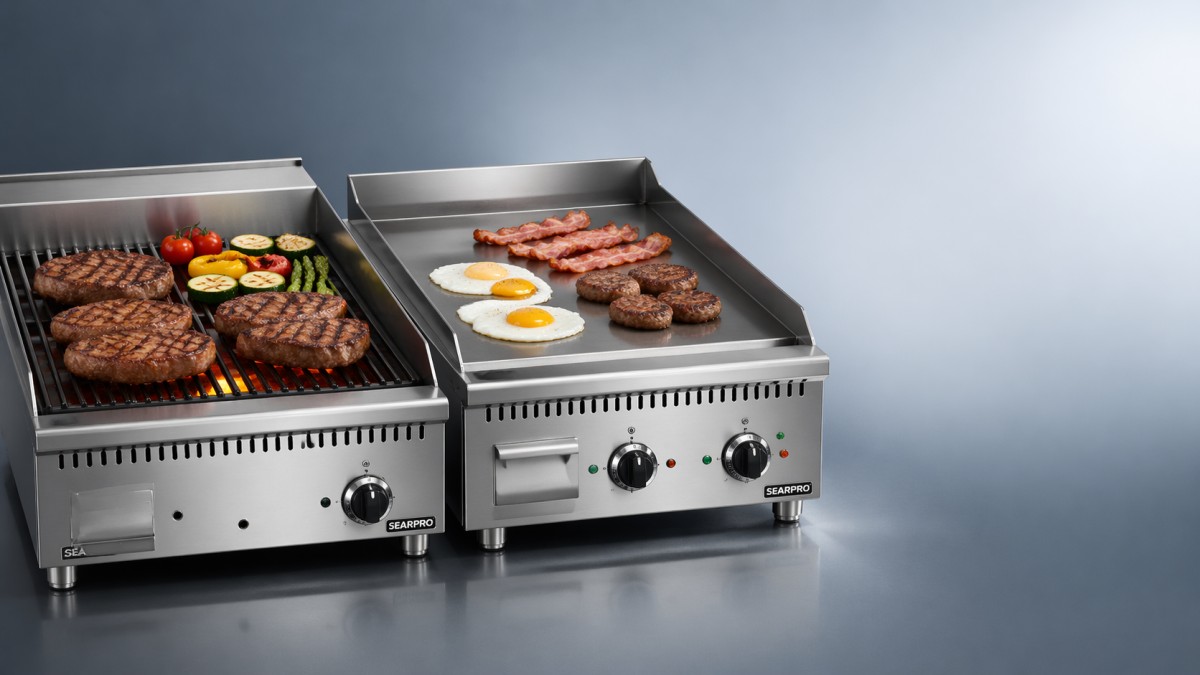
A commercial charbroiler uses open grates over gas burners, radiant heat, or lava rock-style heat distribution to cook food with direct high heat. It is commonly selected for steaks, burgers, chicken, seafood, and vegetables that benefit from grill marks, smoke-like flavor, and fat drainage. Typical countertop units range from 24 to 72 inches, while output and burner configuration vary by kitchen volume.
A commercial griddle uses a flat metal cooking surface that transfers heat through direct contact. It is ideal for eggs, pancakes, bacon, sandwiches, burgers, quesadillas, onions, and delicate proteins. Griddles are often available in 24-inch to 72-inch formats, with thermostatic or manual controls and plate thicknesses commonly falling between 1/2 inch and 1 inch.
From an operational perspective, the difference is simple but significant. A charbroiler prioritizes flame-style searing and product appearance, while a griddle prioritizes even browning, full-surface cooking, and grease management on flat foods. If your menu depends on grilled aroma and visible grill marks, a charbroiler offers a strong advantage. If your menu requires multi-item breakfast or all-day flat-top cooking, a griddle often performs better.
The comparison below highlights the practical distinctions that matter most during kitchen planning and equipment procurement.
For technical evaluators, the key takeaway is that these two cooking systems are not interchangeable in every workflow. They solve different production needs. In many medium- to high-volume kitchens, the decision is driven by whether the operation needs grilled identity, flat-top flexibility, or a combination line with both units positioned under the same hood system.
Why the Difference Matters in Commercial Kitchen Planning
A charbroiler can create stronger sensory appeal, but it also often demands more attention to grease trays, burner access, and ventilation load. A griddle may reduce product variation and simplify line training, especially where 2 to 4 staff members rotate across stations in one shift. That distinction matters in fast-casual, hotel, catering, and chain restaurant environments where consistency is measured by ticket time as much as taste.
Typical Selection Triggers
- If more than 40% of core items rely on grill marks or flame-seared appeal, a commercial charbroiler deserves priority evaluation.
- If breakfast, sandwiches, and high-speed lunch production drive revenue, a commercial griddle often offers better all-day utilization.
- If kitchen space is under 12 square meters on the hot line, versatility per inch becomes a major deciding factor.
How Menu Structure Should Guide Equipment Selection
The best answer to the commercial charbroiler vs griddle question starts with menu engineering. Restaurants often choose based on preference, but procurement teams should first examine the top 10 to 20 selling items, average cook time, plating requirements, and the percentage of proteins versus breakfast or handheld products. A poor match between menu and equipment can reduce throughput and increase remakes during rush periods.
A charbroiler is usually the stronger fit for steakhouses, burger-focused concepts, grilled chicken chains, barbecue-inspired menus, and restaurants where visual grill finish supports pricing. Products cooked on grates can shed excess fat, making the surface better suited to thicker proteins. However, smaller items, liquid batters, and foods requiring full-surface contact are harder to manage on a charbroiler.
A griddle works especially well in diners, breakfast restaurants, cafés, hotel buffets, school canteens, and fast-casual concepts with broad all-day menus. It supports eggs, toast finishing, diced vegetables, pancakes, tortillas, chopped proteins, and burger production in one zone. In kitchens where the same station must handle 6 to 8 menu categories, the flat-top format often increases flexibility.
Decision-makers should also consider menu expansion over the next 12 to 24 months. If the operation may add breakfast, delivery sandwiches, or seasonal lunch items, a griddle often provides more adaptation room. If the brand is strengthening its grilled identity and higher-margin center-of-plate proteins, a charbroiler may produce better customer perception and menu differentiation.
Menu Fit by Business Type
The following table helps connect equipment choice with practical business models and production style.
This comparison shows that the “better” option depends on menu concentration, not popularity. If your top-selling items mostly require one type of heat transfer, buying the other style can create avoidable inefficiency. In mixed-menu concepts, some operators choose a 36-inch griddle plus a 24-inch charbroiler instead of one larger single-purpose unit to balance space and capability.
A Practical 4-Step Selection Method
- List your 15 highest-volume menu items and identify their required cooking surface.
- Estimate peak-hour output, such as 30, 60, or 100 covers per hour.
- Check whether product quality depends more on grill appearance or flat contact cooking.
- Compare future menu plans for the next 1 to 2 years before finalizing the equipment mix.
Performance, Utilities, and Kitchen Workflow Considerations
Beyond menu fit, commercial kitchen equipment must support stable production under real service conditions. For operators and technical reviewers, the charbroiler vs griddle decision often comes down to heat recovery, ease of cleaning, ventilation burden, and station ergonomics. These factors influence not only cook quality but also labor cost and service speed.
Commercial charbroilers generally operate at high heat intensity and can produce strong searing performance, but they also generate more smoke, grease vapor, and occasional flare-ups. That means hood design, fire suppression compatibility, and cleaning discipline become more important. In busy service windows, flare-up management can also affect consistency if staff training is limited.
Commercial griddles usually offer more uniform heat zones and faster adaptation across menu items. Thermostatic models can hold stable surface ranges, often around 120°C to 300°C, depending on the application. That makes them useful for repeatable breakfast service and standardized chain operations. Cleanup may also be faster because grease channels and scraper-based maintenance are more straightforward than grate and burner cleaning.
From a production standpoint, griddles are often easier for cross-trained staff to operate after 1 to 3 shifts of instruction, while charbroilers may require stronger awareness of hot spots, flare patterns, and product placement. In labor-constrained markets, simpler training can be a major advantage.
Typical Evaluation Points for Buyers and Engineers
The table below outlines common technical and operational checkpoints used during specification review.
In practical terms, a griddle often improves all-day station flexibility, while a charbroiler can strengthen premium product positioning. The better investment depends on whether your kitchen bottleneck is cooking identity or operational adaptability.
Workflow Risks to Watch
- Installing a charbroiler without adequate exhaust planning can create heat stress and cleaning pressure within 4 to 8 weeks of operation.
- Choosing an undersized griddle may cause queuing during breakfast peaks, especially when more than 3 product types share one plate.
- Ignoring grease management can increase maintenance frequency and shorten component life on both equipment types.
Procurement Criteria, Cost Factors, and Long-Term Value
For business decision-makers, upfront purchase price is only one part of the evaluation. The more important question is total operating fit over 3 to 5 years. That includes utility demand, parts access, cleaning labor, hood system impact, and how often the unit is used across service periods. A lower-priced unit that only supports 20% of the menu may be less economical than a more versatile model used every day.
When reviewing suppliers, ask for clear details on material grade, burner layout, plate thickness, grease tray design, control type, and cleaning access. In many B2B purchasing situations, delivery lead times for standard units can range from 2 to 6 weeks, while project-based restaurant kitchen planning may require synchronized delivery with hoods, refrigeration, and fabrication schedules.
It is also wise to evaluate replacement parts and after-sales support. A charbroiler with difficult-to-source grates or burner components can create downtime risk. A griddle with unstable thermostat performance can undermine batch consistency. Operators should define acceptable service response windows, such as 24 to 72 hours, especially in high-volume sites.
In chain restaurants and hotel groups, standardization matters. If multiple locations need the same cooking result, equipment with repeatable controls and simpler training may reduce product deviation across sites. For independent restaurants, the decision may lean more heavily toward menu character and guest experience.
A Practical Procurement Checklist
- Confirm gas or electric utility compatibility before comparing models.
- Check line dimensions, hood space, and adjacent equipment clearance.
- Match cooking surface size to peak demand, not average demand.
- Review cleaning labor and maintenance access during daily shutdown.
- Ask about spare parts availability for at least 12 months of normal operation.
- Verify whether the unit supports your future menu roadmap.
Common Buying Mistakes
One common mistake is buying a charbroiler because grilled food looks premium, even though the business mainly sells breakfast sandwiches and eggs. Another is selecting a griddle for a steak-heavy concept where customers expect visible char marks. A third mistake is sizing the unit only for opening-month demand, not for the 20% to 30% capacity increase that often follows successful promotions or delivery expansion.
Buyers should also avoid judging equipment based only on showroom performance. Real-world evaluation should include cleaning time, staff skill level, and the effect on neighboring workstations. In compact restaurant kitchen planning, 1 extra hour of daily cleaning or 15% slower ticket speed can have more impact than a small difference in purchase price.
Implementation Tips, Maintenance Planning, and Frequently Asked Questions
Once the equipment decision is made, successful implementation depends on layout coordination, operator training, and routine maintenance. Commercial kitchen equipment performs best when installation, startup testing, and daily cleaning procedures are aligned from day one. For new projects, many teams use a 3-stage process: pre-installation site check, commissioning and temperature verification, then staff handover with cleaning instruction.
For charbroilers, daily maintenance often includes grate brushing, drip tray emptying, and burner-area inspection. Weekly cleaning may require deeper access to radiant components or internal grease zones. For griddles, common tasks include scraping the surface between batches, emptying grease troughs, and conditioning the plate according to manufacturer guidance. The right routine can reduce residue buildup and help maintain even heat transfer.
Training should be practical rather than theoretical. In many kitchens, a 30- to 60-minute station training session plus supervised production during the first 2 shifts is enough for griddle use, while charbroiler use may need more coaching on flare-up control, heat zones, and product rotation. That difference matters when turnover is high or staffing changes are frequent.
Below are several questions buyers commonly ask during restaurant equipment selection and kitchen upgrade planning.
Which is better for burgers: charbroiler or griddle?
It depends on the burger style. A charbroiler is better for thick patties and a grilled flavor profile. A griddle is often preferred for smash burgers and operations that want strong crust development, retained juices, and fast batch cooking. If burgers are your primary category, test your top 2 patty formats before final procurement.
Is a griddle easier to maintain than a charbroiler?
In many kitchens, yes. A griddle usually has a simpler cleaning routine because food and grease remain on a flat surface and move toward a trough. A charbroiler often needs more attention to grates, burners, and lower grease collection areas. The daily cleaning time difference may range from 10 to 25 minutes depending on size and menu load.
Can one unit replace the other?
Not fully. A griddle cannot replicate true grill marks and open-grate cooking behavior. A charbroiler cannot handle batter items or fully flat contact cooking with the same efficiency. In mixed-menu operations, combining both units or choosing a split cooking line is often the most balanced solution.
How should a buyer make the final decision?
Use 4 filters: top-selling menu items, peak-hour capacity, ventilation and cleaning limits, and future menu expansion. If at least 60% of core demand points toward one cooking surface, that is usually the clearest indicator. If the kitchen has broad menu complexity, prioritize versatility and workflow over isolated product preference.
Choosing between a commercial charbroiler and a commercial griddle is ultimately a business decision shaped by menu design, operational pace, kitchen constraints, and long-term growth plans. A charbroiler supports grilled flavor, premium presentation, and strong protein-focused menus. A griddle supports flexibility, standardized output, and high-efficiency multi-item cooking.
If you are evaluating professional kitchen equipment for a new project, renovation, or multi-site rollout, a structured review of menu, workflow, utilities, and maintenance needs will lead to a better outcome than comparing price alone. Contact us to get a tailored equipment recommendation, discuss product details, or explore more commercial kitchen solutions for your operation.
Popular Tags
Kitchen Industry Research Team
Dedicated to analyzing emerging trends and technological shifts in the global hospitality and foodservice infrastructure sector.
Industry Insights
Join 15,000+ industry professionals. Get the latest market trends and tech news delivered weekly.
No spam. Unsubscribe anytime.
Contact With us
Contact:
Anne Yin (Ceramics Dinnerware/Glassware)
Lucky Zhai(Flatware)