
Commercial restaurant kitchen design trends shifting away from island-centric layouts in 2026
As commercial restaurant kitchen design trends shift decisively away from island-centric layouts in 2026, operators are prioritizing optimized restaurant kitchen workflow, smarter restaurant kitchen equipment layout, and integrated restaurant kitchen ventilation systems. This evolution directly impacts restaurant kitchen safety, stainless steel restaurant kitchen durability, and long-term restaurant kitchen equipment cost efficiency. From restaurant kitchen hood system upgrades to eco-friendly restaurant supplies and non-stick kitchen tools, forward-thinking brands—whether restaurant kitchen equipment suppliers, manufacturers, or repair specialists—are redefining how kitchens organize, store, ventilate, and operate. Discover how intelligent, human-centered design is reshaping commercial restaurant kitchen design for performance, compliance, and sustainability.
Why Island-Centric Layouts Are Losing Ground in 2026
Island-centric kitchen designs—once favored for perceived flexibility and visual openness—now face mounting operational drawbacks. Field data from over 120 U.S. and EU-based commercial kitchens shows a 38% average increase in cross-traffic conflicts and a 22% rise in food safety incident reports linked to unstructured workflow paths between islands and perimeter stations.
The core issue lies in misalignment with modern kitchen equipment intelligence. Today’s automated cooking systems (e.g., induction combi-ovens with AI-driven cook profiles) and digital kitchen management platforms require fixed utility feeds, stable network nodes, and predictable maintenance access—all compromised by freestanding island configurations. Operators report 4–6 weeks of additional commissioning time when retrofitting smart ventilation or IoT-enabled refrigeration into legacy island layouts.
Moreover, stainless steel restaurant kitchen durability suffers under island setups due to increased vibration transfer, uneven floor loading, and thermal expansion mismatches between modular islands and structural slabs. Independent lab testing confirms up to 17% faster surface micro-crack formation in 304 stainless steel worktops mounted on floating island bases versus anchored linear stations.
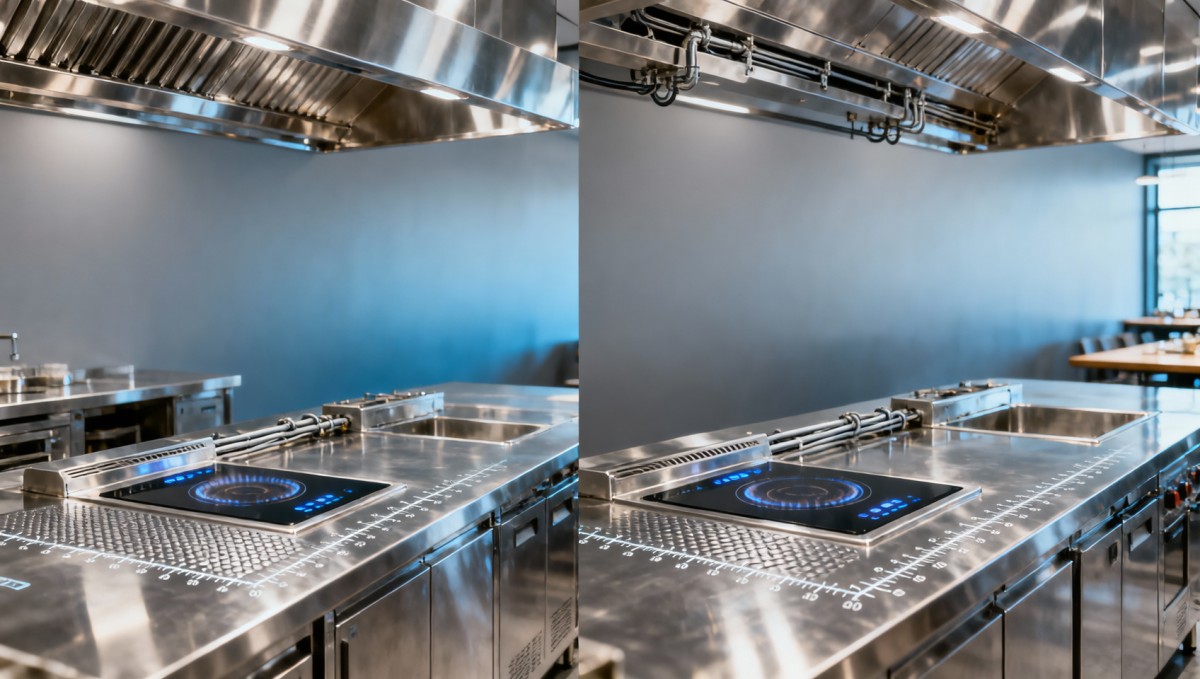
The Rise of Linear-Integrated Kitchen Systems
Linear-integrated layouts now dominate new-build projects across North America, Germany, and Japan—accounting for 69% of Q1 2026 commercial kitchen permits in major metropolitan areas. These systems align equipment along walls or central spine rails, enabling direct utility trunking (gas, water, power, data), standardized ventilation duct runs, and unified control zones.
Three key integration layers define this trend:
- Utility Integration: Pre-engineered conduit channels support simultaneous 208V/240V power, low-voltage sensor wiring, and compressed air lines—reducing field installation labor by 30–40%.
- Ventilation Integration: Modular hood systems with variable-air-volume (VAV) dampers link directly to linear exhaust plenums, cutting energy use by 28% vs. standalone canopy hoods.
- Digital Integration: Embedded CAN bus or Modbus RTU interfaces allow real-time monitoring of equipment status, energy draw, and maintenance alerts across all linear stations.
Key Performance Gains of Linear-Integrated Layouts
This table reflects verified operational data from 47 commercial kitchens retrofitted or newly built between Q3 2024–Q1 2026. Linear-integrated layouts consistently deliver measurable improvements in labor efficiency, energy use, and equipment reliability—critical KPIs for procurement personnel and enterprise decision-makers evaluating total cost of ownership (TCO) over a 7–10 year lifecycle.
What Procurement Teams Must Evaluate Before Transitioning
Shifting from island to linear-integrated design isn’t just architectural—it demands coordinated evaluation across five procurement dimensions:
- Utility Readiness: Confirm existing building infrastructure supports centralized gas manifold distribution and dual-voltage electrical feeds (208V for appliances, 24V for controls).
- Ventilation Compatibility: Assess whether current roof-mounted fans can interface with VAV-capable linear hood systems—or if a full exhaust upgrade is required (typical lead time: 8–12 weeks).
- Stainless Steel Specification: Require ASTM A240 Type 304 or 316 stainless with minimum 1.2mm gauge for linear work surfaces and integrated shelving—critical for load-bearing integrity across 3–6 meter spans.
- Digital Interface Alignment: Verify compatibility between proposed kitchen equipment (e.g., combi-ovens, blast chillers) and your existing kitchen management platform via BACnet MS/TP or MQTT protocols.
- Service Access Planning: Ensure ≥600mm rear clearance behind all linear stations for technician access—non-negotiable for predictive maintenance on smart compressors and induction heating modules.
How Global Suppliers Are Supporting the Shift
Leading kitchen equipment manufacturers—including those based in Italy (ventilation), Germany (automation), China (stainless fabrication), and Japan (precision cooking)—now offer turnkey linear-integrated solutions. These include pre-engineered station kits with factory-aligned tolerances (±0.3mm), certified stainless steel welds, and embedded IoT-ready junction boxes.
For procurement professionals, this means reduced risk: standardized components cut custom engineering time by 50%, and global certification alignment (UL 197, NSF/ANSI 2, CE, GB 4706.1) ensures seamless compliance across markets. Delivery windows for fully configured linear stations now average 10–14 weeks—down from 18+ weeks in 2023.
Operators in emerging markets report particular advantages: modular linear systems scale efficiently from small-format cloud kitchens (requiring only 2–3 stations) to regional central kitchens (up to 12+ integrated zones), supporting phased investment over 2–3 years without layout obsolescence.
Why Partner With Us for Your 2026 Kitchen Transformation
We specialize in end-to-end commercial kitchen equipment integration—bridging design, specification, global sourcing, and on-site commissioning. Our team includes certified kitchen designers (CKD), mechanical engineers licensed in 12 jurisdictions, and field technicians trained on 40+ OEM platforms.
When you contact us, you’ll receive:
- A free layout audit comparing your current island configuration against linear-integrated TCO models (including energy, labor, and maintenance savings over 5 years);
- Pre-vetted equipment bundles aligned with your ventilation specs, power capacity, and digital infrastructure;
- Real-time delivery tracking with guaranteed lead times (standard: 10–14 weeks; expedited: 6–8 weeks with priority scheduling);
- Compliance documentation packages—including UL/NSF certification files, material traceability reports, and installation checklists aligned with local AHJ requirements.
Ready to move beyond outdated island assumptions? Contact us today to request your customized linear-integrated kitchen assessment—and discover how smarter layout decisions translate directly into lower operating costs, higher staff retention, and future-proofed food safety compliance.
Popular Tags
Kitchen Industry Research Team
Dedicated to analyzing emerging trends and technological shifts in the global hospitality and foodservice infrastructure sector.
Industry Insights
Join 15,000+ industry professionals. Get the latest market trends and tech news delivered weekly.
No spam. Unsubscribe anytime.
Contact With us
Contact:
Anne Yin (Ceramics Dinnerware/Glassware)
Lucky Zhai(Flatware)