
Why Bakery Worktable Material Choice Affects Daily Hygiene Control
In bakery operations, the material of a Bakery Worktable directly affects daily hygiene control, cleaning efficiency, and cross-contamination risk. For quality control and safety managers, choosing the right surface is not only about durability but also about meeting food safety standards, simplifying sanitation routines, and supporting consistent production. Understanding these material differences helps build a safer and more manageable bakery environment.
In a busy bakery, a work surface is exposed to flour dust, fats, dairy residues, fruit fillings, yeast, moisture, and repeated tool contact for 8–16 hours a day. That operating reality makes material choice a control point rather than a simple furniture decision.
For quality and safety teams, the right Bakery Worktable should support fast cleaning between batches, stable sanitation results across 2–4 daily cleaning cycles, and low risk of harboring residues in seams, scratches, or absorbent areas. This article focuses on how material selection affects those outcomes in practical bakery settings.
Why worktable material matters in bakery hygiene systems
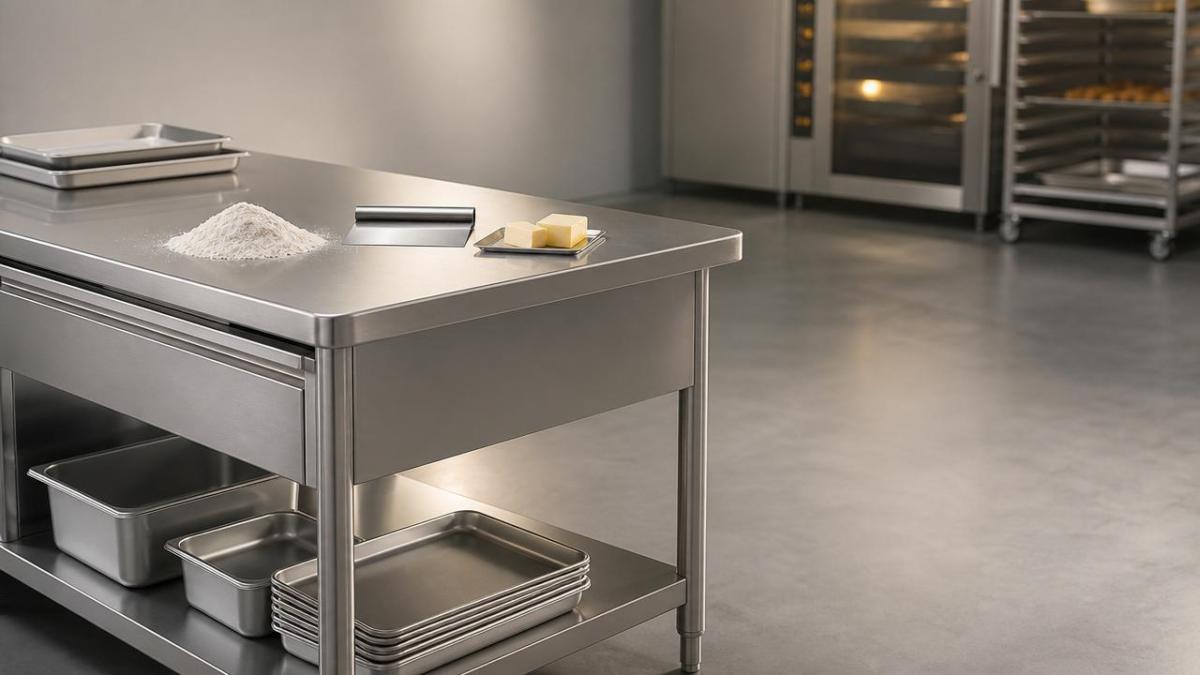
A Bakery Worktable is part of the food contact zone. If the surface is difficult to clean, reacts with ingredients, or degrades under detergents, the sanitation plan becomes harder to execute and verify. In most bakeries, that leads to higher inspection time, more corrective actions, and inconsistent hygiene performance across shifts.
Material affects at least 4 daily control points: residue release, moisture resistance, chemical compatibility, and surface damage rate. A table that performs well in all four areas can reduce manual scrubbing time, improve visual cleanliness, and make ATP or swab-based verification more reliable.
The link between surface condition and contamination risk
Bakery soils are not uniform. Dry flour is easy to remove, but sugar syrup, butter, egg wash, chocolate, and cream fillings behave differently. On a porous or damaged surface, sticky residues can remain in micro-crevices after a standard 5–10 minute wipe-down, especially around corners and joints.
This matters most in operations with allergen separation, ready-to-fill products, or alternating raw and finished dough handling. If one surface supports complete cleaning in 2 steps and another requires 4 steps plus rework, the hygiene burden increases immediately.
How sanitation efficiency changes with material choice
Cleaning efficiency is often underestimated during equipment purchasing. A cheaper table may look acceptable on day 1, yet after 6–12 months it may show scoring, swelling, pitting, or seam failure. Once that happens, cleaning takes longer and verification results become less predictable.
- Non-absorbent surfaces usually support faster wipe-down and lower moisture retention.
- Smooth welds and rounded edges reduce flour buildup and make visual inspection easier.
- Chemically resistant materials tolerate alkaline and neutral detergents over repeated cycles.
- Harder surfaces generally resist knife marks, tray drag, and scraper abrasion better.
For safety managers, the practical question is not only “Which material lasts longer?” but “Which material stays hygienic after 300 cleaning cycles and repeated production changeovers?” That is the decision point where lifecycle hygiene becomes more important than purchase price alone.
Common Bakery Worktable materials and their hygiene impact
Different bakery formats use different surfaces based on dough work, temperature exposure, and production volume. Stainless steel is often preferred for hygiene, but wood, laminated boards, and stone-based tops still appear in specialized pastry or dough applications. Each option brings a different sanitation profile.
The comparison below highlights material behavior from a hygiene-control perspective rather than a purely aesthetic or cost perspective. This is especially relevant when the Bakery Worktable is used for direct food contact more than 5 days per week.
For most commercial bakeries, stainless steel remains the most practical choice because it combines moisture resistance, smooth cleanability, and compatibility with routine sanitation. Alternative materials may still work in narrow applications, but they typically require stricter controls, shorter inspection intervals, or more limited food-contact use.
Why stainless steel is often the baseline standard
A stainless steel Bakery Worktable is usually preferred in production lines that handle cream, custard, egg, or high-moisture dough. These products increase the need for non-absorbent surfaces and repeatable sanitation. In practice, a smooth stainless top with proper weld finishing can simplify both pre-op inspection and end-of-shift cleaning.
Teams should still check gauge, finish quality, underside reinforcement, and joint construction. Hygiene does not depend on the metal name alone. A poorly fabricated stainless surface may perform worse than expected if there are sharp seams, open edges, or rough polishing marks.
Points to verify on a stainless Bakery Worktable
- Surface should be smooth enough for easy wipe verification after each batch.
- Welds should be continuous or well-finished, with no visible gaps or burrs.
- Corners should support cleaning access within 30–60 seconds per section.
- Legs, undershelves, and bracing should not create hidden dust traps.
Key selection criteria for quality control and safety managers
When evaluating a Bakery Worktable, procurement and hygiene teams should use a structured checklist. Material is the starting point, but the final decision should include fabrication details, cleaning workflow, intended food types, and expected service life. A table used in a dry dough bench has different demands than one used for cream piping or fruit topping.
A practical review usually covers 6 dimensions: food-contact suitability, resistance to water and chemicals, seam design, load capacity, maintenance burden, and inspection visibility. Scoring each item on a 1–5 scale can make cross-supplier comparison more objective.
Operational questions to ask before purchase
- Will the Bakery Worktable be cleaned 1 time, 2 times, or 4 times per shift?
- Will it contact raw dough only, or dairy, egg, fruit, chocolate, and allergens?
- Does the team use neutral detergent only, or alkaline sanitizer in rotation?
- Is the environment dry, humid, refrigerated, or near washdown zones?
- Does the table need to support 100 kg, 250 kg, or more under daily use?
These questions help prevent a common mistake: selecting a surface based on appearance or purchase budget while ignoring sanitation realities. In hygiene-sensitive bakeries, the wrong material can add 10–20 minutes of extra cleaning labor per shift and still leave higher verification risk.
The table below provides a procurement-oriented framework that quality and safety managers can adapt during supplier review, pilot testing, or new-facility planning.
This framework is useful because it links purchasing decisions to hygiene verification. Instead of debating material in general terms, the team can compare how each Bakery Worktable performs under actual cleaning frequency, actual product soils, and actual inspection demands.
Material choice by bakery application
Not every production zone has the same hygiene priority. In a central bakery with 3 separate functional areas, the best material may differ by station. Direct-contact assembly benches generally need a stricter specification than temporary tray staging tables or outer packaging areas.
Typical zoning approach
- Zone 1: direct food contact surfaces, highest sanitation requirement.
- Zone 2: adjacent support surfaces, frequent flour and dust exposure.
- Zone 3: packaging or utility surfaces, lower direct contamination risk.
For Zone 1, a stainless steel Bakery Worktable is usually the safest default. For Zone 2, stainless still performs well but design details such as shelf spacing and leg accessibility become more important. Zone 3 may allow broader material choices if food contact is absent and the cleaning plan is clearly separated.
Implementation, inspection, and maintenance in daily bakery use
Choosing the right Bakery Worktable is only the first half of hygiene control. The second half is implementation: placement, cleaning method, inspection frequency, and replacement criteria. Even a high-quality surface can become a hygiene issue if it is installed too close to splash zones, overloaded, or maintained inconsistently.
A strong rollout plan usually includes 3 stages: incoming inspection, operational validation, and routine review. Each stage should define who checks the table, what defects trigger action, and how findings are recorded during the first 30–90 days of use.
A practical 5-step control process
- Inspect the new surface for weld quality, edge condition, and transport damage.
- Validate cleaning with actual dough, cream, sugar, and allergen residues.
- Set a standard cleaning sequence with defined contact time and tools.
- Review surface wear weekly for the first 4 weeks, then monthly.
- Replace or repair when scratches, swelling, or open seams affect cleanability.
This process helps quality teams move from assumption to evidence. If a Bakery Worktable passes production trials, can be cleaned within the planned labor window, and stays defect-free through repeated shifts, it is far more likely to support long-term hygiene targets.
Common mistakes that weaken hygiene performance
One common mistake is using a non-food-focused table in a bakery production area because it appears similar to a commercial prep bench. Another is selecting a smooth top but ignoring the frame, shelf joints, and underside geometry, where flour and moisture can accumulate over time.
A third mistake is over-relying on stronger chemicals to compensate for poor material choice. If the surface itself is absorbent, chipped, or chemically unstable, additional detergent strength may increase wear instead of improving sanitation. Material and cleaning chemistry must be matched as a system.
Inspection triggers that should not be ignored
- Repeated residue found in the same location after 2 cleaning attempts.
- Visible edge lifting, laminate break, or wood fiber exposure.
- Corrosion spots, rough polishing marks, or cracked seal lines.
- Cleaning time increasing by more than 15% versus the original baseline.
These warning signs indicate that the table is no longer supporting the sanitation program efficiently. In most cases, early repair or replacement is less costly than recurring hygiene failures, delayed release, or product segregation caused by contamination concerns.
How to make a smarter purchasing decision
For buyers, the best Bakery Worktable is rarely the one with the lowest initial quote. It is the one that balances hygienic design, cleaning speed, structural stability, and useful service life in the target bakery environment. A slightly higher purchase cost can be justified if it reduces labor time, defect risk, and replacement frequency over 12–36 months.
In B2B bakery operations, supplier communication should include clear use conditions: product types, cleaning chemicals, shift length, humidity exposure, and expected load. That information allows better material recommendations and avoids generic specifications that fail under real production stress.
What decision-makers should request from suppliers
- Detailed material description for the top, frame, joints, and shelf components.
- Surface finishing and fabrication details relevant to food-contact cleaning.
- Recommended cleaning methods and chemical-use limitations.
- Load guidance and expected maintenance points over routine use cycles.
- Photos or drawings showing corners, welds, and underside construction.
For quality control and safety managers, these details matter as much as the visible top surface. A Bakery Worktable should fit the full hygiene process, from pre-op checks to deep cleaning and periodic verification. If the supplier can support that conversation clearly, purchasing risk is lower.
Material choice affects far more than durability. It influences sanitation labor, inspection reliability, allergen control, and the consistency of bakery production every single day. In most food-contact applications, a well-fabricated stainless steel Bakery Worktable offers the strongest balance of hygiene performance and operational practicality.
If you are reviewing bakery equipment for a new line, a facility upgrade, or a hygiene improvement project, it is worth comparing surface materials against actual cleaning needs, product risks, and shift conditions before placing an order. Contact us now to discuss your application, get a tailored Bakery Worktable recommendation, and learn more about practical kitchen equipment solutions for safer bakery operations.
Popular Tags
Kitchen Industry Research Team
Dedicated to analyzing emerging trends and technological shifts in the global hospitality and foodservice infrastructure sector.
Industry Insights
Join 15,000+ industry professionals. Get the latest market trends and tech news delivered weekly.
No spam. Unsubscribe anytime.
Hot Articles
 How to Choose a Leak-Proof Glass Storage Container for Meal Prep and Transport
- How to Size a Commercial Charbroiler for Peak-Hour Restaurant Output
- How to Specify Stainless Steel Kitchen Equipment for High-Volume Commercial Kitchens
- How to Choose Food Containers for Hot, Cold, and Leak-Prone Takeout Meals
Contact With us
Contact:
Anne Yin (Ceramics Dinnerware/Glassware)
Lucky Zhai(Flatware)