
Commercial Kitchen Equipment Checklist: What a New Restaurant Needs
A new restaurant generally needs equipment for cooking, refrigeration, food preparation, storage, warewashing, and sanitation. The exact list depends on the menu and expected service volume: a kitchen serving grilled food has different priorities from one built around salads and cold sandwiches. Buying from a generic list can leave critical capacity short while tying up funds in equipment that rarely gets used.
Use this commercial kitchen equipment checklist to identify essential purchases, match capacity to the busiest service period, and account for installation and operating costs before placing orders. Confirm the proposed layout and utility requirements early; a suitable appliance is not a practical purchase if it cannot fit through the door or operate on the available connections.
Start with the menu and the path food will follow
List each menu item alongside its preparation, cooking, holding, and cleaning requirements. Group dishes that can share equipment, then identify processes that happen at the same time. An oven may be capable of producing every baked item on the menu, but it may not have enough usable capacity if several dishes must be cooked simultaneously during service.
Next, map the path from receiving and storage to preparation, cooking, service, and cleaning. Keep raw and ready-to-eat food handling separated where required, and allow space for staff to move, open equipment doors, remove hot pans, and access cleaning areas. A floor plan should include working clearances, not just the dimensions of the equipment itself.
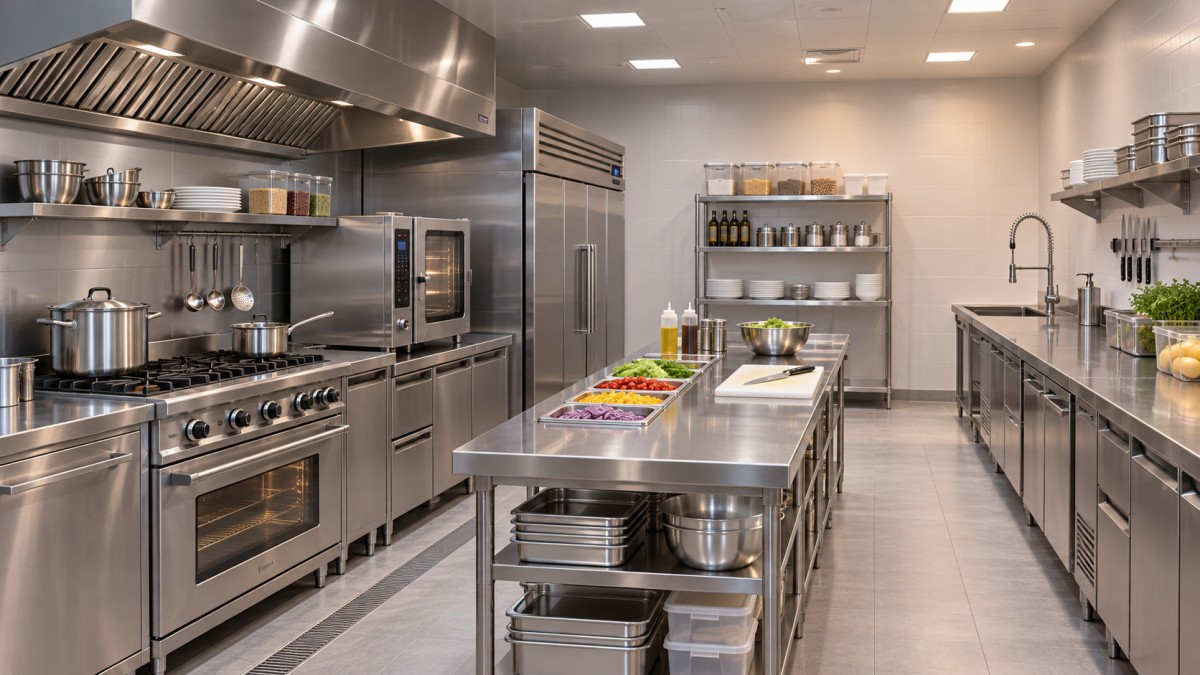
Before requesting quotations, record the available floor space, ceiling height, door widths, electrical supply, gas connection, water and drainage points, and proposed ventilation. Manufacturer installation requirements and applicable local rules may impose additional clearances or service provisions. Resolve these constraints before comparing models.
Core equipment by kitchen function
Cooking and hot holding
Choose cooking equipment around the methods used most often, rather than purchasing one of every appliance. A range with an oven can cover several basic tasks in a compact kitchen; a dedicated griddle, fryer, grill, or additional oven may be justified when a menu item needs consistent capacity during peak service.
- Range and oven: Check burner configuration, oven capacity, pan compatibility, and whether gas or electric service is available.
- Griddle, charbroiler, or grill: Select the cooking surface according to the food and throughput required. Confirm ventilation and clearance needs before ordering.
- Fryer: Include only if fried food is part of the menu. Consider basket capacity, oil filtration or handling, and safe access for cleaning.
- Specialty equipment: Pizza ovens, steamers, combi ovens, and similar units can be worthwhile when their functions match the menu and justify their space and cost.
- Hot-holding equipment: A holding cabinet, heated well, or service-line unit may be needed when cooked food must be kept ready for service. Cooking capacity and holding capacity are separate decisions.
Assess usable production capacity, not only external size or advertised output. Ask suppliers what pan sizes a unit accepts, how much clearance loading requires, and whether capacity figures assume conditions comparable to your menu. Equipment intended for cooking should not automatically be treated as suitable for holding food safely.
Refrigeration and frozen storage
Most restaurants need refrigerated storage for ingredients and prepared food; frozen storage depends on purchasing and menu practices. A reach-in refrigerator may suit a compact operation, while a walk-in may be more appropriate when storage volume and deliveries justify its footprint and installation cost. Under-counter or prep-table refrigeration can place frequently used ingredients near the service line, but it should not substitute for adequate bulk storage.
Size storage around delivery frequency, peak inventory, packaging, shelving, and the space needed to separate products. Check door swing and aisle space, as well as access for cleaning and condenser maintenance. Compare the operating conditions specified by the manufacturer with the kitchen environment: heat near cooking equipment can affect refrigeration performance.
Include reliable temperature-monitoring devices and a plan for checking and recording temperatures where required. Ice machines, beverage refrigeration, and blast chillers are conditional purchases; their value depends on the menu, production process, and applicable food-safety requirements.
Food preparation and smallwares
Preparation often determines whether the kitchen can keep pace before cooking begins. Provide durable worktables and sufficient space for washing, cutting, mixing, portioning, and staging ingredients. Consider a food processor, mixer, slicer, blender, or vacuum sealer only when the task volume and menu support the purchase. For example, a mixer is a priority for a kitchen making substantial dough or batter in-house, but not necessarily for one buying those products prepared.
Do not overlook smallwares: knives, cutting boards, pans, pots, sheet trays, mixing bowls, measuring tools, food-storage containers, thermometers, utensils, and pan racks. Match container and pan sizes to the ovens, refrigeration, shelving, and holding equipment being purchased. Consider how many clean items will be needed during a busy shift, including replacements while others are being washed.
Warewashing, sinks, and waste
Plan for the full return path of dirty dishes, cookware, and utensils. Depending on the operation and local requirements, the kitchen may need a commercial dishwasher, a compartment sink, separate handwashing facilities, food-preparation sinks, and a service or utility sink. Confirm the required sink arrangement with the relevant local authority before finalizing the layout.
When comparing dishwashers, check rack capacity against peak dish return, the available electrical and water services, drainage, and any associated ventilation requirements. Allow room for scraping, sorting, washing, drying, and storing clean items without crossing the dirty flow. Include waste and recycling containers, cleaning-tool storage, and a suitable location for used cooking oil if frying is planned.
Storage, shelving, and transport
Dry-storage shelving, ingredient bins, dunnage racks, and carts are easy to omit from equipment budgets. Specify materials and construction suitable for the intended environment, with surfaces that can be cleaned. Keep supplies arranged so stock can be rotated and food remains protected from contamination. Where mobile racks or carts are needed, check that wheels, loaded dimensions, and turning space suit the route between storage, preparation, and service.
Set capacity before comparing prices
Use the busiest expected service period as the basis for sizing, then work backward through the menu. Estimate how many portions must pass through each stage at the same time, how long the equipment is occupied, and whether another step creates a bottleneck. Allow for setup, loading, cleaning, and changeovers rather than assuming continuous operation at a quoted maximum.
Consider a kitchen that uses the same oven for baked dishes and finishing other menu items. Its nominal daily output may look sufficient, yet simultaneous orders can compete for rack space. The purchasing decision may be a larger oven, a second unit, a different cooking method, or a menu adjustment. Compare those alternatives against available space and utilities before committing to an appliance.
Oversizing has costs too: larger units can consume more space and energy, require more ventilation, and leave less room for preparation. For uncertain demand, consider whether a practical layout and utility plan allow capacity to be added later without disrupting service.
Build a budget around installed cost
The quoted equipment price is only one part of the commitment. Request itemized quotations that distinguish the appliance from delivery, placement, installation, connections, commissioning, and any accessories needed to operate it. Costs for ventilation, electrical or gas work, plumbing, drainage, and building modifications may sit outside an equipment supplier’s quote.
Compare energy and water information on a consistent basis, using published specifications where available. A lower purchase price may be offset by higher utility or maintenance expenses, but savings should not be assumed without comparable usage estimates. Ask for the conditions behind any efficiency claim, and consider whether staff will actually use programmable or automated functions often enough to justify their cost.
Check suppliers and specifications before issuing orders
Give competing suppliers the same equipment schedule and installation information. A useful schedule identifies the intended task, required capacity, available footprint, utility connection, and mandatory accessories. This makes it easier to spot a low quotation that omits a stand, installation component, or other necessary item.
- Confirm suitability. Check that each model is intended for the proposed commercial use and meets applicable local approval and food-safety requirements.
- Verify connections. Match electrical specifications, gas type, water supply, drainage, and ventilation requirements to the site plan. Have qualified installers review the details where necessary.
- Review service coverage. Establish who handles installation, warranty claims, repairs, and replacement parts at the restaurant’s location.
- Check delivery conditions. Confirm lead times, access routes, unloading responsibility, and whether equipment can be moved into its final position.
- Document acceptance. Keep specifications, quotations, installation instructions, warranty terms, and inspection procedures with the purchase order.
Used equipment can reduce initial expenditure, but compare it on its condition and remaining serviceability rather than price alone. Check identification plates, operating history where available, utility compatibility, missing components, and access to parts. Arrange a suitable inspection or operating demonstration before purchase when possible, and establish who bears repair and transport costs.
Before opening: inspect, test, and complete the list
At delivery, compare each item and accessory with the order and record visible damage before acceptance under the agreed delivery terms. After installation, verify that equipment operates as intended, staff can access controls and cleaning points, and doors, drawers, and carts move without obstructing adjacent work areas. Follow manufacturer instructions for commissioning and cleaning before food use.
Run through a planned service using the actual menu and smallwares. Check whether staff can reach ingredients, transfer pans, manage dirty dishes, and replenish cold and hot holding areas without blocking one another. Any gap found at this stage can be assessed against the opening budget: purchase the items needed for safe, workable service first, and defer specialty equipment that does not support an immediate menu requirement.
Popular Tags
Kitchen Industry Research Team
Dedicated to analyzing emerging trends and technological shifts in the global hospitality and foodservice infrastructure sector.
Industry Insights
Join 15,000+ industry professionals. Get the latest market trends and tech news delivered weekly.
No spam. Unsubscribe anytime.


Contact With us
Contact:
Anne Yin (Ceramics Dinnerware/Glassware)
Lucky Zhai(Flatware)