
Why Glass Juice Dispenser Buyers Are Shifting Suppliers
More buyers of glass juice dispenser products are re-evaluating their suppliers because the decision is no longer just about finding a container that pours juice. It is about reducing breakage, protecting hygiene standards, stabilizing supply, and choosing a partner that can support broader restaurant kitchen supplies over time. For procurement teams, operators, and business decision-makers, the shift usually comes down to one practical question: is the current supplier still helping the business run better, or creating hidden costs and risk?
In the kitchen equipment market, buyers now compare suppliers more carefully across product consistency, food-safe materials, packaging, customization, lead times, after-sales support, and the ability to coordinate with other product categories such as kitchen tools and utensils and stainless steel kitchen equipment. That is why supplier switching is becoming more common, especially among wholesalers, hospitality groups, foodservice operators, and importers who need reliability at scale.
Why are buyers changing glass juice dispenser suppliers now?
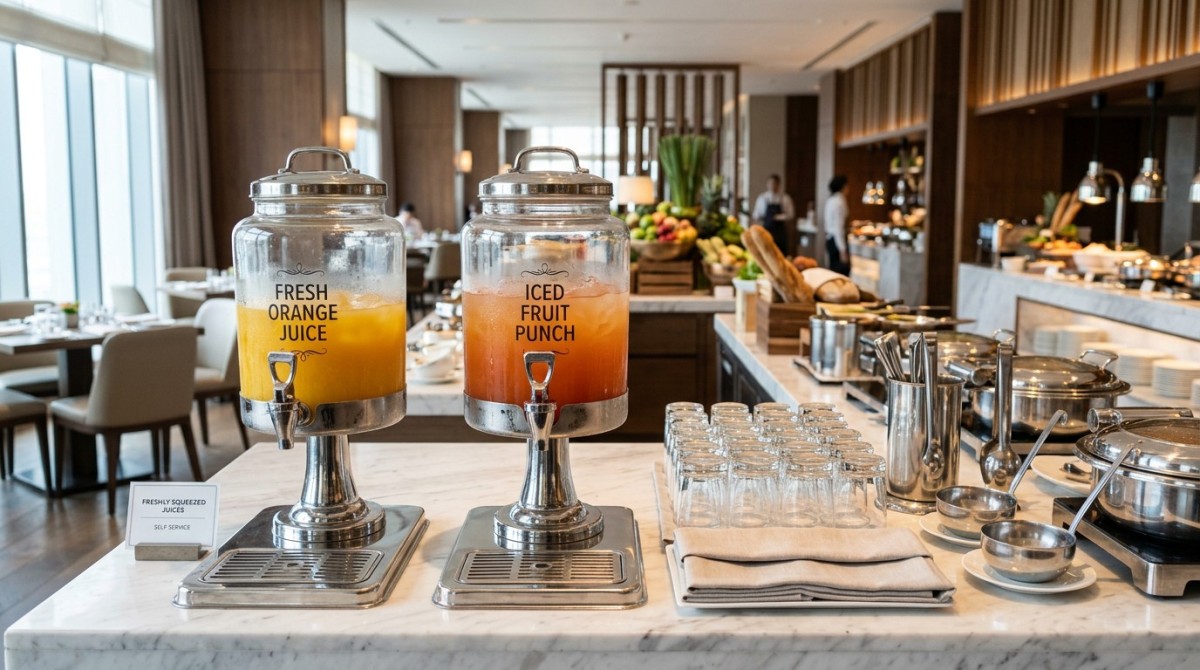
The main reason is that buyer expectations have become more demanding while market competition has intensified. A glass juice dispenser may look like a simple product, but in real-world use it affects service efficiency, beverage presentation, cleaning workflow, food safety, and replacement cost. When one supplier underperforms in any of these areas, buyers start looking elsewhere.
Several shifts are driving this change:
- Higher hygiene expectations: Hotels, restaurants, buffets, and catering businesses need dispensers that are easy to clean, resistant to odor retention, and designed to support food safety compliance.
- Pressure on operating costs: Cheap products often create more breakage, leakage, spare-part issues, and customer complaints, increasing the total cost of ownership.
- Supply chain instability: Buyers want suppliers that can maintain delivery schedules, protect goods in transit, and handle repeat orders consistently.
- Need for broader sourcing efficiency: Many procurement teams prefer suppliers that can support multiple categories, from glass juice dispensers to restaurant kitchen supplies, reducing coordination complexity.
- Brand and presentation value: End users increasingly care about table presentation and buffet appearance, especially in hospitality environments where product aesthetics matter.
In short, buyers are not shifting suppliers only because of price. They are switching because weak supplier performance now has a more visible impact on operations, customer experience, and procurement efficiency.
What problems matter most to buyers before they switch?
Different target readers focus on different risks, but their concerns usually overlap around a few practical issues.
For information researchers, the key need is understanding what signals indicate a supplier is no longer competitive. They want to know whether this shift is temporary or part of a broader market trend. They also look for clear comparison criteria instead of vague claims.
For users and operators, the biggest concerns are ease of use and durability. They care about whether the dispenser leaks, whether the tap works smoothly, whether the glass cracks under regular service conditions, and whether cleaning takes too much time. If staff struggle with maintenance, even an attractive product becomes a liability.
For procurement teams, the focus is on consistency, claim rates, lead times, packaging safety, MOQ flexibility, and responsiveness. A supplier that offers a low unit price but causes repeated shipment damage or replacement delays is often not competitive in practice.
For business decision-makers, the concern is bigger than the product itself. They want to know whether a supplier can support long-term growth, reduce sourcing risk, align with quality standards, and possibly supply adjacent categories such as stainless steel kitchen equipment and kitchen tools and utensils.
These concerns explain why buyers increasingly evaluate suppliers as strategic partners rather than simple product vendors.
Which supplier weaknesses most often trigger a change?
In many cases, buyers do not switch after a single incident. They switch after a pattern of supplier weaknesses becomes too expensive or too difficult to manage. The most common triggers include:
- Inconsistent product quality: Variation in glass thickness, lid fit, tap quality, or base stability can create operational problems and damage buyer confidence.
- Frequent transit damage: Poor export packaging is a major issue for fragile products like glass dispensers. A supplier that does not invest in protective packaging creates avoidable loss.
- Limited customization support: Buyers may need logo printing, metal stand options, different capacity sizes, or packaging tailored for retail or wholesale channels.
- Slow communication: Delayed replies during quotation, sampling, or complaint handling often indicate larger service issues later.
- Weak compliance documentation: Buyers increasingly expect material declarations, food-contact information, and quality control records.
- Poor production planning: Unstable lead times make it difficult for distributors and operators to manage seasonal demand.
- Narrow product range: If a supplier can only provide one isolated item, buyers may prefer a partner that can also support related restaurant kitchen supplies.
When several of these issues appear together, switching suppliers becomes less of a purchasing experiment and more of a risk-control decision.
How should buyers evaluate a new glass juice dispenser supplier?
A useful evaluation process should go beyond catalog photos and quotations. Buyers should assess whether the supplier can perform reliably in real commercial conditions.
Here are the most important evaluation areas:
- Product construction and usability
Check glass quality, spigot durability, sealing performance, stand stability, lid fit, and ease of disassembly for cleaning. Ask for samples and test them in realistic service environments. - Food safety and hygiene suitability
Confirm whether materials that contact beverages meet relevant food-contact requirements. Review how easy the unit is to sanitize and whether the design minimizes residue buildup. - Packaging and shipping protection
For glass products, packaging quality is critical. Ask how the supplier reduces breakage risk during long-distance shipping and whether they have historical damage-rate data. - Production capability and consistency
A good supplier should explain their quality control process, inspection standards, and batch consistency measures. This matters especially for wholesalers and multi-location operators. - Commercial flexibility
Review MOQ, sample policies, payment terms, production lead times, and how the supplier handles urgent replenishment or specification changes. - Category support
If your business also buys kitchen tools and utensils, stainless steel kitchen equipment, or other restaurant kitchen supplies, check whether the supplier can help consolidate sourcing. - After-sales responsiveness
Ask what happens if products arrive damaged, parts fail, or a shipment does not match specifications. The answer often reveals more than the quotation.
The best supplier is not always the one with the lowest price. It is usually the one that offers the strongest balance of quality, service, predictability, and category fit.
What business value do buyers gain by switching to a stronger supplier?
Changing suppliers takes time, so buyers need a clear reason. In most successful cases, the value comes from operational improvement rather than headline savings alone.
A stronger supplier can help buyers:
- Reduce hidden costs by lowering breakage rates, complaints, returns, and replacement frequency
- Improve service efficiency through better product design, smoother dispensing, and easier cleaning
- Strengthen brand presentation with better-looking dispensers for buffet lines, beverage stations, and hospitality settings
- Stabilize procurement planning with more reliable lead times and communication
- Simplify sourcing when one supplier can cover multiple restaurant kitchen supplies categories
- Support long-term scaling through customization, repeat-order consistency, and better account management
For enterprise decision-makers, this means supplier switching can improve not just purchasing performance, but also customer satisfaction, internal efficiency, and supply chain resilience.
When is the right time to switch suppliers?
Buyers often wait too long because changing suppliers feels disruptive. In reality, the right time is usually when recurring issues begin to show a pattern rather than remaining isolated exceptions.
Consider reviewing alternative suppliers if you are seeing any of the following:
- Repeated breakage or leakage complaints
- Inconsistent quality between orders
- Slow quotation or complaint response times
- Missed delivery commitments affecting operations
- Lack of support for customization or packaging improvement
- Difficulty sourcing related kitchen equipment from the same partner
- Price increases without corresponding quality or service improvement
Even if you do not switch immediately, benchmarking the market can improve your negotiating position and clarify whether your current supplier still meets today’s standards.
How can buyers make a safer supplier transition?
A well-managed transition reduces risk and helps teams compare suppliers more objectively. Instead of replacing a supplier based only on frustration, buyers should use a structured process.
A practical transition approach includes:
- Define the exact problems with the current supplier using measurable data such as damage rate, lead time variance, and complaint frequency.
- Create a short list of alternative suppliers with relevant experience in glass juice dispenser production and export handling.
- Request samples and compare them under real usage conditions, not just visual inspection.
- Audit communication speed, documentation quality, and packaging standards during the quotation phase.
- Start with a trial order before moving larger volumes.
- Review whether the new supplier can support future needs across stainless steel kitchen equipment, kitchen tools and utensils, or broader restaurant kitchen supplies.
This kind of transition process helps both procurement teams and management make a decision based on business value, not just short-term unit pricing.
Conclusion
Glass juice dispenser buyers are shifting suppliers because the purchasing decision now carries greater operational, commercial, and strategic importance. Quality consistency, food safety, packaging reliability, lead time stability, and supplier responsiveness all matter more than they did in the past. For buyers across the kitchen equipment industry, the most competitive suppliers are those that can deliver dependable products while also supporting broader sourcing needs and long-term growth.
If a supplier is creating repeated friction, hidden costs, or avoidable uncertainty, switching may be the most practical way to protect efficiency and improve results. The key is to evaluate suppliers based on total value, not just product appearance or initial price. That is where better purchasing decisions start.
Popular Tags
Kitchen Industry Research Team
Dedicated to analyzing emerging trends and technological shifts in the global hospitality and foodservice infrastructure sector.
Industry Insights
Join 15,000+ industry professionals. Get the latest market trends and tech news delivered weekly.
No spam. Unsubscribe anytime.
Contact With us
Contact:
Anne Yin (Ceramics Dinnerware/Glassware)
Lucky Zhai(Flatware)