
Stainless Steel Kitchen Equipment Supply Risks in 2026
In 2026, stainless steel kitchen equipment supply risks are no longer a background issue for procurement teams. They directly affect delivery reliability, food safety compliance, operating costs, and equipment lifecycle value. For buyers of kitchen equipment wholesale, restaurant kitchen supplies, commercial refrigerator systems, Kitchen Shelf units, and catering kitchen equipment, the biggest concern is not simply whether supply will continue, but whether the right products can be sourced on time, at a stable cost, and with consistent quality. The overall judgment is clear: supply will remain available, but volatility in stainless steel pricing, manufacturing lead times, freight conditions, certification requirements, and supplier reliability will make procurement decisions more complex than in previous years.
For researchers, operators, purchasing managers, and business decision-makers, the practical question is this: how can you reduce supply risk before it turns into delayed openings, maintenance issues, compliance failures, or budget overruns? The answer lies in evaluating supply risk as a combination of raw material exposure, supplier resilience, specification control, and logistics planning rather than treating kitchen equipment purchasing as a simple price comparison exercise.
What are the biggest stainless steel kitchen equipment supply risks in 2026?
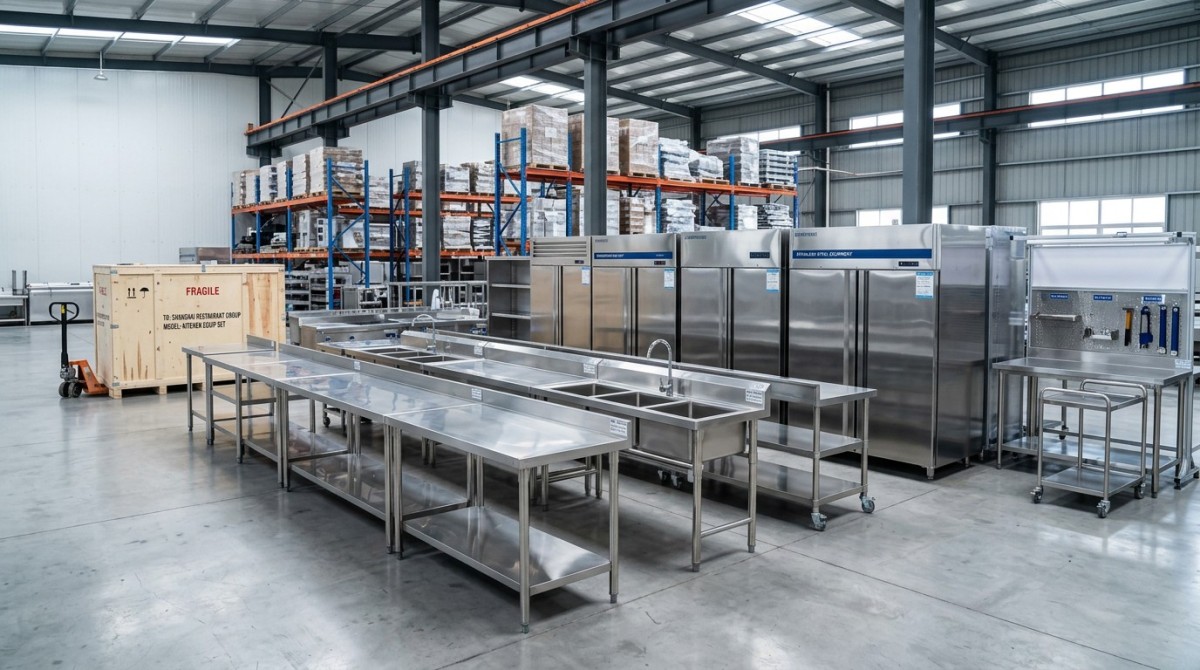
The most important supply risks in 2026 are concentrated in five areas: raw material volatility, uneven manufacturing quality, shipping and lead-time instability, regulatory compliance pressure, and supplier concentration risk. These issues affect nearly every category of stainless steel kitchen equipment, from prep tables and sinks to Kitchen Shelf systems, storage units, workstations, and integrated catering kitchen equipment.
1. Stainless steel raw material price volatility
Prices of stainless steel remain sensitive to nickel, chromium, energy costs, and global industrial demand. Even when end-market demand from restaurants or hotels appears stable, raw material fluctuations can change supplier pricing quickly. This makes budgeting difficult for buyers managing large projects, chain rollouts, or central kitchen upgrades.
2. Inconsistent grade and thickness specifications
Not all stainless steel equipment marketed as durable offers the same actual performance. Some suppliers may substitute lower grades or reduce material thickness to protect margins during volatile supply periods. For buyers, this creates hidden risk: equipment may look similar during quotation review but perform very differently in corrosion resistance, structural stability, and cleaning durability.
3. Long or unpredictable lead times
Manufacturing bottlenecks, container shortages, port congestion, and customs delays can all extend delivery schedules. For commercial kitchen projects, even a delay in one stainless steel fabrication item can affect installation sequencing for cooking lines, commercial refrigerator placement, shelving layout, and workflow commissioning.
4. Compliance and certification gaps
Foodservice operations increasingly require products that meet local hygiene, food contact, fire safety, and electrical integration standards. Imported restaurant kitchen supplies and catering kitchen equipment may face approval issues if documents are incomplete or manufacturing standards differ by market.
5. Overdependence on a small supplier base
Many businesses still rely heavily on one country, one factory group, or one trading partner. This creates serious exposure if exchange rates shift, export restrictions tighten, quality consistency drops, or the supplier prioritizes larger customers during peak demand periods.
Why do these risks matter more for commercial buyers than for casual purchasers?
For commercial buyers, stainless steel kitchen equipment is tied to revenue generation, hygiene management, labor efficiency, and operational continuity. A delayed household purchase is an inconvenience. A delayed commercial kitchen delivery can postpone a restaurant opening, disrupt a hotel renovation, or slow food processing output.
Procurement teams are also balancing more variables than before. They must compare kitchen equipment wholesale pricing, installation schedules, hygiene standards, operating environment, service access, and replacement planning. Decision-makers are not just purchasing products; they are securing business continuity.
This is especially important for high-usage environments such as:
- Restaurants with heavy daily cleaning and rapid turnover
- Hotels that require long-life, visually consistent kitchen systems
- Central kitchens that need standardized stainless steel work zones
- Food processing facilities with strict sanitary requirements
- Catering operations that depend on durable, movable, and easy-to-maintain equipment
In these settings, the wrong sourcing decision can lead to accelerated rusting, weld failure, unstable shelving, poor drainage, cleaning difficulty, and higher maintenance costs. That is why 2026 supply risks should be evaluated in terms of total business impact, not only purchase price.
What should buyers check before ordering stainless steel kitchen equipment?
To make better decisions, buyers should focus on a short list of practical checks that reveal true supply reliability.
Verify stainless steel grade
Ask whether the equipment uses 304 or 201 stainless steel, and confirm where each grade is applied. In many commercial kitchen applications, 304 is preferred for better corrosion resistance, especially in wet or demanding environments. If a supplier cannot clearly document material grade, that is an early warning sign.
Confirm thickness and structural design
For items such as Kitchen Shelf units, worktables, sinks, and storage racks, thickness affects both durability and load performance. Ask for detailed specifications, not just product photos. Reinforcement, weld quality, and support structure matter as much as appearance.
Review lead times by product category
Standard items and customized stainless steel fabrication can have very different production schedules. Buyers should separate in-stock products from made-to-order equipment and build procurement timelines accordingly.
Check certification and documentation
For imported restaurant kitchen supplies and commercial equipment, request test reports, material certificates, and compliance documents early in the process. Waiting until shipment or installation stage creates avoidable risk.
Assess supplier manufacturing capability
A supplier may offer attractive pricing but still lack scalable production, quality consistency, or export coordination. Buyers should review factory capacity, quality control systems, packaging standards, and experience in serving commercial projects.
Clarify after-sales support
Even stainless steel equipment may require replacement parts, adjustments, or technical clarification. For integrated projects involving commercial refrigerator systems, counters, shelves, and prep stations, responsive support matters more than many buyers initially expect.
How can procurement teams reduce supply risk in 2026?
The most effective strategy is to shift from reactive purchasing to structured risk-managed sourcing. That means planning purchases around reliability, flexibility, and long-term value.
1. Dual-source critical categories
If possible, avoid relying on one supplier for all stainless steel kitchen equipment. Maintaining backup sources for key items such as worktables, storage racks, sinks, and catering kitchen equipment can reduce project disruption.
2. Standardize specifications internally
Many procurement issues come from vague product definitions. Create internal standards for material grade, thickness, dimensions, load capacity, finish, and hygiene requirements. This improves quotation accuracy and reduces substitution risk.
3. Place orders earlier for project-based installations
For restaurants, hotels, and central kitchens, ordering too late creates avoidable exposure to production and shipping delays. Early procurement is especially important for custom stainless steel items and equipment that must align with refrigeration, ventilation, or utility layouts.
4. Evaluate total landed cost, not just unit price
A lower quoted price may be offset by longer lead times, higher freight costs, inconsistent quality, or greater installation rework. Buyers should compare total landed cost and expected lifecycle value.
5. Build stronger supplier communication routines
Regular updates on production progress, material availability, and shipping schedules help identify risk early. This is particularly useful when sourcing kitchen equipment wholesale across multiple product lines.
6. Prioritize suppliers with stable export experience
Suppliers familiar with international packing, documentation, and compliance processes are usually better equipped to reduce delays and claims. In 2026, execution capability is becoming as important as manufacturing capability.
Which product categories are most exposed to supply disruption?
Not all product categories face the same level of risk. In 2026, buyers should pay special attention to categories where stainless steel usage, customization, and operational dependence are highest.
Custom fabrication items
These include made-to-measure counters, sink stations, exhaust-compatible prep tables, and integrated shelving systems. They are more vulnerable because they depend on exact specifications, production scheduling, and project coordination.
High-volume structural items
Kitchen Shelf units, racks, cabinets, and storage systems may appear simple, but quality inconsistency can create load-bearing and hygiene problems. These items are often ordered in larger quantities, increasing the impact of any defect or delay.
Combined equipment packages
Projects that bundle stainless steel tables, commercial refrigerator units, sinks, trolleys, and restaurant kitchen supplies into one procurement package face more coordination risk. A delay in one category can affect the entire installation timeline.
Specialized catering kitchen equipment
Mobile, modular, or heavy-duty catering equipment may involve more complex fabrication and transport requirements. Buyers should expect greater variation in lead times and packaging standards.
How should decision-makers balance cost, quality, and resilience?
The most practical approach is to treat stainless steel kitchen equipment as an operational asset rather than a commodity purchase. The cheapest option may work for light-duty use, but in commercial environments, poor durability or unreliable delivery often creates higher long-term cost.
Decision-makers should ask three business-focused questions:
- Will this sourcing choice reduce the risk of operational disruption?
- Will the equipment maintain hygiene, durability, and appearance over time?
- Does the supplier provide enough transparency to support planning and accountability?
If the answer is uncertain, the procurement risk is usually higher than the quotation suggests. In 2026, resilient sourcing means choosing suppliers and specifications that protect uptime, food safety, and replacement cost control.
For enterprise buyers, a slightly higher initial investment can often deliver better returns through longer service life, fewer maintenance interventions, and lower replacement frequency. This matters across restaurant groups, hotel chains, institutional kitchens, and food production environments.
What is the outlook for stainless steel kitchen equipment supply in 2026?
The outlook is not defined by shortage alone, but by selective instability. The market for kitchen equipment wholesale and global restaurant kitchen supplies will remain active, and major manufacturing countries will continue to supply international demand. However, buyers should expect continued pressure from pricing adjustments, uneven supplier quality, longer planning cycles, and stricter compliance expectations.
In other words, supply will still exist, but low-risk supply will be harder to secure without preparation. Companies that rely on rushed purchasing, unclear specifications, or single-source dependency will face greater exposure. Those that strengthen supplier evaluation, internal standards, and purchasing timelines will be better positioned to control cost and maintain continuity.
Stainless steel kitchen equipment supply risks in 2026 should be viewed as a procurement management issue, not just a market trend. For buyers, operators, and business leaders, the most useful response is to focus on verified material quality, supplier stability, lead-time planning, and compliance readiness. Whether sourcing Kitchen Shelf systems, commercial refrigerator support equipment, restaurant kitchen supplies, or complete catering kitchen equipment packages, the goal is the same: reduce uncertainty before it affects operations. The businesses that make better sourcing decisions now will be in a stronger position to protect budgets, maintain food safety standards, and support long-term kitchen performance.
Popular Tags
Kitchen Industry Research Team
Dedicated to analyzing emerging trends and technological shifts in the global hospitality and foodservice infrastructure sector.
Industry Insights
Join 15,000+ industry professionals. Get the latest market trends and tech news delivered weekly.
No spam. Unsubscribe anytime.
Contact With us
Contact:
Anne Yin (Ceramics Dinnerware/Glassware)
Lucky Zhai(Flatware)