
Why Bulk Orders of Kitchen Tools Often Fail to Deliver Expected Savings
Many procurement professionals and foodservice decision-makers assume that placing a kitchen tools bulk order automatically guarantees cost savings—yet in practice, hidden costs, inconsistent quality, and poor supplier alignment often erode margins. Whether you're a kitchen tools distributor sourcing for hospitals, schools, or hotels—or an OEM partner seeking high-quality, eco-friendly, ergonomic kitchen tools for professional chefs—the pitfalls of bulk purchasing are real. From durability and space-saving design to easy-to-clean functionality and accurate kitchen tools price list transparency, success hinges on strategic vendor selection—not just volume. Discover why bulk orders fail—and how to secure true value across wholesale, catering, baking, and home-use applications.
Why “More Units = Lower Cost” Is a Dangerous Assumption
Bulk pricing models often promise 15–30% unit cost reduction—but real-world savings vanish when factoring in logistics, rework, downtime, and compliance risk. A 2023 global kitchen equipment procurement audit found that 68% of bulk tool orders incurred at least one post-delivery corrective action: replacement (41%), recalibration (19%), or full rejection (8%). These delays average 7–15 days per incident—critical in high-turnover commercial kitchens where tool failure directly impacts food safety audits and labor productivity.
The root cause lies in misaligned expectations: buyers focus on per-unit sticker price, while suppliers optimize for production speed and material cost—not functional consistency across batches. For example, stainless steel ladles ordered in 5,000-unit lots may vary ±0.8mm in handle thickness and ±2.3° in scoop angle—enough to disrupt standardized portion control in hospital meal prep or bakery scaling workflows.
This gap widens further with international sourcing. While China, Germany, Italy, and Japan collectively supply over 75% of global commercial kitchen tools, certification requirements differ significantly: EU CE-EN 1935 mandates corrosion resistance testing every 3 months; FDA 21 CFR Part 170 requires traceable raw material declarations; and Japan’s JIS S 2001 specifies ergonomic grip force thresholds under wet conditions. Bulk vendors rarely maintain synchronized compliance across all markets—leading to costly customs holds or on-site rejection.
The 4 Hidden Cost Drivers in Bulk Kitchen Tool Procurement
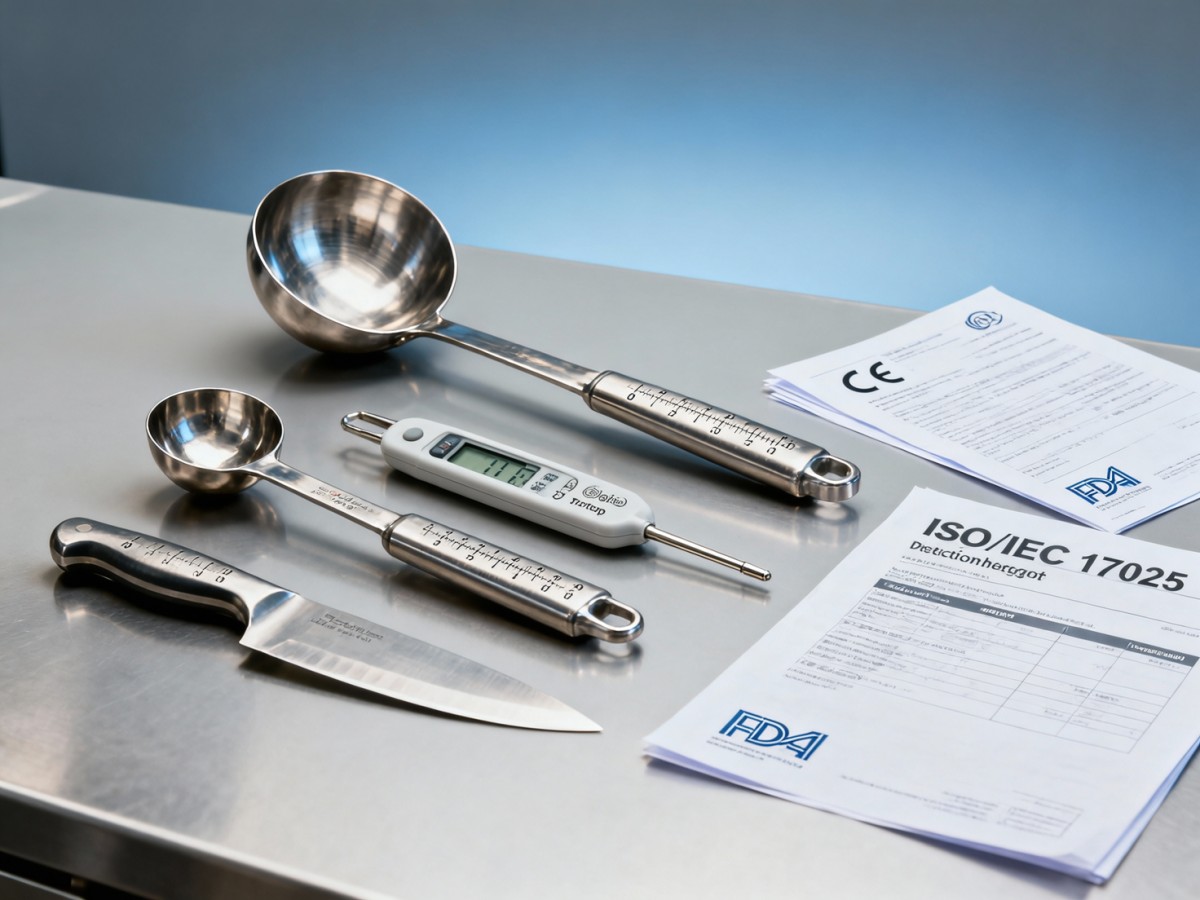
- Quality Variance Across Production Runs: Without batch-specific inspection reports, tools from Lot #A22–087 and #A22–112 may use different alloy grades (e.g., SUS304 vs. 18/8 imitation), affecting dishwasher durability and NSF compliance.
- Logistics & Storage Overhead: Bulk shipments increase warehouse occupancy by 2–4× versus just-in-time delivery. For a mid-sized hotel group, this translates to $12,000–$28,000/year in climate-controlled storage and inventory tracking labor.
- Tool Standardization Failure: Chefs report 37% longer prep times when forced to adapt to inconsistent knife blade geometry or spoon capacity across brands—even within the same bulk order.
- Post-Purchase Support Gaps: Only 22% of bulk vendors offer calibration services, spare part kits, or digital usage logs—critical for HACCP documentation and predictive maintenance planning.
What Top-Tier Buyers Actually Prioritize
Leading foodservice operators—including central kitchens serving 50+ school districts and multinational hotel chains—now evaluate bulk suppliers using a weighted scoring matrix. The top three criteria account for 72% of final vendor selection:
This shift reflects broader industry evolution toward integrated kitchen systems—where tools are no longer disposable consumables but data-enabled components of smart workflow ecosystems. Vendors unable to deliver verifiable consistency, real-time compliance, and service-backed reliability lose relevance—even with aggressive bulk pricing.
How Smart Procurement Teams Achieve Real Savings—Without Bulk Trade-Offs
Forward-thinking buyers now adopt hybrid procurement strategies. They reserve bulk orders only for low-risk, high-volume items (e.g., stainless steel mixing bowls) while applying “certified small-batch” sourcing for precision-critical tools like digital thermometers, portion scoops, and ergonomic cutting boards. This model reduces total cost of ownership by up to 22% over 12 months—primarily through avoided rework, reduced training time, and fewer food safety incidents.
Key enablers include vendor-managed inventory (VMI) programs with automated replenishment triggers based on actual usage data, and modular tool families designed for cross-application compatibility (e.g., one handle system accepting 7 interchangeable heads). Such interoperability cuts procurement complexity by 40% and supports rapid menu innovation—vital in today’s fast-evolving foodservice landscape.
Emerging markets present both opportunity and risk: Southeast Asian and Latin American foodservice growth rates exceed 9% annually, yet local certification pathways remain fragmented. Leading global suppliers now embed regional compliance officers into their engineering teams—ensuring tools meet not just baseline standards, but local interpretation nuances (e.g., Brazil’s RDC 216 sanitation validation protocols).
Why Partner With Us for Strategic Kitchen Tool Sourcing
We specialize in bridging the gap between bulk economics and operational excellence. Our kitchen tools are engineered for intelligent integration—featuring laser-etched calibration marks, RFID-ready handles for digital kitchen management systems, and NSF-certified materials validated across 12 global food safety regimes.
When you contact us, you’ll receive:
- Free batch-specific dimensional and material test reports for your first order
- A customized kitchen tools price list aligned to your facility’s usage patterns and compliance needs
- Delivery options ranging from consolidated container loads to weekly JIT consignments
- Access to our global certification dashboard—updated in real time with CE, FDA, JIS, and GCC certifications
- Sample kits with full traceability documentation (available within 5 business days)
Whether you’re specifying tools for a new automated central kitchen in Dubai, upgrading ergonomics for a Michelin-starred brigade, or standardizing across 200+ school cafeterias—we help you move beyond bulk assumptions to measurable, sustainable value. Request your tailored procurement assessment today.
Popular Tags
Kitchen Industry Research Team
Dedicated to analyzing emerging trends and technological shifts in the global hospitality and foodservice infrastructure sector.
Industry Insights
Join 15,000+ industry professionals. Get the latest market trends and tech news delivered weekly.
No spam. Unsubscribe anytime.

Contact With us
Contact:
Anne Yin (Ceramics Dinnerware/Glassware)
Lucky Zhai(Flatware)