Restaurant supplies OEM: where hidden costs usually appear
In restaurant supplies OEM projects, hidden costs often surface long after the quoted unit price is approved. For financial decision-makers, expenses tied to tooling changes, compliance, packaging, logistics, after-sales service, and production delays can significantly affect total procurement value. Understanding where these costs usually appear helps control budgets, reduce risk, and improve long-term supplier decisions.
For finance approvers, a checklist-based review is more useful than a price-only comparison because restaurant supplies OEM cost overruns rarely come from one dramatic issue. They usually accumulate through small omissions in specifications, testing, lead time planning, freight assumptions, or warranty terms. In the kitchen equipment industry, where products may serve restaurants, hotels, central kitchens, food processing sites, and retail channels, these omissions can quickly turn an acceptable quotation into an underperforming procurement decision.
The practical goal is simple: before approving a supplier, identify which expenses are already included, which are variable, and which are likely to appear later as exceptions. This guide focuses on the most common hidden-cost areas in restaurant supplies OEM, the checks that matter most, and the questions finance teams should ask before releasing budget.
Why finance teams should review restaurant supplies OEM with a total-cost checklist
In restaurant supplies OEM sourcing, the quoted ex-factory price is only one part of total procurement cost. Commercial kitchen equipment and related restaurant supplies often involve product customization, electrical or food-contact compliance, export packaging, spare parts planning, and region-specific labeling. Each of these areas can introduce charges that are not obvious during the first quotation round.
A checklist helps finance decision-makers compare suppliers on a like-for-like basis. Instead of asking which supplier offers the lowest unit cost, the better question is which supplier offers the lowest landed and managed cost over the full project cycle. This is especially important when sourcing from major manufacturing hubs where cost structures differ by tooling capability, compliance readiness, automation level, and after-sales support depth.
The core hidden-cost checklist: what to confirm before approval
Use the following checklist as a first-pass filter in any restaurant supplies OEM review. Each point should be verified in writing, not assumed from a quotation sheet.
- Tooling and mold changes: Confirm whether initial tooling is included, partially subsidized, or billed separately. Ask who pays for future design revisions, replacement molds, wear-related repairs, and sample-stage modifications.
- Compliance and certification: Check whether testing for food-contact materials, electrical safety, energy efficiency, or regional certifications is included. Hidden costs often appear when a product must meet different standards for different markets.
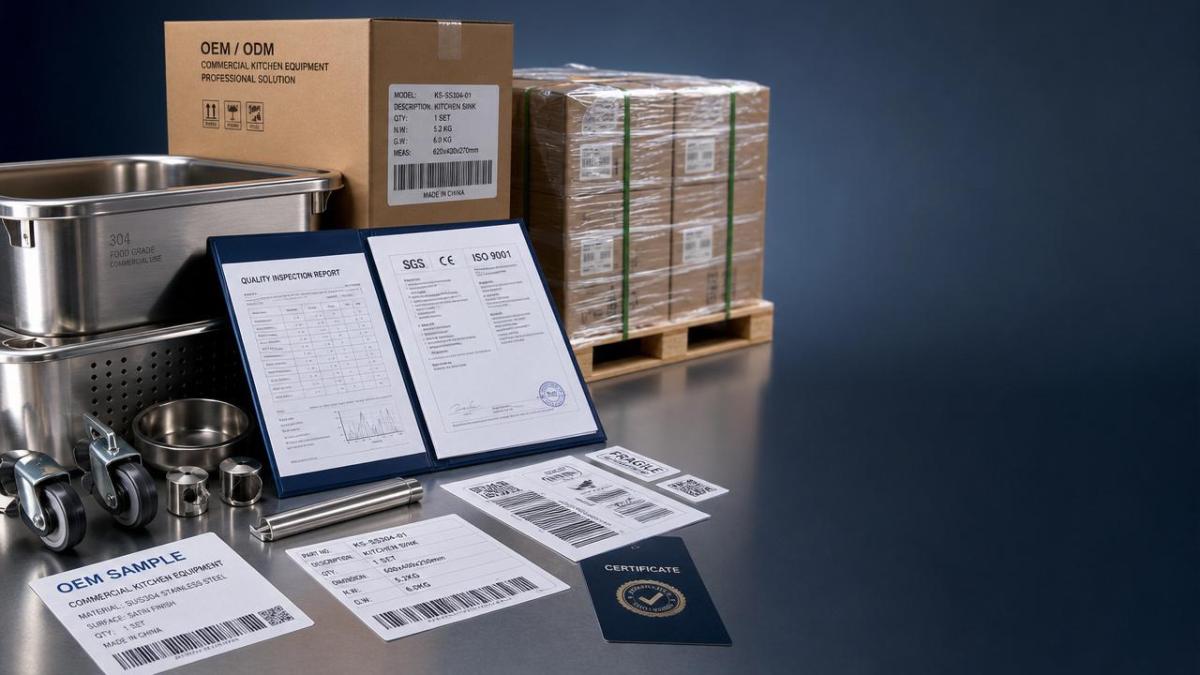
- Packaging specifications: Verify carton strength, pallet requirements, retail-ready packaging, barcode labels, manuals, and multilingual artwork. Small packaging upgrades can materially affect total cost in restaurant supplies OEM projects.
- Minimum order quantity and mixed-SKU rules: A low unit price may depend on order volume thresholds that do not match real demand. Clarify MOQ by model, color, voltage, accessory bundle, and replacement-part package.
- Freight assumptions: Identify whether the quote is EXW, FOB, CIF, or DDP, and whether inland transport, port congestion, demurrage, insurance, and fuel surcharges are excluded.
- Quality control scope: Confirm if in-line inspection, final inspection, third-party audits, and pre-shipment testing are included. If not, quality assurance becomes an external cost or a future failure cost.
- Warranty and spare parts: Ask who covers replacement units, repair labor, technical support, and urgent spare-part shipments. Warranty wording in restaurant supplies OEM contracts is often too general.
- Lead time risk: Clarify whether quoted lead times include sample approval, raw material shortages, holiday shutdowns, and peak-season factory loading.
A supplier that clearly documents these items is usually easier to manage financially than one that offers a lower base price but leaves exceptions open.
Where hidden costs usually appear in restaurant supplies OEM projects
1. Product development and engineering changes
Many OEM buyers underestimate the cost impact of “small” specification changes. In kitchen equipment and restaurant appliances, a handle redesign, thermostat adjustment, stainless steel grade change, power-plug variation, or digital control update may trigger new drawings, new components, fresh testing, or slower production. Finance teams should ask whether engineering change notices are free within a limited range or billed by event.
2. Material substitution and quality drift
Some hidden costs do not appear as invoices; they appear as claims, returns, or reduced equipment life. If a supplier substitutes insulation, coatings, motors, seals, or food-contact plastics due to price fluctuations, the downstream cost may exceed any initial savings. Financial approvers should require a locked bill of materials, approved alternative material procedures, and penalties for unapproved substitutions.
3. Certification gaps across export markets
The kitchen equipment sector serves multiple regions with different rules. A product acceptable in one country may need additional electrical, sanitation, energy, or food-safety documentation elsewhere. Hidden cost appears when a shipment is ready but certification is incomplete, forcing retesting, relabeling, storage, or delayed launch. In restaurant supplies OEM, compliance should be budgeted as a project line item, not treated as a minor document task.
4. Packaging, branding, and retail presentation
Restaurant supplies sold through distributors, e-commerce, or branded foodservice channels often need more than plain export cartons. Inner protection, drop-test performance, logo printing, QR labels, instruction manuals, and country-specific warnings all affect cost. Artwork revisions are another common source of repeated fees and approval delays. Finance teams should review packaging samples early, especially when products include glass, electronics, or precision components.
5. Logistics and inventory timing
Freight volatility remains one of the most underestimated expense categories. Even if the supplier quote looks stable, total landed cost can shift through container utilization inefficiency, split shipments, expedited replenishment, customs handling, and local warehousing. In restaurant supplies OEM, poor forecast alignment often creates airfreight events for missing accessories or replacement parts. These emergency shipments can erase margin quickly.
6. After-sales support and field failure response
Commercial kitchen buyers care about uptime. If the OEM supplier lacks spare-parts planning, troubleshooting documentation, or technical response standards, the importer or brand owner absorbs the support burden. The hidden cost is not only parts replacement; it includes service coordination, reputation risk, and customer compensation. For restaurant supplies OEM, after-sales terms should define response time, root-cause analysis process, and replacement responsibility.
A practical review table for financial approval
Before approving a supplier, use a simple decision table to compare visible and hidden cost exposure.
What changes by buyer type and sourcing scenario
Not every restaurant supplies OEM project carries the same cost profile. Finance teams should adjust their checklist depending on business model and channel.
For distributors and importers
Focus on packaging durability, spare-parts availability, and multi-market compliance. Distributor costs rise when one product line needs different manuals, plugs, labels, or certifications across countries.
For private-label brands
Branding, artwork control, and product consistency matter most. Hidden costs often come from design change cycles, intellectual property safeguards, and batch-to-batch visual differences that lead to rejected inventory.
For project-based hospitality buyers
Delivery timing and installation readiness are critical. A late shipment in a hotel or restaurant opening project creates indirect costs far beyond the equipment itself, including contractor idle time and launch delay.
Commonly ignored warning signs in restaurant supplies OEM
- The quotation is detailed on unit price but vague on packaging, testing, and warranty.
- Samples look acceptable, but there is no signed mass-production specification.
- The supplier promises short lead times without confirming component availability.
- There is no defined process for handling defect rates, returns, or replacement freight.
- Payment terms appear attractive, but hidden setup charges are listed outside the main quotation.
- The supplier has manufacturing capability but weak export documentation support.
Each of these signs suggests that restaurant supplies OEM cost may rise later through exceptions, claims, or project friction.
Execution advice: how to reduce hidden cost before signing
A strong approval process does not need to be slow. It needs to be specific. Finance approvers can reduce risk by requiring a cost-breakdown attachment, a specification lock document, a compliance matrix by destination market, and a written after-sales responsibility chart. These four documents often reveal more than a polished quotation.
It is also useful to run one scenario analysis before final approval: what happens if demand drops below MOQ, if one certification fails, if one shipment is split, or if defect rate exceeds target? In restaurant supplies OEM, scenario-based review helps convert procurement uncertainty into manageable budget ranges.
Where possible, build approval around total landed cost per sellable unit rather than ex-factory cost per manufactured unit. This approach aligns better with how commercial kitchen equipment actually creates financial outcomes in distribution and project channels.
FAQ for finance decision-makers
Is the lowest quote usually the cheapest restaurant supplies OEM option?
Not necessarily. The lowest quote may exclude tooling revision, compliance testing, stronger packaging, spare parts, or quality inspections. Total cost frequently becomes higher after launch.
Which hidden cost should be checked first?
Start with specification clarity, compliance scope, and logistics terms. These three areas most often trigger downstream charges and delivery disruption.
How can finance teams compare suppliers more accurately?
Ask each supplier to complete the same cost checklist and identify all exclusions in writing. Standardized comparison is more reliable than reviewing differently formatted quotations.
Final decision guide and next-step questions
A well-managed restaurant supplies OEM project is not defined by a low opening price. It is defined by cost visibility, quality consistency, delivery reliability, and manageable after-sales exposure. For financial approval, the most effective method is to confirm which costs are fixed, which are conditional, and which depend on volume, market, packaging, or service assumptions.
Before moving forward, prioritize these questions with the supplier: What exact specifications are locked? Which certifications are included for each target market? What packaging standard is priced? What warranty cost is shared or excluded? What happens if lead time slips or defects exceed tolerance? Clear answers to these questions will improve budget control, reduce procurement surprises, and support better long-term restaurant supplies OEM decisions.
Popular Tags
Kitchen Industry Research Team
Dedicated to analyzing emerging trends and technological shifts in the global hospitality and foodservice infrastructure sector.
Industry Insights
Join 15,000+ industry professionals. Get the latest market trends and tech news delivered weekly.
No spam. Unsubscribe anytime.
Contact With us
Contact:
Anne Yin (Ceramics Dinnerware/Glassware)
Lucky Zhai(Flatware)