
Bakery Worktable details that affect daily efficiency
A Bakery Worktable may look simple, but the right details can make a major difference in daily speed, hygiene, and operator comfort. From surface material and storage design to mobility and cleaning efficiency, every feature affects how smoothly baking tasks are completed. Understanding these practical factors helps users choose a worktable that supports consistent performance and reduces unnecessary workload.
For operators in bakeries, pastry rooms, hotel kitchens, and central production spaces, the worktable is not just a flat surface. It is the center of prep, shaping, temporary storage, and cleaning coordination. A poorly designed Bakery Worktable can add dozens of unnecessary movements per hour, increase sanitation risk, and create fatigue over a full 8–12 hour shift.
In the broader kitchen equipment industry, where efficiency, food safety, and ergonomic design are becoming decisive purchasing factors, even simple stainless-steel furniture now requires more careful evaluation. Users increasingly look beyond price and ask practical questions: Is the surface suitable for dough work? Can it handle 150–300 kg loads? Is the undershelf useful or just hard to clean? Can one table support multiple tasks without slowing the team down?
This article explains the Bakery Worktable details that most directly affect daily efficiency, including materials, dimensions, storage, mobility, hygiene, and maintenance. It is written for operators and decision-makers who need a reliable, practical reference before selecting or upgrading bakery workstations.
Why small Bakery Worktable details matter in daily production
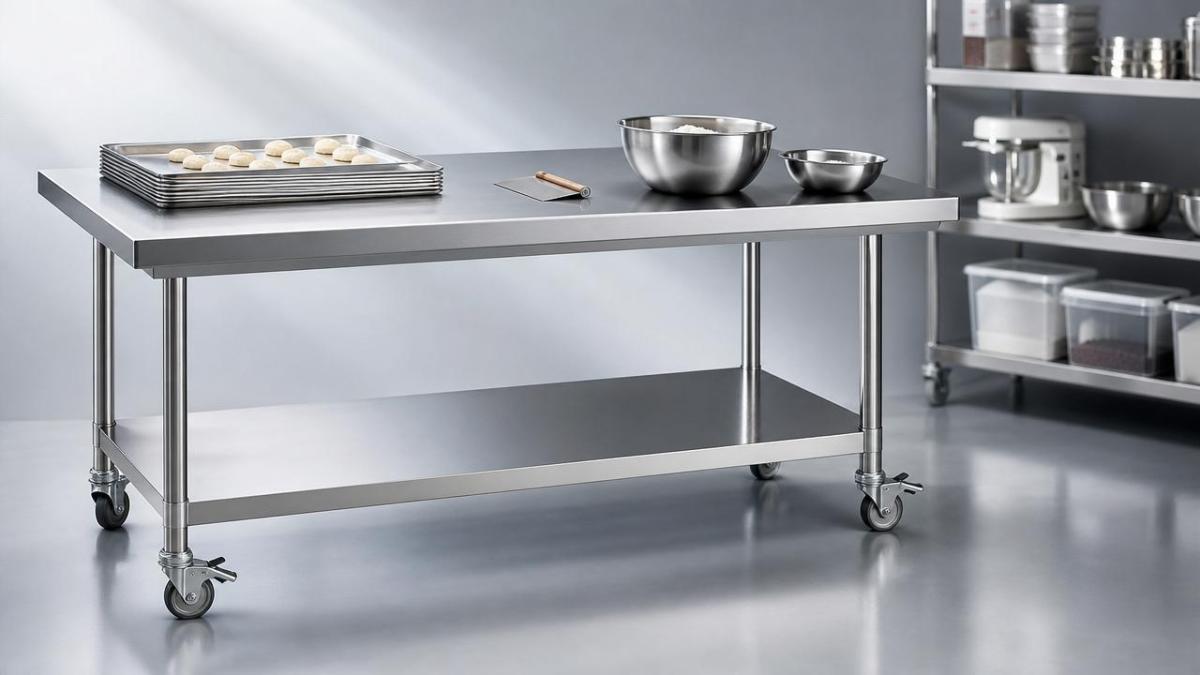
In many bakery workflows, the same table may be used for scaling ingredients, kneading dough, shaping pastries, resting trays, or packing finished items. When one station supports 4–6 process steps, minor design flaws quickly become major efficiency losses. A surface that stains easily, a shelf that blocks foot space, or a frame that vibrates under pressure can interrupt production throughout the day.
A practical Bakery Worktable should support three daily goals at the same time: stable operation, fast cleaning, and reduced operator strain. If it performs well in only one area, the total workflow still suffers. For example, a strong frame with poor surface finish may survive heavy use but slow down sanitation between batches.
Movement, reach, and task repetition
In a busy bakery, operators may repeat the same hand movement hundreds of times per shift. If a tool shelf is too low, flour bins are stored too far away, or tray placement requires turning more than 90 degrees, the delay accumulates. Saving even 3–5 seconds per repetitive task can produce measurable gains over 200 or 300 cycles in one day.
The best layout usually keeps the most-used items within an arm’s reach of 40–60 cm. Ingredients used less frequently can be placed on lower shelves or nearby racks. This is why worktable design should be considered together with surrounding bakery equipment, not as a standalone purchase.
Hygiene pressure in commercial environments
Bakery production involves flour dust, butter, cream, fillings, sugar syrup, and raw dough residue. These create a different sanitation profile from standard hot kitchens. Tables with rough welds, sharp corners, or open joints tend to trap particles. Over 1–2 weeks of heavy use, those small retention points can increase cleaning time and inspection risk.
For operators, smooth edges, easy-drain surfaces, and accessible undershelf areas are often more important than decorative finish. A Bakery Worktable that takes 6 minutes to clean instead of 12 minutes can save substantial labor time when cleaning is repeated several times per shift.
Typical operational pain points
- Table height causes shoulder or wrist strain after 2–3 hours of dough work.
- Surface scratches hold flour and fat residue, increasing sanitation effort.
- Unstable legs create vibration during rolling, cutting, or portioning.
- Storage shelves are present, but not designed for real tray, bin, or utensil sizes.
- Casters improve movement, but poor locking systems reduce safety during use.
The table below compares several common worktable details and their direct effect on daily bakery operations. This helps users connect product features with real production outcomes rather than evaluating on appearance alone.
The key takeaway is simple: daily efficiency is rarely determined by one feature alone. The most effective Bakery Worktable is the one that reduces movement, supports sanitation, and remains stable during continuous production. A strong purchase decision starts with workflow analysis, not just material thickness.
Core design features that improve bakery efficiency
When selecting a Bakery Worktable, users should evaluate design details based on workload, product type, and cleaning frequency. A pastry station for fine decoration has different requirements from a dough prep table in a high-volume bread line. In most commercial environments, however, six design factors consistently influence performance.
1. Surface material and top construction
Stainless steel remains the most common choice because it balances hygiene, durability, and compatibility with commercial kitchen cleaning routines. For bakery use, the quality of the finish matters as much as the base material. A smoother top reduces residue build-up and is easier to wipe down between tasks.
Operators should also consider whether the top needs reinforcement. Tables used for mixing bowl support, dough pressing, or heavy tray stacking often benefit from stronger understructure. In practical terms, load capacity in the 150–300 kg range suits many bakery tasks, while heavier production zones may require more.
2. Dimensions and workstation fit
An oversized table can crowd the room and slow circulation. An undersized one forces operators to stack trays vertically or split one process across multiple stations. Common table depths such as 600 mm, 700 mm, or 800 mm work differently depending on whether the table is mainly for dough handling, tray staging, or packing.
Height is equally important. Around 850–900 mm is often suitable for standing prep, but this should be matched to the user group and task type. Delicate pastry finishing may require a slightly different working posture than heavy dough pressing. If multiple operators share the same station over 2 shifts, ergonomic compromise becomes even more important.
3. Storage configuration under the table
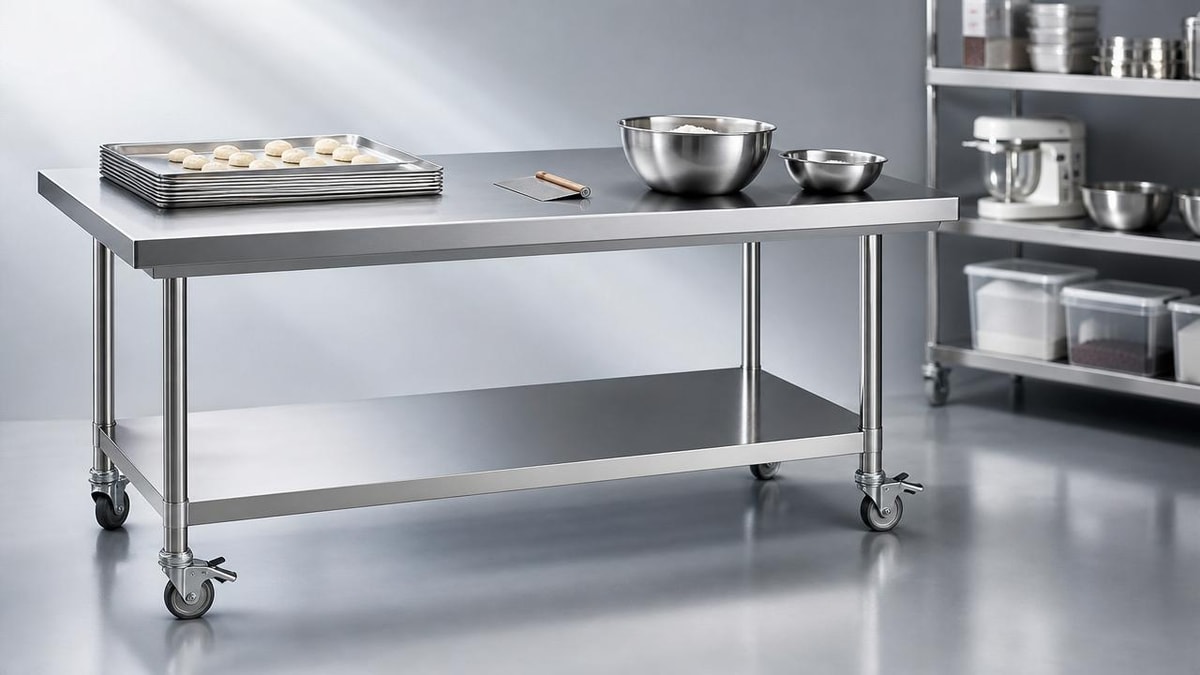
A Bakery Worktable with an undershelf can reduce unnecessary walking, but only if the storage layout fits real tools and containers. Shallow shelves are useful for trays and parchment, while deeper areas may better suit ingredient bins or mixing bowls. Drawers can improve organization for smaller tools, scrapers, piping accessories, and thermometers.
However, too much built-in storage can create cleaning blind spots. Operators should check if the shelf is raised enough for mopping access and whether corners are easy to wipe. In high-sanitation operations, open and accessible storage often performs better than enclosed but awkward compartments.
4. Mobility versus fixed stability
Some bakeries need fixed workstations for consistent line flow, while others prefer mobile tables that can be repositioned for seasonal peaks, cleaning, or process changes. Casters can be valuable in spaces where one room must support prep in the morning, decorating in the afternoon, and packing in the evening.
The trade-off is stability. If the table moves slightly during rolling or cutting, operators may lose speed and precision. For this reason, high-quality brakes and frame strength are essential. A mobile Bakery Worktable should feel almost as stable as a fixed one once locked in place.
Common feature priorities by application
The next table shows how feature priorities change depending on the bakery task. This helps users avoid choosing a general-purpose table when a task-specific setup would perform better.
This comparison shows that the best Bakery Worktable depends on process demands. Users should start with the dominant task and then choose the design that removes the biggest bottlenecks in that workflow.
How to choose the right Bakery Worktable for operators
A good purchasing process should be simple, but not superficial. Operators and supervisors can usually identify the right worktable by checking a short list of practical criteria. This is especially important in growing bakeries, hotels, foodservice kitchens, and food processing rooms where one table may stay in service for 3–8 years.
Step-by-step evaluation points
- Define the main task: dough prep, assembly, decorating, or packing.
- Measure available space, including aisle width and tray movement paths.
- Check required load capacity based on bowls, trays, bins, and small equipment.
- Review cleaning routine: dry wipe, wet wash, sanitizer use, and frequency per shift.
- Confirm whether mobility is necessary or if a fixed station is better.
- Evaluate storage based on actual utensils and ingredient containers, not assumptions.
This 6-point approach reduces the chance of buying a table that looks suitable on paper but performs poorly in production. It also helps connect bakery furniture selection with broader kitchen equipment planning, including racks, mixers, proofing areas, and packaging lines.
Questions operators should ask before purchase
Will the table support the real workload?
A Bakery Worktable used only for light pastry assembly does not need the same structural strength as one supporting heavy dough bins or countertop machines. Ask for practical load guidance, not just a general product description. If the work area handles dense dough or stacked trays, frame rigidity matters immediately.
Can it be cleaned fast enough for your schedule?
If the area is cleaned 3 times per shift, design flaws have a multiplied cost. Check corners, joints, shelf spacing, and wheel access. A table that saves 5 minutes per cleaning cycle can save 15–20 minutes per day in active operations.
Does it match surrounding equipment?
The table should align with tray sizes, ingredient bins, nearby racks, and operator movement direction. If the station sits beside ovens, proofers, refrigerators, or packaging benches, height and access should support smooth transitions. Good integration often matters more than choosing the heaviest specification available.
Common selection mistakes
- Buying based only on top size without checking aisle clearance.
- Choosing mobile casters for every table even where fixed stability is more useful.
- Ignoring cleaning access under shelves and around leg braces.
- Adding drawers that interfere with operator leg space.
- Selecting a standard table for specialized pastry tasks that need finer organization.
In commercial kitchen and bakery environments, efficiency comes from the fit between equipment and workflow. The right Bakery Worktable should reduce extra handling, limit contamination risk, and make repetitive tasks less physically demanding for the people using it every day.
Maintenance, lifespan, and long-term value
Even a well-designed Bakery Worktable will lose efficiency if maintenance is inconsistent. Daily wiping, weekly inspection of joints and shelves, and periodic checks on caster brakes or leveling feet are simple steps, but they protect both hygiene performance and service life.
In many bakery environments, the table is exposed to moisture, acidic ingredients, sugar residue, flour accumulation, and repeated impact from bowls or trays. A maintenance routine every 7 days for structural checks and every 1–3 months for deeper inspection is a practical standard for heavily used stations.
Practical upkeep checklist
- Wipe and sanitize the top after each production phase.
- Remove flour and grease from undershelves before build-up becomes compacted.
- Check weld areas and corners for residue traps or surface damage.
- Test caster locks or leveling stability at least once per week.
- Review whether storage use has changed and created clutter or unsafe loading.
When replacement or upgrading makes sense
Replacement is worth considering when cleaning time keeps increasing, the frame becomes unstable, or workflow changes make the original design unsuitable. For example, a bakery moving from artisanal batches to semi-standardized production may need larger surfaces, better mobility, or more structured storage.
Because the kitchen equipment sector is moving toward more efficient and integrated workspaces, users should also view furniture as part of process optimization. Upgrading one Bakery Worktable in the right location can improve flow between mixers, ovens, racks, and packaging points without major renovation.
A Bakery Worktable influences far more than bench space. The right surface, height, storage layout, and cleaning accessibility can improve speed, reduce operator fatigue, and support better hygiene every single day. For bakeries, hotel pastry sections, and foodservice production rooms, these details directly affect consistency and labor efficiency.
If you are comparing options for a new facility or replacing an underperforming station, focus on real workflow demands rather than basic dimensions alone. Choose a Bakery Worktable that matches task type, cleaning frequency, and operator movement patterns. To get a practical recommendation, customized specification advice, or more kitchen equipment solutions, contact us today and discuss your working requirements in detail.
Popular Tags
Kitchen Industry Research Team
Dedicated to analyzing emerging trends and technological shifts in the global hospitality and foodservice infrastructure sector.
Industry Insights
Join 15,000+ industry professionals. Get the latest market trends and tech news delivered weekly.
No spam. Unsubscribe anytime.
Contact With us
Contact:
Anne Yin (Ceramics Dinnerware/Glassware)
Lucky Zhai(Flatware)