
Restaurant Kitchen Equipment Specifications That Get Overlooked
In commercial foodservice, the most expensive equipment mistakes are often not dramatic failures but small specification details missed during planning or purchasing. A range may fit the menu but overload the ventilation system. A sink may meet basic needs but fail local sanitation workflow. Stainless steel may look identical at delivery but behave very differently after years of heat, chemicals, and cleaning. If you are comparing restaurant kitchen equipment, the real question is not only “What does this machine do?” but “What specifications will affect safety, compliance, labor efficiency, and future operating cost?”
For restaurant operators, kitchen staff, buyers, and business decision-makers, overlooked specifications usually show up later as bottlenecks: cramped prep zones, difficult cleaning, grease buildup, utility upgrades, code issues, and avoidable maintenance. These are not minor technicalities. They directly affect ticket speed, food safety, downtime, and the cost of ownership over the life of the kitchen.
This guide focuses on the restaurant kitchen equipment specifications that are most often underestimated during selection and layout planning. Instead of repeating generic buying advice, it highlights the details that help you judge practical value: restaurant kitchen stainless steel grades, hood capacity, sink dimensions, counter depth, utility loads, cleaning clearance, storage compatibility, and layout coordination. If you want a kitchen that performs well on opening day and still works efficiently years later, these are the specifications worth checking closely.
Why overlooked specifications become expensive later
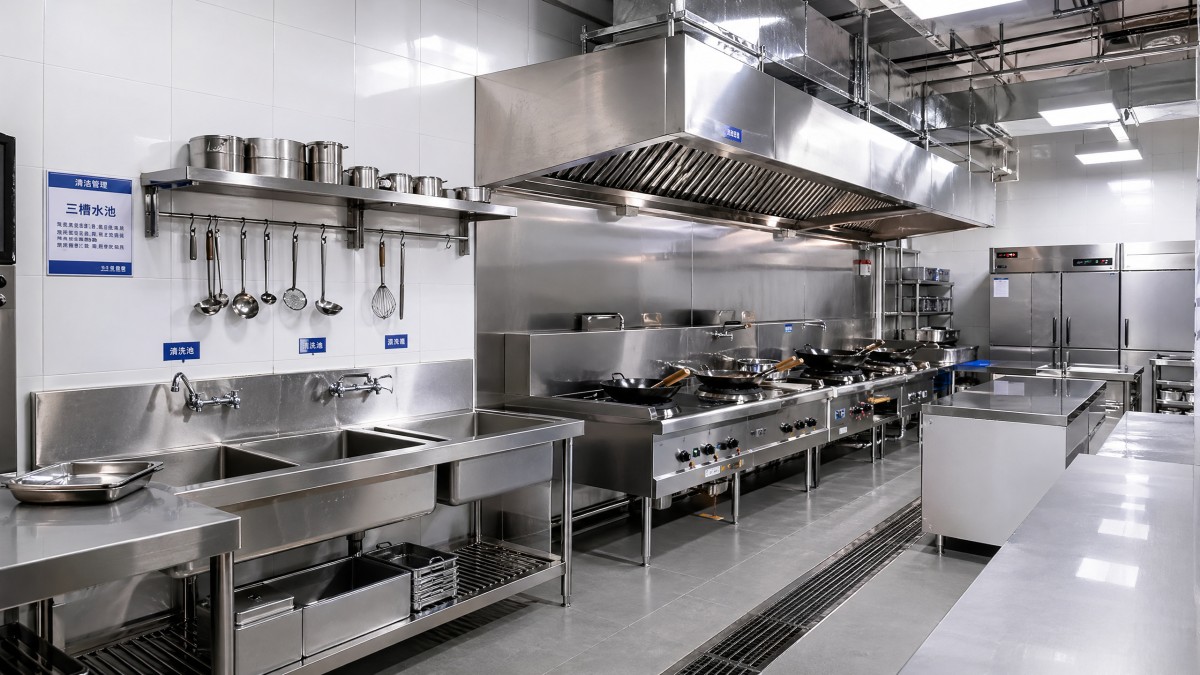
Many buyers review capacity, price, brand, and external dimensions first. Those are important, but they do not tell the whole story. A fryer’s production rate means little if the gas supply is undersized. A dishwasher’s advertised throughput is less useful if the dish landing space is inadequate. A prep table may have the right width but the wrong pan configuration for daily mise en place. In practice, performance depends on how equipment interacts with workflow, utilities, sanitation routines, and local regulations.
This is why the core search intent behind this topic is practical evaluation. Readers are usually not looking for abstract definitions of commercial kitchen equipment. They want to know which technical details get missed, why they matter, and how to avoid costly errors before purchase or installation. Procurement teams want better specification checklists. Operators want fewer workflow problems. Decision-makers want to reduce retrofit risk and protect return on investment.
The most useful way to approach specifications is to separate “visible” features from “operational” features. Visible features include shape, size, finish, and listed capacity. Operational features include heat rejection, required clearance, drainage needs, service access, material durability, cleaning design, and compatibility with the rest of the restaurant kitchen layout. The second group is where many hidden costs begin.
Restaurant kitchen stainless steel grades are not all equal
Stainless steel is one of the most frequently misunderstood restaurant kitchen equipment specifications. To many buyers, stainless is simply “stainless.” In reality, grade, thickness, and finish all influence corrosion resistance, structural durability, and cleaning performance. In high-moisture, high-chemical, and high-heat environments, these differences become visible quickly.
For many commercial applications, 304 stainless steel is preferred in food-contact areas because it offers stronger corrosion resistance than 430 stainless steel. Equipment exposed to acidic ingredients, salt, frequent washdowns, or aggressive cleaning chemicals usually benefits from 304 in key surfaces. By contrast, 430 stainless may be acceptable in some exterior panels or lower-demand applications where budget is a priority, but it may show wear or corrosion sooner under harsher conditions.
Gauge matters too. A thinner sheet can reduce initial price but may dent more easily, feel less stable, and shorten service life in busy kitchens. Buyers should also look at weld quality, edge finishing, and whether joints create dirt traps. Smooth, well-finished surfaces support easier cleaning and better sanitation outcomes. If your team is comparing units, ask not only what steel is used, but where it is used, at what thickness, and in which food-contact or high-exposure zones.
Ventilation and hood capacity are often underestimated during equipment selection
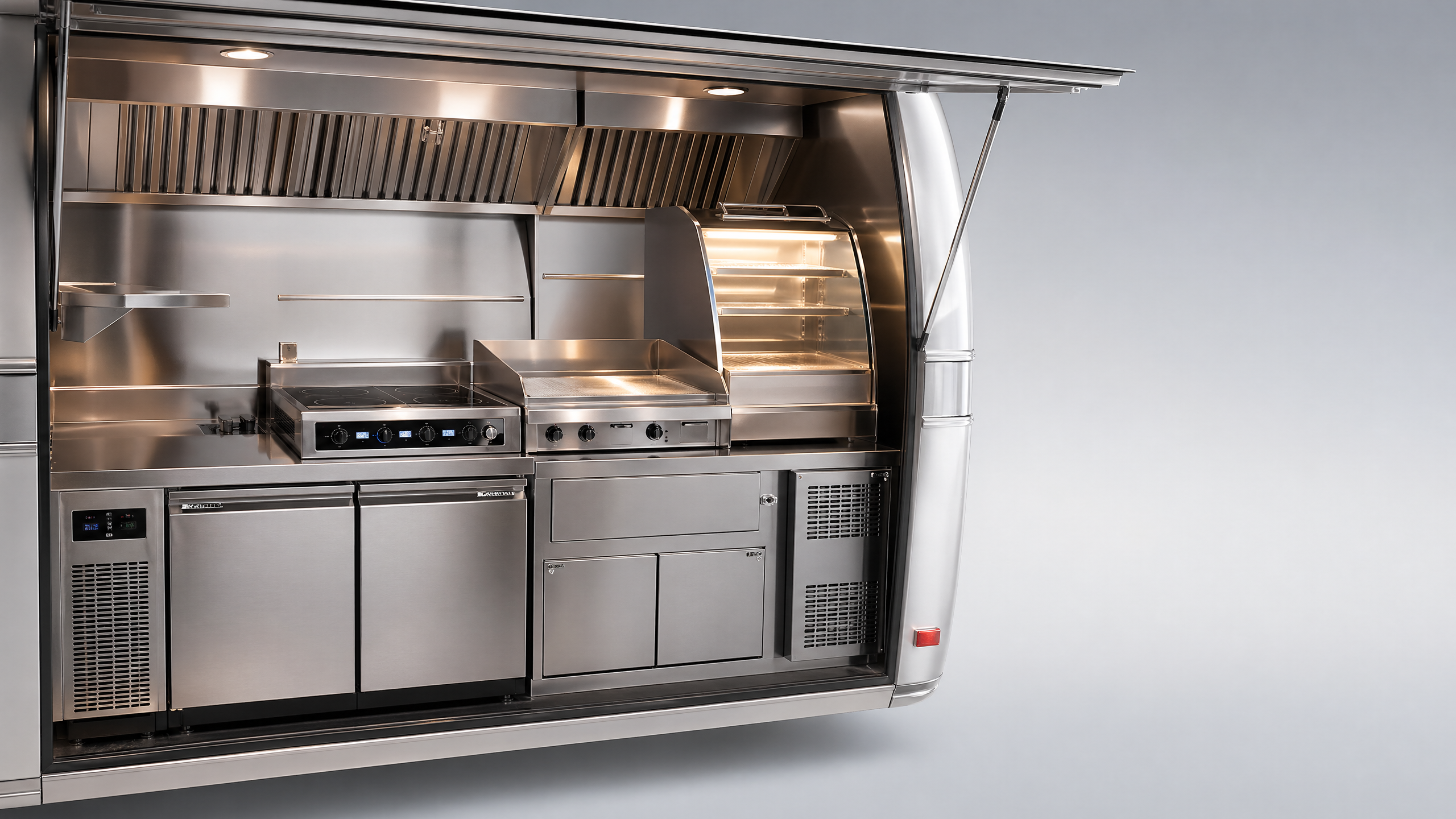
Restaurant kitchen hood capacity is one of the most critical and most frequently overlooked factors in kitchen planning. Cooking equipment does not operate in isolation. Ranges, griddles, charbroilers, fryers, and combi ovens generate heat, grease, vapor, and smoke loads that must be matched by the ventilation system. If equipment is added or changed without recalculating hood performance, the kitchen can become uncomfortable, unsafe, and non-compliant.
Insufficient hood capacity can lead to grease accumulation, poor air quality, heat stress for staff, and negative effects on nearby equipment. At the same time, oversizing is not automatically better. Excessive exhaust may increase energy use and create air balance problems if makeup air is poorly designed. What matters is coordination between cooking line output, hood type, local code requirements, and the total airflow strategy of the restaurant kitchen.
Operators and procurement teams should verify several points early: the appliance duty category, hood dimensions, capture area, exhaust volume, makeup air requirements, fire suppression compatibility, and whether future menu expansion could raise heat and grease loads. A good specification review should include both current cooking demand and likely future changes. Retrofitting ventilation after installation is far more disruptive and expensive than planning it correctly at the start.
Sink sizing affects sanitation workflow more than many teams expect
Restaurant kitchen sink sizing is often treated as a basic fixture decision, but it has major implications for food safety, labor efficiency, and code compliance. A sink is not just a basin. Its bowl size, depth, drainboard length, splash protection, faucet configuration, and placement all shape how staff wash produce, rinse utensils, sanitize tools, and manage dirty-to-clean flow.
Undersized sinks create practical problems every shift. Large sheet pans may not fit properly. Staff may stack wares unsafely. Water splash can contaminate nearby prep areas. Handwashing sinks placed too far from workstations are also a recurring compliance and behavior issue. In many facilities, the real problem is not the number of sinks but the mismatch between sink dimensions and task volume.
When evaluating sink specifications, consider the actual items being washed, the frequency of use, nearby storage for chemicals and utensils, drain capacity, grease management, and whether the sink zone supports clear separation between prep, wash, and sanitation tasks. Buyers should also confirm local health department requirements for compartment count, indirect waste, hand sink accessibility, and food prep sink usage rules. Correct sink sizing protects both hygiene and workflow speed.
Counter depth, work height, and reach distance shape productivity every day
Counter depth is one of those restaurant kitchen specifications that looks simple on paper but has daily ergonomic and operational consequences. A counter that is too shallow may not support prep volume or equipment footprint. A counter that is too deep can make items harder to reach, increase unnecessary motion, and create cleaning challenges at the back edge. Over a full service day, these small inefficiencies add up.
Work height deserves equal attention. Kitchen teams often adapt to poorly sized work surfaces, but that does not mean those surfaces are appropriate. Repetitive bending, awkward reaching, and poorly positioned undercounter storage can slow prep and contribute to fatigue. This matters not only for employee comfort but also for consistency and speed during high-volume periods. Different stations may need different ergonomic priorities depending on tasks such as chopping, plating, dough work, or equipment loading.
During restaurant kitchen layout planning, review counter depth and height together with aisle width, shelving placement, and equipment door swing. The right specification is not universal; it depends on menu style, pan sizes, labor pattern, and station turnover. A kitchen that feels “crowded” is often suffering from specification mismatch, not just lack of space. Good dimensions reduce wasted movement and improve line coordination more than many teams realize.
Utility specifications determine whether equipment delivers its promised performance
Equipment brochures often highlight production output, but actual output depends heavily on site utilities. Electrical phase, voltage, amperage, gas pressure, water pressure, drainage, and floor load capacity all need verification before final selection. One of the most common causes of underperformance in commercial kitchens is equipment installed in conditions that do not match its operating requirements.
For example, an electric combi oven may require power characteristics unavailable at the site without upgrade. An ice machine may be affected by water quality, temperature, or filtration gaps. A high-capacity dishwasher may technically fit the room but exceed the drain or hot water recovery capability of the facility. These are not rare edge cases. They are common coordination failures between equipment purchase and site readiness.
Procurement teams should request utility schedules for every major item and compare them against actual building conditions, not assumptions. This includes startup load, peak demand, connection location, shutoff accessibility, and maintenance clearance. Decision-makers should also factor in the cost of utility adaptation when evaluating price. A lower-priced machine can become the more expensive option if installation requires major electrical, plumbing, or ventilation modifications.
Cleaning access and maintenance clearance are specifications with long-term ROI impact
One of the most overlooked commercial kitchen equipment specifications is service and cleaning access. Equipment may fit tightly into a plan and still be a poor operational choice if staff cannot clean around it or technicians cannot access critical components. Grease traps, condenser coils, burners, filters, drains, and seals all require regular attention. If access is difficult, maintenance tends to be delayed, and hygiene risks increase.
This is especially important for refrigeration, cooking suites, and warewashing systems. Small design choices such as removable panels, coved corners, sealed backsplashes, open-leg bases, or casters can significantly change labor time for cleaning and service. In a busy kitchen, equipment that is easier to move, inspect, and sanitize can reduce downtime and improve compliance over many years.
When comparing models, ask practical questions: Can staff clean beneath and behind it? Is there enough clearance for safe operation and ventilation? Can parts be accessed without dismantling adjacent equipment? Does the design reduce food debris traps? These details may not be the headline features in a catalog, but they often determine whether equipment remains reliable, safe, and cost-effective in daily use.
Storage compatibility and pan configuration are easy to miss but critical in real kitchens
Another area that gets overlooked is the relationship between equipment dimensions and the storage system around it. Refrigerated prep tables, hot holding units, shelving, ingredient bins, and undercounter cabinets should match the pans, containers, and replenishment rhythm used by the operation. If not, staff lose time transferring products, overstock stations, or create congestion around service areas.
Pan count and layout are especially important. Two prep tables of similar exterior size may support very different ingredient access patterns. Likewise, undercounter refrigeration may have enough cubic capacity on paper but still fail operationally if shelving geometry does not accommodate standard containers, sheet pans, or high-turn items efficiently. This becomes a major issue in quick-service, high-mix, and multi-station kitchens.
Good specification review means checking interior usability, not just external dimensions. Buyers should evaluate door type, shelf adjustability, pan rail format, access direction, and whether equipment supports first-in, first-out handling. Storage compatibility directly affects speed, waste, and station discipline. In many cases, it is one of the hidden factors behind smooth service versus constant mid-shift disruption.
How to build a smarter specification checklist before buying
The best way to avoid overlooked restaurant kitchen equipment specifications is to use a cross-functional review process. Operators know workflow pain points. Kitchen staff understand cleaning and handling realities. Procurement teams compare supplier data. Managers and owners evaluate budget, growth, and lifecycle cost. When these perspectives are combined early, specification gaps are easier to catch before purchase orders are finalized.
A strong checklist should cover at least these areas: material grade, dimensions, work height, utility demand, ventilation impact, sanitation design, maintenance clearance, noise and heat output, pan or rack compatibility, code requirements, warranty terms, replacement part availability, and total installation cost. If the equipment affects the line or sanitation flow, it should also be reviewed within the broader restaurant kitchen layout planning process, not as a standalone item.
Finally, treat equipment specifications as business decisions, not only technical data. The right specification reduces labor friction, supports food safety, extends service life, and limits future upgrade costs. The wrong one may still operate, but it often creates invisible penalties every day. Careful review at the specification stage is one of the simplest ways to protect both operational performance and long-term investment.
Conclusion: the details that seem small are often the ones that matter most
When commercial kitchens underperform, the problem is often traced back to details that looked minor during planning: the wrong stainless steel grade in high-exposure areas, a hood system that does not match the cooking load, a sink that disrupts sanitation flow, counters that reduce ergonomic efficiency, or utilities that cannot fully support the equipment installed. These are the specifications that get overlooked because they are less visible than brand, price, or headline capacity.
For information researchers, operators, buyers, and business leaders, the practical takeaway is clear: evaluate equipment in the context of the full kitchen system. Ask how each specification affects cleaning, compliance, maintenance, workflow, and future flexibility. If a detail could create repeated labor, safety, or retrofit costs, it deserves attention now rather than after opening.
The most successful restaurant kitchen equipment decisions come from precise specification review, realistic workflow analysis, and disciplined restaurant kitchen layout planning. When those elements work together, the kitchen becomes easier to operate, safer to maintain, and more resilient as the business grows.
- commercial kitchen equipment
- cooking equipment
- restaurant kitchen
- Griddle
- Charbroiler
- kitchen equipment
- restaurant kitchen equipment
- restaurant kitchen layout planning
- restaurant kitchen equipment specifications
- restaurant kitchen layout
- restaurant kitchen hood
- restaurant kitchen sink
- restaurant kitchen stainless steel
Popular Tags
Kitchen Industry Research Team
Dedicated to analyzing emerging trends and technological shifts in the global hospitality and foodservice infrastructure sector.
Industry Insights
Join 15,000+ industry professionals. Get the latest market trends and tech news delivered weekly.
No spam. Unsubscribe anytime.
Contact With us
Contact:
Anne Yin (Ceramics Dinnerware/Glassware)
Lucky Zhai(Flatware)