
Commercial Convection Oven vs Standard Oven: Key Differences
Choosing between a commercial convection oven and a standard oven can directly affect cooking speed, consistency, and operating costs in modern kitchens. For buyers comparing commercial kitchen oven solutions, this guide explains the key differences, ideal applications, and how commercial convection oven technology fits into today’s catering kitchen equipment and restaurant kitchen supplies landscape.
What really separates a commercial convection oven from a standard oven?
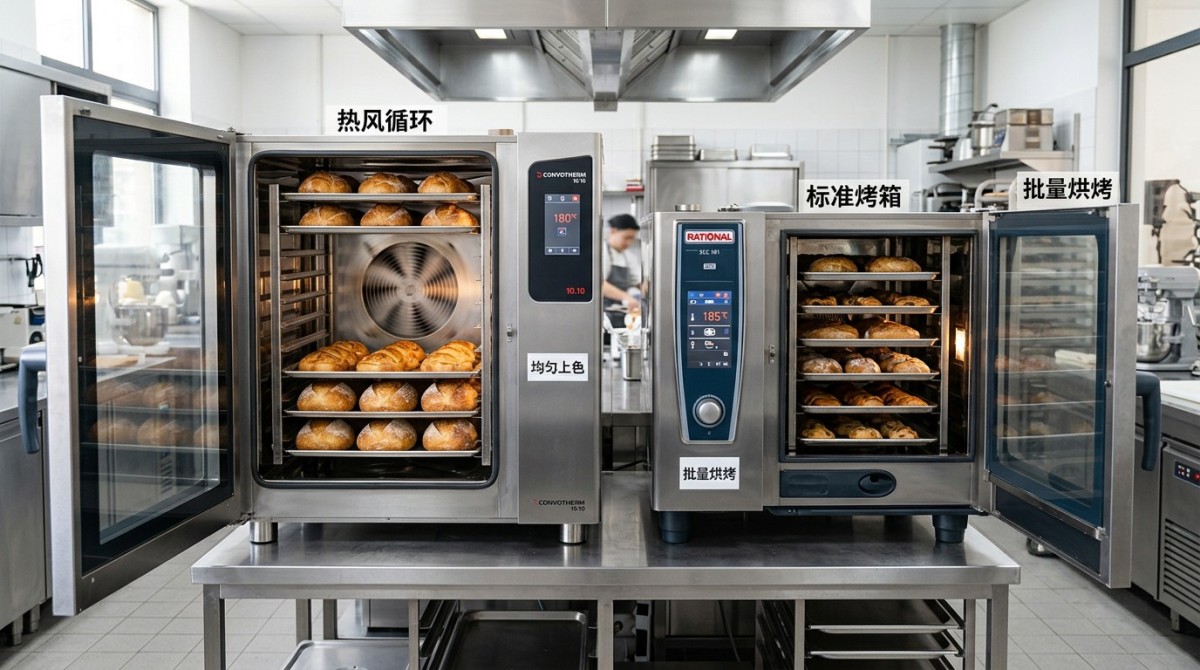
At a basic level, both ovens use enclosed heat to cook food, but the operating principle and intended workload are very different. A standard oven usually relies on natural heat circulation, while a commercial convection oven uses one or more fans to move hot air around the cavity. That airflow changes heat transfer, cooking uniformity, and recovery speed after the door is opened.
In commercial kitchens, this difference matters because production is rarely a single-batch task. Restaurants, hotels, bakeries, central kitchens, and foodservice operations often run equipment for several service periods per day, sometimes 6–12 hours depending on menu structure. Under those conditions, stable temperature distribution and faster batch turnover become operational requirements, not optional features.
A standard oven is often sufficient for light household use, test kitchens with low output, or applications where exact browning across multiple trays is not critical. A commercial convection oven is designed for repeated opening and closing, higher tray capacity, heavier door hardware, and more demanding output targets. It also fits better into broader trends in smart kitchen equipment, energy-conscious design, and digital workflow management.
For procurement teams, the key issue is not simply which oven is “better.” The real question is which oven matches production volume, labor skill level, kitchen layout, power availability, food safety process, and expected return period. In many cases, choosing the wrong oven leads to avoidable problems within 3–6 months, including uneven cooking, slower service, or higher rework rates.
Core functional differences buyers should understand
- Air circulation: Commercial convection ovens actively circulate heat, helping reduce cold spots across 4, 6, or more tray positions.
- Batch output: Commercial models are usually built for continuous service cycles rather than occasional single-dish cooking.
- Construction strength: Commercial units generally use heavier insulation, stronger hinges, more durable control panels, and easier-clean interiors.
- Workflow fit: They are often integrated into commercial kitchen equipment lines, including proofers, racks, extraction systems, and digital controls.
These differences are especially relevant in the kitchen equipment industry, where buyers increasingly compare not only appliance price but also labor efficiency, food consistency, utility cost, maintenance interval, and compatibility with larger kitchen systems. That is why the commercial convection oven versus standard oven comparison remains a common and practical purchasing topic.
Side-by-side comparison for cooking performance, capacity, and daily use
The most useful way to evaluate a commercial convection oven versus a standard oven is to compare the factors that directly affect kitchen operations. These include heat distribution, preheat speed, tray loading, cleaning difficulty, operator learning curve, and fit for high-frequency cooking. The table below summarizes common distinctions seen in restaurant kitchen supplies and catering kitchen equipment decisions.
This comparison shows why many professional buyers move toward convection technology when throughput and consistency become linked to revenue. If one oven cycle can be reduced by even 10–20 minutes in repetitive service windows, the benefit appears not just in speed but also in queue management, labor scheduling, and product repeatability. For operators handling pastries, roasted proteins, vegetables, or tray-baked items, these gains can be meaningful over each week and quarter.
However, not every menu benefits equally. Delicate items that depend on very gentle heat may require recipe adjustment, lower temperature settings, or a different cavity configuration. That is why product comparison should include real menu testing, not only brochure specifications. In practical purchasing, at least 5 checkpoints are worth reviewing: tray count, temperature range, airflow pattern, cleaning access, and service support.
Where performance differences appear most clearly
The first area is multi-tray use. A standard oven can perform well with 1–2 trays, but loading 4 trays at once often increases the chance of uneven browning or the need to rotate pans manually. A commercial convection oven is specifically intended to reduce that intervention, which can save labor minutes in high-volume kitchens.
The second area is service pressure. During breakfast, lunch, banquet prep, or evening rush periods, the oven door may be opened repeatedly. Better heat recovery reduces waiting time and helps the next batch start under more stable conditions. In operations with back-to-back production cycles, this can improve output rhythm over 2–3 peak periods in a single day.
The third area is recipe consistency across locations. Multi-unit restaurant groups and hotel kitchens often need standardized cooking outcomes. A commercial convection oven, when properly specified and calibrated, supports repeatable settings better than a basic oven used beyond its intended workload range.
Which kitchen scenarios benefit most from a commercial convection oven?
Application fit depends on product mix, daily volume, labor structure, and service expectations. In the broader kitchen equipment industry, commercial convection ovens are commonly selected where output consistency and speed directly affect customer experience or production planning. The right choice often becomes clearer when the equipment is matched to real operating scenarios instead of abstract specifications.
Restaurants with diversified menus usually benefit from a convection system because they cook proteins, baked sides, vegetables, and reheated items in repeated cycles. Hotels and banquet kitchens need batch capacity and timing control during concentrated demand windows. Central kitchens may use convection ovens for pre-cook, finishing, or standardized tray production. In these settings, a standard oven may become a bottleneck once volume rises above light-duty use.
The table below helps buyers align common business types with typical oven needs. It is not a rigid rule, but it provides a practical selection framework for procurement teams, operators, and decision-makers comparing commercial kitchen oven options.
A key takeaway is that capacity planning should include expected growth, not only current demand. A café serving 40 covers today may stay with a standard oven, but if the concept is expected to reach 80–120 covers or add breakfast and catering within 6–12 months, a commercial convection oven may be the more economical long-term choice. Underbuying can lead to earlier replacement, workflow disruption, and uneven food quality.
Scenario-specific considerations
For operators and kitchen staff
Operators should look at tray spacing, airflow exposure, control simplicity, and cleaning access. A more advanced oven only adds value if staff can use it consistently. In busy kitchens, simplified control logic and clear temperature ranges often matter as much as raw heating power.
For procurement teams
Procurement should compare utility type, installation requirements, maintenance accessibility, and spare parts availability over a 12–36 month planning window. Purchase price alone rarely reflects real ownership cost in foodservice operations.
For decision-makers
Decision-makers should ask whether the oven supports labor efficiency, menu expansion, and standardization across sites. In multi-location or export-oriented foodservice projects, equipment consistency helps simplify training and operating procedures.
How should buyers evaluate specifications, operating cost, and compliance?
A commercial convection oven should be evaluated through three lenses: technical suitability, operating cost, and compliance readiness. This is especially important in a kitchen equipment market moving toward energy efficiency, digital control, and safer food production. Buyers often focus on cavity size first, but a better sequence is to confirm workflow need, then power conditions, then operating control, and finally after-sales support.
Typical specification checks include temperature range, number of tray positions, chamber dimensions, power input, control type, ventilation need, and cleaning method. Depending on menu and region, common operating ranges may extend well beyond basic roasting needs, so buyers should confirm whether the oven can support low-temperature finishing as well as higher-temperature batch cooking. For many commercial applications, delivery planning also matters, with common lead times ranging from 2–6 weeks depending on configuration and destination.
A practical 6-point procurement checklist
- Confirm daily batch volume: estimate trays per cycle and cycles per service period before choosing chamber size.
- Check utility conditions: verify electric or gas compatibility, site ventilation, and installation limits.
- Review control needs: manual controls may suit simple menus, while programmable settings help standardize repeat recipes.
- Assess cleaning and maintenance: removable racks, smooth interior surfaces, and easy fan access reduce downtime.
- Ask about service support: spare parts, training, and response time affect long-term equipment reliability.
- Verify market requirements: for cross-border projects, check destination-country electrical standards and applicable commercial equipment compliance documents.
Compliance should also be considered early. Requirements vary by region and application, but buyers commonly review electrical safety, food-contact suitability, and installation conformity. In B2B projects involving hotels, chains, or institutional kitchens, documentation quality can affect approval speed just as much as price. It is wise to confirm required paperwork before production or shipment, especially when the project timeline is tight.
From a cost perspective, a standard oven may look attractive upfront, but the ownership picture changes if cooking time is longer, batch quality is less consistent, or extra labor is needed for tray rotation and monitoring. Over a 12-month cycle, small inefficiencies repeated every day can outweigh the initial price gap. For this reason, professional oven selection should consider labor minutes, utility use, output value, and maintenance frequency together.
Common buying mistakes to avoid
- Choosing based only on purchase budget without calculating total operating cost.
- Ignoring recipe adaptation needs when switching from a standard oven to convection cooking.
- Overlooking installation constraints such as clearance, airflow, and power load.
- Buying too small for future output growth, creating replacement pressure within 1–2 years.
FAQ: what do buyers and users ask most often?
Is a commercial convection oven always faster than a standard oven?
Not always in every recipe, but it is often faster in practical foodservice use because hot air circulates more actively and heat recovers better after door openings. In repeated production, the time advantage may come from improved batch flow rather than dramatic reduction in a single recipe. For a kitchen running several cycles per shift, that difference can improve service pacing and labor coordination.
Can a standard oven still work in a small commercial setting?
Yes, if output is low, menu complexity is limited, and cooking uniformity across many trays is not critical. A small café, tasting room, or low-volume prep area may start with a standard oven. The decision becomes less suitable when the kitchen needs continuous use, multiple tray levels, or consistent results across morning, lunch, and evening service windows.
What should be checked before switching recipes to convection cooking?
Operators should review temperature setpoints, cooking time, tray placement, and product moisture response. Many kitchens test 3–5 representative menu items first, then adjust settings gradually. This reduces waste and helps staff understand how airflow affects browning, crispness, and internal doneness.
How long is the usual procurement and implementation process?
For standard configurations, procurement and delivery may take around 2–6 weeks, while custom projects or export orders may require longer depending on documentation, voltage specification, and transport route. Installation, commissioning, and operator familiarization are often completed in 1–3 stages, depending on project size and whether the oven is part of a larger kitchen equipment package.
Why contact us when comparing commercial kitchen oven options?
If you are deciding between a commercial convection oven and a standard oven, the most efficient next step is a specification-based discussion rather than a general product search. We can help map your menu, output targets, kitchen space, and utility conditions to a more suitable commercial kitchen oven solution, whether you are purchasing for a restaurant, hotel, bakery, central kitchen, or food processing support area.
Our support can focus on the questions that matter during real procurement: tray capacity, temperature range, electric or gas options, estimated delivery cycle, installation considerations, cleaning requirements, and compatibility with broader catering kitchen equipment. If your project involves cross-border sourcing, we can also discuss common documentation and compliance expectations for different markets without overcomplicating the process.
For buyers with limited time, we recommend a 4-step consultation path: confirm application scenario, review technical parameters, compare 2–3 suitable configurations, and then align on quotation, lead time, and service scope. This shortens decision cycles and helps avoid mismatches between purchase price and operating reality.
Contact us to discuss product selection, configuration advice, delivery timelines, sample or test support, certification questions, and quotation planning. A clear requirement list at the start usually saves far more time than replacing underperforming equipment later.
Popular Tags
Kitchen Industry Research Team
Dedicated to analyzing emerging trends and technological shifts in the global hospitality and foodservice infrastructure sector.
Industry Insights
Join 15,000+ industry professionals. Get the latest market trends and tech news delivered weekly.
No spam. Unsubscribe anytime.
Contact With us
Contact:
Anne Yin (Ceramics Dinnerware/Glassware)
Lucky Zhai(Flatware)