
Restaurant kitchen equipment dimensions before final drawings
Before final drawings move into approval and fabrication, checking restaurant kitchen equipment dimensions is one of the most important technical steps in kitchen planning. Accurate dimensions affect not only whether equipment fits on site, but also whether the full kitchen can support safe movement, efficient production flow, utility access, maintenance clearance, and regulatory compliance. In restaurants, hotels, food processing areas, and central kitchens, a dimensional review reduces installation conflicts, prevents expensive redesign, and helps ensure the final layout works in real operating conditions rather than only on paper.
Definition and scope of restaurant kitchen equipment dimensions
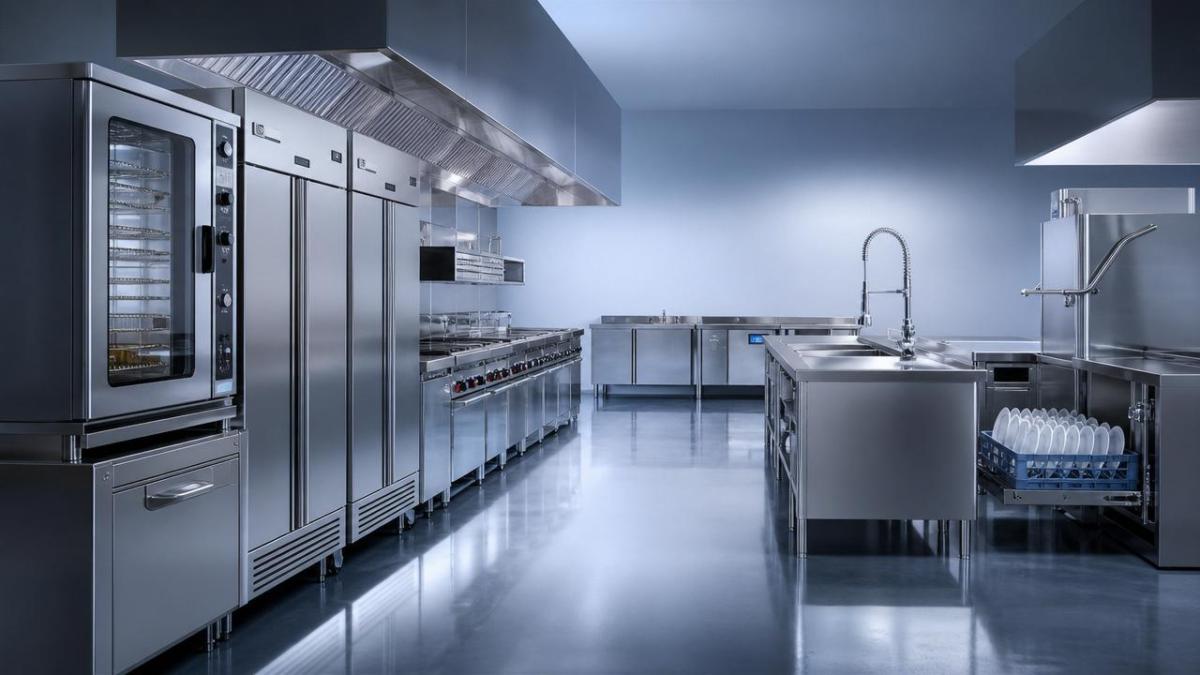
The term restaurant kitchen equipment dimensions covers more than basic width, depth, and height. In professional kitchen design, it also includes operating clearances, door swing, ventilation offsets, service access, drain locations, gas points, electrical entries, loading height, and the space needed for cleaning and repair. A combi oven, for example, may fit physically within a wall line, yet still fail in practice if the door opening blocks circulation or if the service panel cannot be reached after installation.
This dimensional scope applies to cooking equipment, refrigeration units, stainless steel worktables, dishwashing systems, food preparation machinery, shelving, exhaust hoods, and integrated utility systems. In a modern foodservice environment, smart and energy-efficient equipment often has added control boxes, sensors, cable routes, and ventilation requirements. That means dimensional verification must account for both the equipment body and the operational envelope around it.
A reliable review usually compares supplier technical sheets, architectural drawings, MEP coordination plans, and actual site measurements. This process is especially important in projects where imported equipment is used, because stated dimensions may differ by market standard, model generation, or installation method. Early coordination creates a more realistic base for final drawings and later commissioning.
Industry context and current dimensional review priorities
The kitchen equipment industry is evolving toward automation, digital control, and higher energy efficiency. As a result, dimensional planning has become more detailed than in traditional kitchens. Equipment is no longer selected only for cooking capacity; it must also match workflow logic, utility demand, food safety requirements, and future upgrade flexibility. In compact urban restaurants, dimensional precision is often the difference between a productive line and a congested workspace.
Several factors explain why restaurant kitchen equipment dimensions now receive greater attention before final drawings:
- More equipment integration with ventilation, automation, and digital monitoring systems
- Higher pressure on space efficiency in restaurants, hotels, and central kitchens
- Stronger compliance expectations for hygiene, fire safety, and worker circulation
- Increased use of modular kitchen systems and imported commercial appliances
- Rising installation and change-order costs when dimensions are checked too late
The table below summarizes common review signals in contemporary kitchen projects:
Operational value of accurate dimensional verification
Accurate restaurant kitchen equipment dimensions create value across the full project lifecycle. During planning, they support realistic layout decisions. During construction, they reduce clashes between equipment and building systems. During operation, they improve movement efficiency and reduce cleaning difficulty. Over time, a well-coordinated kitchen also adapts more easily to menu changes, new equipment, or increased output.
From a workflow perspective, dimensions shape how products move from receiving to storage, preparation, cooking, plating, service, warewashing, and waste handling. Even a small error in aisle width or table depth can slow multiple stations. In high-volume kitchens, these small inefficiencies accumulate into longer ticket times, staff congestion, and uneven sanitation control.
From a technical standpoint, dimensional verification is equally important for utility coordination. Cooking equipment must align with extraction and make-up air strategy. Refrigeration needs air circulation around condensers. Dishwashing systems require drainage slope, chemical access, and loading space. Without checking these requirements before final drawings, the project may install technically correct equipment in functionally incorrect positions.
There is also a cost benefit. Correct dimensions lower the chance of last-minute substitutions, stainless steel re-fabrication, wall opening changes, and delayed commissioning. In many restaurant projects, the cost of one major dimensional correction can exceed the time and effort needed for a full pre-approval review.
Typical equipment categories and dimensional checkpoints
Different equipment categories require different dimensional checks. Reviewing them by function makes the process more structured and practical.
In projects involving food processing support or central kitchen production, the same logic extends further. Conveyor-fed preparation machines, vacuum packaging equipment, cold room doors, and automated portioning systems all require extra attention to access path, service zone, and future replacement space. This is why dimensional planning should not stop at the main restaurant line.
Practical review method before final drawings
A practical review of restaurant kitchen equipment dimensions works best when completed in sequence. First, confirm the latest technical data for every selected model. Second, compare equipment dimensions against actual room size, structural columns, door openings, and ceiling constraints. Third, check operational clearance and service access. Fourth, confirm all utility connection coordinates. Finally, verify that the equipment arrangement still supports the intended production flow.
The following checklist can help structure the review:
- Confirm model numbers and revision dates on technical sheets
- Check actual equipment body dimensions against drawing symbols
- Review door opening, drawer pull-out, and operator standing space
- Verify hood, duct, and exhaust interface dimensions
- Align gas, electric, water, steam, and drain points
- Ensure cleaning gaps and wall finishes remain workable
- Confirm transport route from site entrance to installation area
- Reserve tolerance for leveling, skirting, and service panels
It is also useful to distinguish between nominal dimensions and installation dimensions. A machine may be listed as 800 mm wide, but leveling feet, handles, rear cable bends, or side ventilation requirements can increase the real occupied space. Final drawings should reflect the true installed condition, not only catalog data.
Common mistakes and implementation guidance
One common mistake is relying only on 2D layout blocks without checking manufacturer details. Another is verifying fit but not serviceability. A third is ignoring the relationship between equipment dimensions and operational sequence. Kitchens may appear efficient on a drawing while creating crossing traffic, unsafe turning points, or blocked cleaning access once equipment is in place.
Implementation should therefore combine drawing review with site validation. Where possible, measure critical wall lengths, floor levels, and utility rough-ins before releasing final fabrication. For complex kitchens, mark major equipment footprints on site or in a digital coordination model to test circulation and loading paths. This approach is especially valuable for mixed-use projects that combine restaurant service, banquet support, and food preparation functions in one back-of-house area.
Well-managed dimensional review also supports long-term sustainability. Proper spacing improves ventilation efficiency, reduces strain on refrigeration systems, and allows easier cleaning around high-use equipment. In an industry moving toward smart, integrated, and energy-saving kitchens, these details contribute directly to operating stability and lower lifecycle cost.
Next-step action for final drawing readiness
Before approving final drawings, prepare a coordinated dimensional register for all major equipment and compare it with architectural, mechanical, electrical, plumbing, and ventilation plans. Focus first on cooking line depth, refrigeration door clearance, warewashing flow, and service access, because these areas generate the most frequent conflicts. Then confirm transport route and installation sequence so the selected equipment can actually reach its final position.
A disciplined review of restaurant kitchen equipment dimensions creates a stronger link between concept design and operational reality. It helps restaurants and other foodservice environments avoid preventable errors, improve workflow, support compliance, and build kitchens that are efficient from day one. When final drawings reflect real dimensions rather than assumptions, the result is a safer, more functional, and more future-ready kitchen system.
Popular Tags
Kitchen Industry Research Team
Dedicated to analyzing emerging trends and technological shifts in the global hospitality and foodservice infrastructure sector.
Industry Insights
Join 15,000+ industry professionals. Get the latest market trends and tech news delivered weekly.
No spam. Unsubscribe anytime.

Contact With us
Contact:
Anne Yin (Ceramics Dinnerware/Glassware)
Lucky Zhai(Flatware)