
Kitchen design for hospitals where compliance shapes every layout
In kitchen design for hospitals, every layout decision affects hygiene control, workflow safety, regulatory compliance, and food quality. For quality control and safety managers, a well-planned hospital kitchen is not just an operational space but a critical system that supports infection prevention, efficiency, and consistent meal service. Understanding how compliance shapes design is essential to reducing risk and improving performance.
For readers searching for kitchen design for hospitals, the core need is rarely aesthetic inspiration. The real question is how to create or assess a hospital kitchen layout that can withstand inspections, reduce contamination risks, support safe food handling, and maintain reliable meal service under pressure. In practice, compliance is not an extra layer added after planning. It is the logic that determines zoning, equipment selection, traffic flow, storage, cleaning access, and staff behavior.
For quality control personnel and safety managers, the most useful perspective is this: a compliant hospital kitchen should make the safe way of working the easiest way of working. If the layout forces staff to cross clean and dirty paths, store allergens inconsistently, or improvise around hard-to-clean equipment, the design itself becomes a source of operational risk. That is why the best hospital kitchens are designed backward from food safety, sanitation, and workflow control requirements.
Why compliance drives every serious hospital kitchen layout
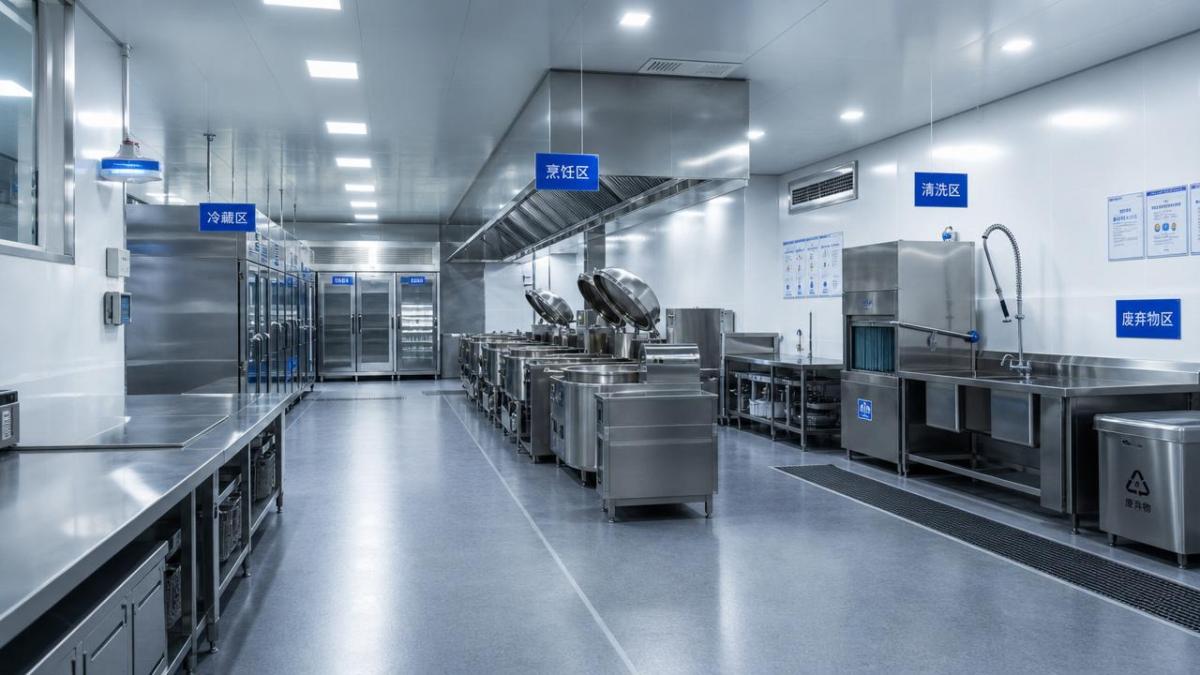
Hospital foodservice operates under stricter expectations than many other commercial kitchens because the consequences of failure are higher. Patients may be immunocompromised, on restricted diets, or dependent on precise meal timing. A minor lapse in temperature control, allergen separation, or sanitation can become a patient safety issue rather than only a service problem.
That reality changes how kitchen design for hospitals should be evaluated. A good layout is not simply one that fits equipment into a room. It is one that supports hazard control points, reduces unnecessary handling, separates incompatible activities, and allows monitoring staff to verify compliance without disrupting operations.
From a management standpoint, compliance-led design also improves consistency. When work areas are clearly zoned and flows are intuitive, staff training becomes easier, audits are more straightforward, and corrective actions are less frequent. This lowers the hidden costs of rework, waste, inspection failures, and food safety incidents.
What quality and safety managers should evaluate first
Before reviewing equipment brands or production capacity, safety-focused stakeholders should start with five questions. First, does the layout separate raw, cooked, clean, and waste-related activities? Second, can staff move through the kitchen without crossing contaminated and protected paths? Third, are cleaning and sanitation built into the design rather than treated as afterthoughts? Fourth, can critical controls such as temperature, storage conditions, and allergen handling be monitored easily? Fifth, does the design support emergency response and operational continuity?
These questions matter because many kitchen problems that appear to be staff errors are actually design errors. If handwashing stations are badly located, if receiving and prep areas overlap, or if tray assembly happens too close to waste handling, even well-trained staff will struggle to maintain standards consistently.
For hospital projects, the review should also include meal distribution requirements, diet segregation needs, and service frequency. Unlike a standard restaurant, a hospital kitchen must often support therapeutic diets, high meal volumes at fixed times, and traceability across multiple patient categories. The layout has to support that complexity without increasing confusion or contamination risk.
How zoning reduces contamination and audit risk
Zoning is one of the most important design principles in hospital foodservice. In simple terms, it means assigning distinct areas for receiving, cold storage, dry storage, raw preparation, cooking, plating, tray assembly, warewashing, waste handling, and staff hygiene. The purpose is not only organization. It is to establish physical and procedural barriers that reduce cross-contamination.
A strong zoning plan should support one-way movement wherever possible. Food should move from receiving to storage to preparation to cooking to service in a logical sequence. Dirty items should return through separate paths to washing and waste areas. Staff should not need to walk back through clean production zones while carrying waste, used trays, or soiled utensils.
For quality control teams, zoning also makes verification easier. When each activity has a defined place, it becomes simpler to inspect cleanliness, observe compliance, and identify deviations. If functions are mixed together in ambiguous spaces, nonconformities become harder to detect and much harder to correct systematically.
In many hospital kitchens, the highest-risk conflict points are between raw and ready-to-eat foods, clean and dirty dish flows, and allergen-sensitive meal preparation versus general production. These areas deserve special scrutiny during design review because they are common causes of contamination events and failed audits.
Equipment selection must support sanitation, not just output
Hospital kitchens need productive equipment, but high throughput alone is not enough. Equipment must be selected based on cleanability, maintenance access, hygienic construction, and suitability for controlled workflows. Smooth surfaces, minimal crevices, accessible service zones, and durable materials are not small details. They directly affect the time, effort, and reliability of sanitation.
For example, equipment placed too close to walls or too tightly grouped may look space-efficient on paper, yet create inaccessible dirt traps during real operation. Similarly, poorly integrated refrigeration, holding, and transport systems can weaken temperature control even when the appliances themselves perform well in isolation.
Quality and safety managers should ask practical questions during specification review. Can the equipment be cleaned without disassembly that staff are unlikely to perform correctly? Are seals, drains, joints, and undersides accessible for inspection? Does the placement allow visual monitoring of hygiene? Can preventive maintenance be completed without contaminating adjacent areas?
In kitchen design for hospitals, the best equipment decisions are those that reduce daily compliance friction. If a layout requires shortcuts to keep service on time, the design is setting the operation up for failure. Hygienic performance and operational performance should reinforce each other.
Storage, temperature control, and allergen management need layout support
Food safety controls become unreliable when storage design is weak. Hospital kitchens require clear separation between chilled, frozen, ambient, raw, cooked, and special-diet items. Layout planning should include enough capacity, correct adjacency, and easy labeling access so that storage rules can be followed under peak load, not only in ideal conditions.
Temperature-sensitive movement is another major concern. The longer food travels between preparation, cooking, holding, plating, and delivery, the greater the exposure to unsafe conditions. A compliant layout reduces transfer distance, avoids bottlenecks, and supports holding solutions that preserve both safety and food quality. This is especially important when serving large patient populations within narrow time windows.
Allergen management is equally critical. In hospitals, dietary sensitivity is not just a preference issue. It can be a direct medical risk. Kitchens should provide designated storage, preparation tools, labeling systems, and where necessary, physically separated work areas for allergen-controlled meals. If those controls depend entirely on memory rather than on layout and visual structure, the risk remains too high.
Safety managers should also consider traceability. Ingredient receipt, storage rotation, production batches, and meal dispatch processes should all fit naturally into the design. Traceability works best when the physical environment supports documentation rather than competing with it.
Cleaning flow, waste handling, and staff hygiene are design priorities
One of the clearest signs of a weak hospital kitchen layout is when cleaning activities interfere with food production. Warewashing, waste removal, chemical storage, and housekeeping should be carefully positioned to avoid contaminating clean zones. Dirty return areas should be isolated from plating and ready-to-serve activities, with controlled entry points and clear separation of utensils, carts, and staff movement.
Hand hygiene infrastructure deserves special attention. Sinks must be placed where staff need them, not where leftover space happens to exist. If workers must walk too far or cross work paths to wash hands, compliance rates will drop. The same principle applies to changing areas, PPE storage, and sanitation supply access.
Waste handling should also be built into the operational sequence. Temporary waste staging, container cleaning, and disposal routes need to be planned so they do not create odors, pests, leaks, or accidental contact with clean materials. This is particularly important in healthcare environments where environmental hygiene expectations are high across the entire facility.
From an audit perspective, kitchens that separate cleaning and production flows clearly are easier to assess and easier to defend. The physical design demonstrates control, which strengthens confidence in the operation even before documentation is reviewed.
Workflow efficiency matters because safety depends on it
Some teams treat efficiency and compliance as separate goals, but in hospital kitchens they are tightly linked. Congestion, long travel distances, repeated handling, and unclear task sequencing all increase the chance of mistakes. When staff are rushed, forced to backtrack, or competing for shared space, safety controls become harder to maintain.
That is why kitchen design for hospitals should balance risk control with realistic workflow analysis. Meal peaks, staffing patterns, trolley movement, replenishment timing, dish returns, and equipment downtime all affect how the kitchen performs under stress. A layout that looks compliant during a walkthrough may fail during actual service if it cannot absorb volume and timing pressure.
For safety managers, one useful review method is to assess the design based on worst-case operating conditions rather than average conditions. Ask what happens during simultaneous receiving, production, tray assembly, and warewashing. Ask where temporary storage appears when demand spikes. Ask how segregated diets are protected when the team is under time pressure. These questions reveal whether the layout is resilient or only theoretically compliant.
How to assess whether a proposed design is truly fit for a hospital
When evaluating a new build or renovation, decision-makers should go beyond vendor presentations and architectural drawings. A structured review should include process mapping, hazard analysis, cleaning validation considerations, staff movement simulation, and maintenance accessibility checks. The layout should be tested against real workflows rather than only against room dimensions.
It is also wise to involve multiple functions early. Food safety, infection prevention, facilities, operations, dietetics, and maintenance teams often identify different risks. A design that satisfies one department but ignores another can create expensive modifications later. Early cross-functional review reduces redesign costs and improves operational readiness.
Another practical step is to examine whether the design supports ongoing compliance, not just opening-day approval. Can monitoring points be observed easily? Are there enough utilities in the right places? Can future equipment upgrades be integrated without disrupting hygiene zones? Will the kitchen still function safely if meal volume increases or service models change?
In many cases, the most valuable decision is not adding more equipment but improving clarity of flow. Better adjacency, better segregation, and better access often generate greater risk reduction than simply expanding capacity.
Conclusion: in hospital kitchens, layout is a safety control
For quality control and safety managers, the central takeaway is clear: compliance does not sit on top of hospital kitchen design. It shapes it from the start. The strongest layouts are those that embed zoning, sanitation access, temperature control, allergen management, and efficient movement into the physical environment so that safe performance becomes routine rather than dependent on constant correction.
When reviewing kitchen design for hospitals, focus first on whether the space reduces risk in daily practice. A compliant kitchen should protect patients, support staff, simplify verification, and remain reliable under operational pressure. If the layout achieves that, it is not only meeting regulations. It is actively improving food safety, service quality, and long-term operational confidence.
Popular Tags
Kitchen Industry Research Team
Dedicated to analyzing emerging trends and technological shifts in the global hospitality and foodservice infrastructure sector.
Industry Insights
Join 15,000+ industry professionals. Get the latest market trends and tech news delivered weekly.
No spam. Unsubscribe anytime.
Contact With us
Contact:
Anne Yin (Ceramics Dinnerware/Glassware)
Lucky Zhai(Flatware)