
Restaurant supplies factory lead times are changing by region
Lead times from a restaurant supplies factory are no longer predictable in the same way across global markets. Regional differences in labor, energy costs, supply chain stability, and manufacturing capacity are reshaping delivery schedules for commercial kitchen equipment. For buyers researching sourcing options, understanding why lead times vary by region is essential to reducing procurement risk and improving planning.
For importers, distributors, restaurant groups, and project teams planning a new kitchen or replacement cycle, lead time is no longer a simple number on a quotation sheet. A fryer, prep table, combi oven, stainless sink line, or food processing unit may all follow different production paths depending on where the factory is located and how concentrated its supplier base is.
In the kitchen equipment industry, delays often come from a combination of 4 factors: raw material availability, component sourcing, factory scheduling, and outbound logistics. When these variables shift by region, buyers need a more practical sourcing framework. The right question is not only “How many days is production?” but also “What part of the lead time is stable, and what part is exposed to disruption?”
Why regional lead times are changing for a restaurant supplies factory
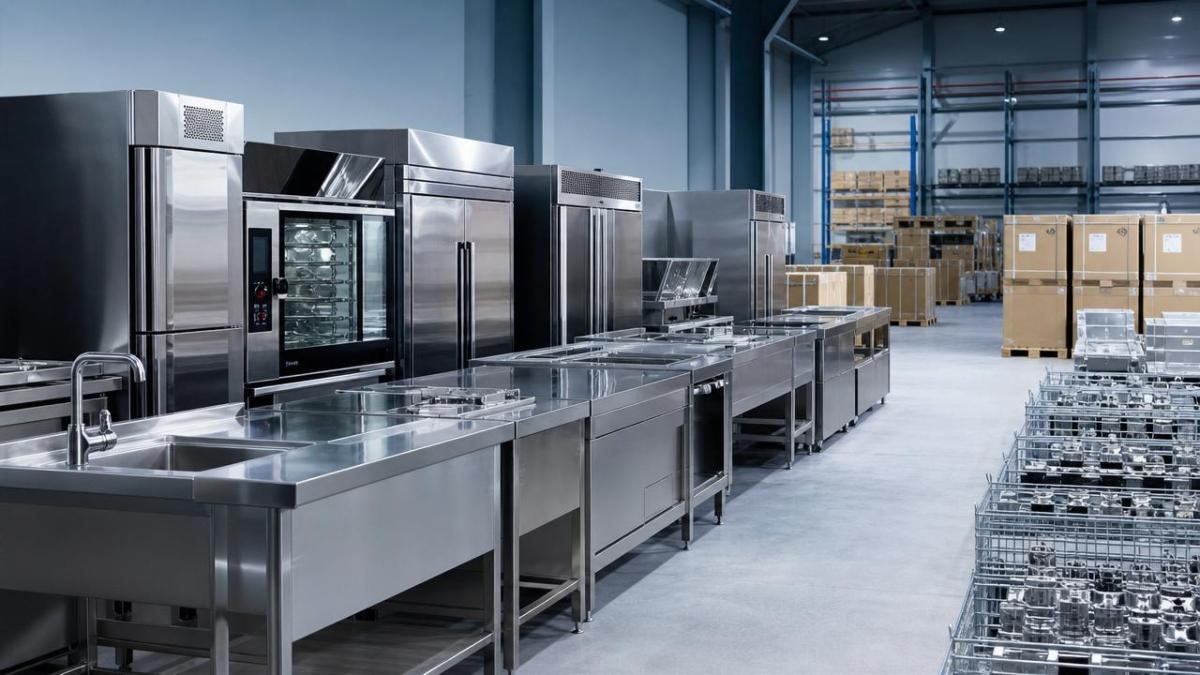
A restaurant supplies factory typically works within a layered supply chain. Stainless steel sheets, compressors, thermostats, motors, burners, control boards, insulation materials, packaging, and export documentation all affect delivery. If one region has strong local integration, standard products may move in 15–30 days. If a factory depends on imported key components, the same item may take 30–60 days or longer.
The four main drivers behind longer or shorter schedules
- Labor structure: Regions with stable skilled labor pools can maintain more consistent assembly and welding output.
- Energy costs: High electricity or gas prices can reduce operating shifts, especially for metal fabrication and heat-treatment processes.
- Supplier concentration: Areas with dense industrial clusters often cut 5–10 days from component replenishment.
- Port and inland logistics: Export lead time can change by 7–21 days based on vessel space, customs congestion, and trucking capacity.
For commercial kitchen products, not all categories behave the same way. Standard stainless worktables, shelving, and sinks generally have shorter production cycles because they rely on common metal processing steps. Refrigeration systems, smart cooking equipment, or automated food processing units usually require more purchased parts, testing time, and quality inspection windows.
Typical product complexity and time exposure
The table below shows how product type often influences timing when evaluating a restaurant supplies factory in different regions.
The key takeaway is that regional comparison only works when buyers compare similar product complexity. A 20-day lead time for a fabricated sink line does not indicate that the same restaurant supplies factory can deliver smart combi equipment in 20 days as well.
How lead times differ across major manufacturing regions
Regional lead times should be viewed through an operational lens rather than a country label alone. Within the same country, factories located near industrial clusters and export ports may outperform inland facilities by 1–3 weeks. Still, broad regional patterns are useful for information-stage buyers comparing sourcing options.
East Asia: scale advantages with scheduling pressure
East Asian manufacturing hubs, especially those with mature kitchen equipment supply chains, often offer strong capacity for both OEM and standard models. For standard restaurant appliances and stainless products, a restaurant supplies factory in these clusters may quote 15–35 days. During peak export seasons or when steel prices move sharply, schedules can extend to 40–55 days.
The biggest strength in this region is component availability. Factories can often source hinges, digital controls, wheels, compressors, GN-pan fittings, and packaging locally or within a short domestic radius. That reduces replenishment time, but heavy order concentration may still create bottlenecks in final assembly and container loading.
Europe: precision and compliance with longer planning windows
European kitchen equipment producers are often selected for engineering quality, energy-efficient designs, and consistency in technical documentation. Lead times are commonly longer, ranging from 30–70 days for many categories, especially where products involve customized electrical specifications, gas safety adaptations, or premium stainless finishing.
For buyers, the benefit is usually predictability once a slot is confirmed. However, short-notice changes can be harder to absorb because production planning may be more rigid. If a project requires 220V/60Hz conversion, custom footprint dimensions, or higher-spec insulation, the additional engineering review may add 5–15 working days.
South and Southeast Asia: growing capacity with mixed supplier maturity
These regions are attracting attention for cost competitiveness and expanding fabrication capacity. Standard metal products may move in 20–40 days, while more technical products can be less predictable if critical components still rely on imports. Buyers should pay special attention to power components, refrigeration units, and controller availability.
A restaurant supplies factory in an emerging manufacturing base may be highly competitive on price but less vertically integrated. That means nominal production time may look short, while actual completion depends on 2–3 external suppliers. For research-stage buyers, supplier mapping is often more important than the quoted factory calendar.
North America and nearby sourcing zones: shorter transit, higher unit cost
Nearshoring and regional sourcing can reduce shipping uncertainty, particularly for buyers who need partial shipments, service responsiveness, or project coordination. Production time may still range from 25–60 days, but the logistics leg can be reduced significantly. In some cases, reducing transit from 30–40 days to 5–10 days is more valuable than saving a small percentage on product cost.
Regional comparison at a practical level
The next table summarizes common lead-time characteristics buyers should evaluate when screening a restaurant supplies factory by region.
These ranges are not fixed guarantees, but they help buyers frame trade-offs. The fastest apparent factory quote is not always the lowest-risk option if customs lead time, testing, or replacement part access remain weak.
What buyers should ask before choosing a restaurant supplies factory
For information-stage procurement, better questions lead to better sourcing outcomes. Instead of only asking for a total lead time, buyers should break the timeline into 5 checkpoints: engineering confirmation, material preparation, production start, final inspection, and shipment release. This method makes hidden risk visible.
A practical due diligence checklist
- Ask whether the quoted lead time is based on standard specification or custom configuration.
- Confirm which components are stocked and which are purchased after order deposit.
- Request a production timeline with at least 3 milestones, not just a shipment date.
- Verify MOQ, sample policy, and batch scheduling rules for mixed models.
- Check whether packaging, export marks, manuals, and destination voltage are included in the stated schedule.
This is especially important in commercial kitchen projects where one delayed item can slow site installation. A central kitchen may be unable to commission cold storage, prep lines, and hot cooking zones on schedule if a single equipment category arrives 2 weeks late. The cost of downtime often exceeds the savings from chasing the shortest quote.
Signals that a factory lead time is realistic
A reliable restaurant supplies factory usually explains assumptions behind the delivery window. That includes order quantity, material grade such as 201 or 304 stainless steel, electrical standard, accessory inclusion, and whether testing requires 24–72 hours. Factories that only provide a single number without process detail may be estimating rather than scheduling.
Common buyer mistakes
- Comparing ex-factory production days with door-to-door delivery days as if they are the same.
- Ignoring the effect of mixed orders across fabricated, refrigerated, and electrical categories.
- Changing specifications after approval and expecting the original lead time to remain valid.
- Assuming a peak-season sample lead time can be repeated for a 1x40HQ bulk order.
How to reduce lead-time risk in kitchen equipment sourcing
The most effective strategy is not always to find the fastest restaurant supplies factory, but to build a sourcing plan with buffers, alternates, and specification control. Buyers handling restaurant chains, hotel projects, food processing upgrades, or central kitchen expansions often benefit from a dual approach: stable core suppliers for strategic categories and flexible secondary sources for standard items.
Risk control measures that work in practice
- Lock critical specifications early, ideally 4–6 weeks before required production start.
- Separate urgent standard products from custom-engineered products in different purchase orders.
- Build a 7–14 day logistics buffer for international shipments involving transshipment or port congestion risk.
- Use phased delivery for multi-zone kitchen projects so site work can continue even if one category slips.
- Request pre-shipment photos, packing lists, and inspection records 3–5 days before cargo release.
There is also a growing role for digital coordination. Buyers increasingly expect production updates, document sharing, and inventory visibility through simple digital workflows. Even basic weekly updates can improve decision-making because they allow procurement teams to react before a delay becomes critical.
When a longer lead time may still be the better choice
A 45-day quote from a technically strong supplier can be lower risk than a 25-day quote from a factory with unstable sourcing. This is especially true for energy-efficient kitchen systems, automated food processing lines, or equipment requiring post-installation service compatibility. In B2B procurement, reliability across the full lifecycle often matters more than shipping speed alone.
As restaurant operations become more dependent on smart controls, food safety compliance, and integrated kitchen workflows, lead-time planning should be treated as part of operational risk management. The best sourcing decisions align production timing, logistics, installation needs, and after-sales readiness rather than focusing on one metric in isolation.
Regional differences are now a permanent part of sourcing from any restaurant supplies factory. Buyers who understand the relationship between factory location, product complexity, supplier depth, and logistics exposure can make better decisions and avoid costly project disruption. If you are evaluating kitchen equipment suppliers, comparing manufacturing regions, or planning a commercial kitchen project, contact us to discuss sourcing options, request a tailored recommendation, or learn more solutions for stable delivery and lower procurement risk.
Popular Tags
Kitchen Industry Research Team
Dedicated to analyzing emerging trends and technological shifts in the global hospitality and foodservice infrastructure sector.
Industry Insights
Join 15,000+ industry professionals. Get the latest market trends and tech news delivered weekly.
No spam. Unsubscribe anytime.

Contact With us
Contact:
Anne Yin (Ceramics Dinnerware/Glassware)
Lucky Zhai(Flatware)