
How to spot weak welds in stainless steel restaurant supplies
Weak welds can shorten the life of stainless steel restaurant supplies, create safety risks, and increase repair costs for restaurants and hotels. Whether you source from a restaurant supplies manufacturer, compare commercial restaurant supplies, or plan a restaurant supplies bulk order, knowing how to inspect weld quality is essential. This guide explains practical ways to identify weak welds before buying or using equipment.
If you need a quick answer, weak welds in stainless steel equipment usually show up through visible signs first: uneven weld beads, discoloration, cracks, pinholes, rough finishing, poor alignment, or rust appearing near the joint. For buyers and operators, the most useful approach is not advanced lab testing but a practical inspection process: check the weld appearance, inspect stress points, look for corrosion risks, ask the supplier about welding process and finishing, and verify whether the weld quality matches the hygiene and workload demands of the application.
Why weak welds matter more than many buyers realize
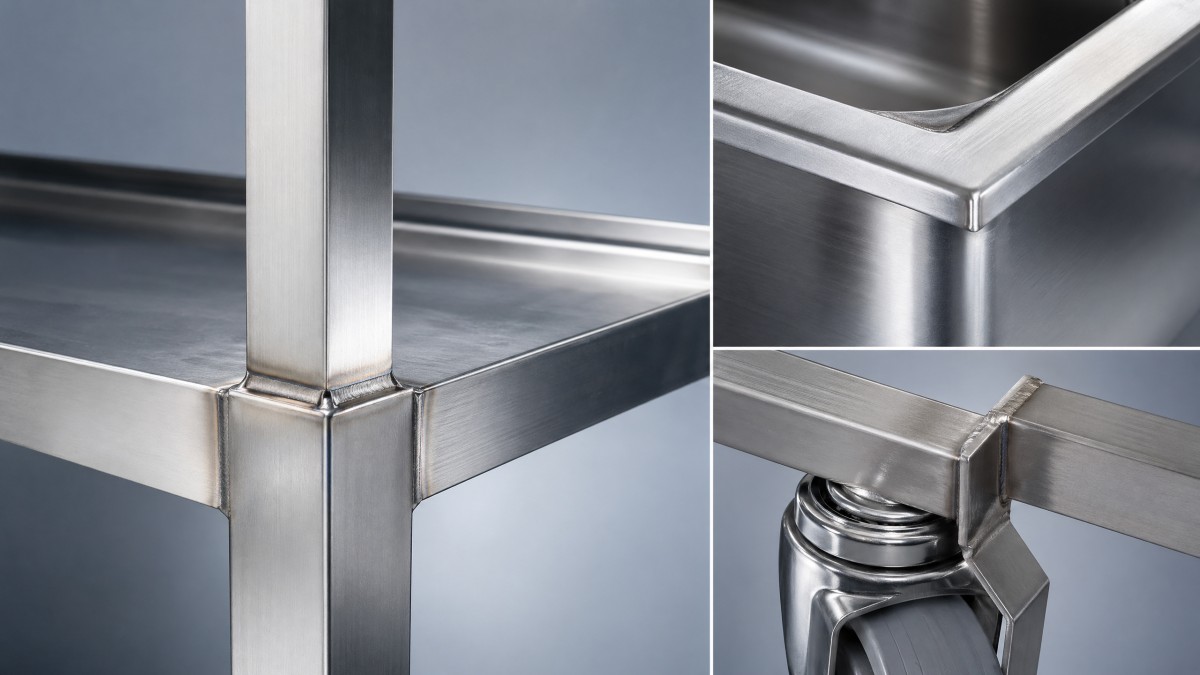
In restaurant and hotel kitchens, stainless steel supplies are exposed to heat, moisture, cleaning chemicals, grease, salt, vibration, and repeated daily use. If a weld is weak, the problem is not only cosmetic. It can lead to:
- Premature equipment failure
- Sharp edges or broken joints that create operator safety hazards
- Hygiene risks caused by cracks, pits, or crevices that trap food residue and bacteria
- Higher maintenance and replacement costs
- Downtime during service
- Warranty disputes with suppliers
For procurement teams and business decision-makers, weld quality directly affects total cost of ownership. A lower purchase price may not be a real saving if tables, sinks, racks, trolleys, shelves, or food prep stations start failing under normal kitchen conditions.
What weak welds look like in stainless steel restaurant supplies
You do not need to be a welding engineer to spot many common weld defects. In most cases, visual inspection already tells you a lot.
1. Uneven or inconsistent weld beads
A strong weld usually looks consistent in width and profile. If the bead suddenly becomes too thick, too thin, lumpy, or irregular, it may suggest poor process control or inconsistent heat input.
2. Visible cracks
Even tiny surface cracks are a serious warning sign. Cracks often grow over time, especially on equipment that is moved frequently or carries weight, such as carts, sinks, racks, and worktables.
3. Pinholes or porosity
Small holes in the weld bead can indicate gas contamination during welding. Porosity weakens the joint and can create sanitation problems because moisture and residue may collect there.
4. Burn marks and heavy discoloration
Some color change is normal after welding stainless steel, but excessive blue, black, or dark brown oxidation may indicate poor shielding gas protection or poor post-weld treatment. This matters because damaged surface passivation can reduce corrosion resistance.
5. Rough, sharp, or poorly finished seams
In foodservice environments, welds should often be smooth enough to clean easily. Rough seams, spatter, undercut edges, and sharp transitions are signs of lower-quality fabrication and may create hygiene or cleaning issues.
6. Misalignment at the joint
If two sections do not line up properly where they are joined, the weld may be carrying uneven stress. This can shorten service life, especially on load-bearing parts.
7. Rust around the weld area
Rust near a stainless steel weld is a red flag. It may suggest contamination with carbon steel tools, poor finishing, inadequate passivation, or heat damage that compromised corrosion resistance.
Where weak welds most often appear on commercial restaurant supplies
Not every weld on a product carries the same risk. Buyers and users should pay special attention to high-stress and high-exposure locations, including:
- Table legs and undershelf connections
- Sink bowl corners and drain areas
- Casters and wheel brackets on carts or trolleys
- Door hinge mounts on cabinets
- Handle joints on mobile equipment
- Shelf supports and rack frames
- Joints near burners, steam, or high heat zones
If you are evaluating commercial restaurant supplies for heavy-duty use, these locations deserve closer inspection than decorative or non-structural seams.
How to inspect weld quality before buying
For sourcing teams, the goal is to catch problems before placing a large order. A practical pre-purchase inspection process can reduce risk significantly.
Ask for close-up product photos or video
Do not rely only on full product images from catalogs. Request detailed images of corners, joints, underside welds, leg connections, and stress points. For a restaurant supplies bulk order, ask for photos from actual production rather than only polished samples.
Request sample units when possible
If the order value is meaningful, inspecting one physical sample can reveal a lot about fabrication consistency, finish quality, and cleanliness of welds.
Check whether the welds match the application
A light-duty utility table and a heavy-load equipment stand should not be held to the same standard. Review expected load, movement frequency, cleaning intensity, and exposure to moisture or chemicals.
Review supplier quality control practices
Ask the restaurant supplies manufacturer:
- What welding method is used, such as TIG or MIG?
- Are welders trained specifically for stainless steel fabrication?
- Are welds ground and polished where hygiene matters?
- Is passivation or post-weld cleaning performed?
- Are there inspection standards for structural and food-contact areas?
Suppliers with mature quality systems are usually able to answer clearly and consistently.
How to inspect welds on equipment already in use
Operators, maintenance staff, and kitchen managers should inspect stainless steel restaurant supplies regularly, especially in busy commercial environments.
Use a simple field checklist
- Look for new cracks, rust spots, or discoloration
- Check whether the joint flexes during normal use
- Press gently around the welded area to detect looseness
- Inspect whether shelves, legs, or handles are shifting out of alignment
- Watch for water retention or residue buildup around seams
- Note any sharp edges or broken finishing around the weld
Pay attention to performance clues
Weak welds do not always fail suddenly. Warning signs can include wobbling tables, squeaking carts, doors that no longer align, or repeated cleaning difficulty at welded joints.
Act early
If a weld shows cracking or corrosion, repair or replacement should be evaluated before the joint fails during service. For load-bearing parts, delayed action can create both safety and operational risks.
Questions procurement teams should ask suppliers
When comparing suppliers of restaurant equipment or restaurant supplies, asking better questions often produces better buying decisions.
- What grade of stainless steel is used, such as 201 or 304?
- Which parts are fully welded and which are spot welded or mechanically joined?
- Are welds continuous in food-contact or wet areas?
- How are welds cleaned, polished, and protected after fabrication?
- Can the supplier provide inspection records, certifications, or factory audit support?
- What is the failure rate or warranty claim history for this product type?
These questions help buyers move beyond price comparison and assess long-term reliability.
Common buying mistakes that lead to weld-related problems
Many weld quality problems begin with sourcing decisions rather than factory accidents. Common mistakes include:
- Choosing based only on unit price
- Ignoring underside or hidden weld areas during inspection
- Assuming all stainless steel products have the same corrosion resistance
- Not matching duty level to actual kitchen usage
- Skipping sample review before a large restaurant supplies bulk order
- Failing to define finish and weld quality requirements in purchase specifications
For enterprise buyers, a more detailed specification sheet can prevent many of these issues. It should define material grade, welding expectations, polishing level, and hygiene requirements for key product categories.
When a weak weld is acceptable and when it is not
Not every imperfect-looking weld means the product is unsafe. Some non-critical areas may show minor cosmetic variation without affecting performance. However, weak welds are not acceptable when they appear in:
- Load-bearing joints
- Food-contact areas
- Wet or chemical-exposed zones
- Mobile equipment subject to vibration or impact
- Products expected to support heavy commercial use
The key is to judge the weld by both appearance and application. A cosmetic flaw may be manageable on a light-duty storage item, but the same flaw could be unacceptable on a sink frame or heavy equipment stand.
How good weld quality adds business value
For decision-makers, better weld quality supports more than durability. It also improves:
- Kitchen safety and compliance
- Cleaning efficiency and hygiene control
- Brand reputation for hotels, restaurants, and foodservice groups
- Asset lifespan and maintenance planning
- Confidence in repeat purchasing from the same manufacturer
In other words, weld quality is not just a technical detail. It is part of product reliability, operational efficiency, and procurement risk management.
Conclusion
To spot weak welds in stainless steel restaurant supplies, focus first on practical signs: cracks, porosity, rust, poor finishing, misalignment, and uneven weld beads. Then evaluate where the weld is located, how the equipment will be used, and whether the supplier can clearly explain its welding and finishing standards. For operators, regular inspection helps prevent accidents and downtime. For buyers and managers, better weld assessment leads to smarter sourcing, lower lifecycle costs, and more reliable commercial kitchen performance.
If you are comparing restaurant supplies manufacturers or planning a commercial restaurant supplies purchase, weld quality should be part of your checklist from the start, not something discovered after installation.
Popular Tags
Kitchen Industry Research Team
Dedicated to analyzing emerging trends and technological shifts in the global hospitality and foodservice infrastructure sector.
Industry Insights
Join 15,000+ industry professionals. Get the latest market trends and tech news delivered weekly.
No spam. Unsubscribe anytime.
Contact With us
Contact:
Anne Yin (Ceramics Dinnerware/Glassware)
Lucky Zhai(Flatware)