
Commercial Gas Range or induction for heavy service
When comparing a Commercial Gas Range with induction for heavy-duty service, the short answer is this: gas still wins where kitchens need maximum flexibility, visual flame control, wok-style heat, and simple field service, while induction often delivers lower energy waste, cooler line conditions, faster pan efficiency, and cleaner operation. For technical evaluators, the right choice depends less on preference and more on duty cycle, cookware mix, ventilation design, utility capacity, menu profile, and lifecycle cost.
Search intent behind this topic is highly practical. The reader is not looking for a generic technology overview. They want a specification-level comparison that helps them decide which platform is better for sustained, high-volume commercial use. They are likely evaluating a new kitchen, replacing aging equipment, or standardizing systems across multiple sites.
The biggest concerns usually include peak performance under continuous load, recovery speed during service rushes, energy efficiency, hood and HVAC impact, maintenance burden, safety, installation constraints, and total cost of ownership. They also want to know where induction is genuinely superior, where gas remains hard to replace, and how to avoid a mis-specification that creates operational bottlenecks.
This article focuses on those decision points. Instead of treating both technologies as equal in every use case, it examines where each one performs best in real heavy-service environments and how technical buyers can build a more defensible procurement decision.
What matters most in heavy-service kitchens: not just heat, but sustained throughput
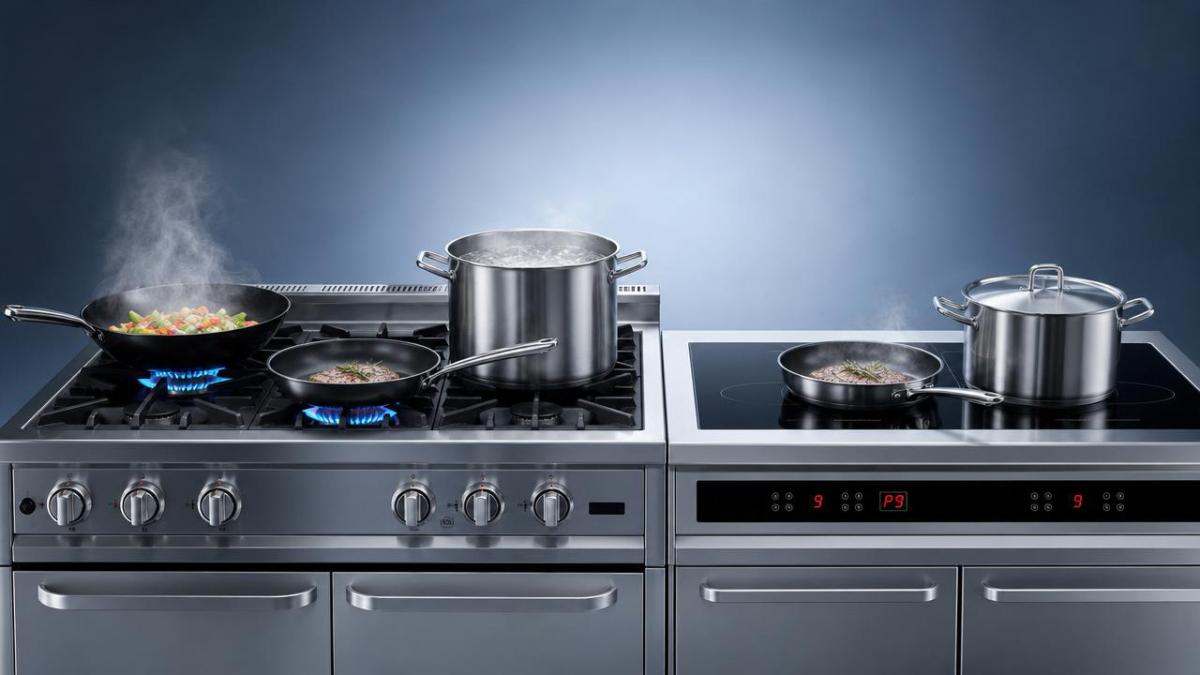
In heavy-duty commercial cooking, equipment should not be judged by headline BTU or wattage alone. The real question is whether the cooking platform can maintain output, recover quickly between batches, support the station workflow, and remain reliable over long service windows. A range that performs well in a demo kitchen may behave very differently during a four-hour peak period in a busy hotel, banquet operation, or high-volume restaurant.
A Commercial Gas Range is often favored in these settings because it supports varied cookware, open-flame techniques, and quick operator adjustments without requiring specialized pans or retraining. Gas ranges also tend to be familiar to chefs and maintenance teams, which reduces adoption friction. For kitchens running stockpots, sauté pans, cast iron, and mixed vessel sizes all day, that flexibility matters.
Induction, however, changes the performance equation by transferring a much higher percentage of energy directly into the pan. This can shorten heat-up times, reduce ambient heat release, and improve cooking consistency on certain stations. In a heavy-service setting, those advantages become significant if the menu is compatible and the electrical infrastructure is properly designed.
Technical evaluators should therefore define “heavy service” clearly before comparing technologies. Is the kitchen executing rapid pan cooking at multiple stations, doing constant stock and sauce work, using oversized cookware, or relying on char, blister, and flame response? The answer shapes the recommendation far more than marketing claims about speed or efficiency.
Performance comparison: heat delivery, recovery, and cooking control
Gas remains strong where visible heat response and broad cooking technique support are required. Operators can instantly see and adjust the flame, move pans partly on or off the burner, and use cookware that is warped, oversized, or non-magnetic. This matters in kitchens where speed depends on human tactile control rather than fixed programmed settings.
For high-BTU applications, a Commercial Gas Range also handles aggressive cooking methods well. Wok cooking, charring, flame-kissed finishes, and large-pan sauté operations are often better suited to gas. If the menu relies on these methods, replacing gas with induction may reduce production quality or require process changes that offset theoretical efficiency gains.
Induction performs especially well in pan contact heating. Because energy is generated in the vessel itself, thermal transfer is direct and efficient. In many controlled cooking tasks, induction can outpace gas in boiling, simmer stability, and repeatability. It is often excellent for sauce stations, finishing lines, hotel breakfast production, institutional kitchens, and operations that value measured consistency.
Recovery speed should be judged at the pan level, not the burner level. Gas has high raw output, but much of that energy escapes around the pan. Induction may have lower perceived drama, yet it can restore pan temperature quickly because less heat is lost to the surrounding air. In batch cooking, that can improve throughput if cookware and loading patterns are appropriate.
Still, induction is not automatically superior for all high-demand lines. Performance depends heavily on cookware quality, pan flatness, and matching vessel diameter to the hob. In real kitchens, inconsistent cookware discipline can reduce induction’s advantage. Technical teams should test actual menu loads, not laboratory assumptions.
Energy efficiency and HVAC impact: where induction often changes the economics
One of induction’s biggest advantages in heavy service is system efficiency beyond the cooktop itself. Gas cooking sends substantial heat into the room, which increases hood capture requirements and raises HVAC load. In hot kitchens, this affects not only utility costs but also staff comfort, productivity, and retention.
A Commercial Gas Range generally requires stronger ventilation because of combustion byproducts and higher ambient heat release. This means the cost comparison should include exhaust airflow, make-up air, and cooling demand. In some projects, the mechanical system implications are large enough to narrow or even reverse the equipment price gap over time.
Induction usually reduces waste heat substantially. That can improve line conditions and lower air-conditioning demand, especially in enclosed kitchens, front-of-house cooking areas, and facilities with high occupancy. In all-day operations, the environmental benefit is operational, not just theoretical: cooler kitchens are easier to staff and can support more stable working conditions.
For technical buyers, the lesson is simple: never compare only burner efficiency. Compare total kitchen energy behavior. A gas range may cost less upfront and still create higher facility operating costs. Conversely, a site with inexpensive gas and constrained electrical capacity may still favor gas despite induction’s efficiency profile.
Infrastructure and installation: the hidden deciding factor in many projects
Many technology comparisons become unrealistic because they ignore site infrastructure. In existing buildings, the choice between induction and a Commercial Gas Range is often determined by utility availability, panel capacity, service upgrades, gas piping condition, and ventilation design rather than by cooking theory.
Gas installation typically requires fuel piping, shutoff valves, combustion-safe placement, and compliance with local code for ventilation and fire protection. In many foodservice markets, contractors and service teams are deeply familiar with these requirements, which can simplify deployment and support.
Induction may appear simpler because there is no combustion, but high-output commercial units can demand substantial electrical capacity. If the facility lacks available amperage, transformer support, or distribution upgrades, installation costs can rise quickly. The result is that a lower-operating-cost technology may carry a higher project entry cost than stakeholders expected.
Another issue is resilience. In some regions, gas supply is stable and economically attractive, while electric rates are volatile or demand charges are significant. In other markets, electrification incentives favor induction and can improve project economics. Technical evaluators should therefore model local utility conditions rather than rely on generic global assumptions.
Compatibility with the broader cooking line also matters. If the kitchen already depends on gas charbroilers, griddles, and stockpot equipment, a fully electric transition may complicate service planning. Hybrid configurations are increasingly common because they let operators place each technology where it performs best.
Maintenance, reliability, and serviceability under continuous use
For heavy-duty operations, maintenance planning is as important as performance. A Commercial Gas Range is mechanically familiar and often field-repairable by a wide pool of technicians. Burners, valves, igniters, and grates can typically be inspected and replaced with established service procedures. That simplicity is one reason gas remains popular in kitchens where downtime carries immediate revenue risk.
However, gas equipment also accumulates grease, carbon deposits, and burner contamination. Flame irregularity, ignition problems, clogged ports, and wear on mechanical controls can affect output over time. Preventive maintenance is essential, especially where the range operates continuously and cleaning discipline varies by shift.
Induction units eliminate combustion-related cleaning issues and often keep the cooking surface cleaner. In many operations, this supports better hygiene and faster line reset between periods. But induction introduces electronics, cooling components, and control modules that require qualified support. If local service coverage is weak, a failure can be harder to resolve than a gas burner issue.
Reliability also depends on user behavior. Slamming heavy pans onto a glass-ceramic surface, using poor-quality magnetic cookware, or blocking cooling airflow can shorten induction equipment life. Technical buyers should review duty-cycle ratings, ingress protection, fan design, spare parts availability, and mean-time-to-service expectations before standardizing on induction.
Cookware, menu fit, and operator adoption: where projects often succeed or fail
No specification is successful if the kitchen team cannot use it naturally. A Commercial Gas Range accepts a broad range of cookware with minimal restrictions. That is valuable in multi-concept operations, legacy kitchens, and facilities where pans circulate across different stations. Gas is forgiving, and that forgiveness reduces friction.
Induction requires magnetic cookware and works best with flat, well-matched pan bases. If the operation uses aluminum pans, rounded-bottom vessels, very large stockpots not suited to the hob, or cookware with inconsistent flatness, performance and user satisfaction can suffer. The cookware replacement budget should be included in project planning.
Menu analysis is equally important. If the kitchen produces soups, sauces, braises, breakfast items, and controlled pan work, induction may provide excellent results. If the concept depends on flambé, visible flame, wok hei, aggressive searing across varied pan types, or improvisational line movement, gas may remain the better fit.
Operator adoption should never be underestimated. Even when induction is technically efficient, resistance from chefs can slow implementation if they believe control is reduced. Practical trials, side-by-side cooking tests, and training sessions can reveal whether the team will actually use the new platform effectively.
Total cost of ownership: the best framework for technical evaluation
For technical assessment teams, the most useful comparison is total cost of ownership across five to ten years. That means combining purchase price, installation, utility cost, ventilation impact, cookware replacement, maintenance, expected downtime, and equipment life. Looking only at upfront price or nominal efficiency can easily produce the wrong result.
A Commercial Gas Range often has advantages in acquisition cost, installation familiarity, and service accessibility. Where gas pricing is favorable and the menu benefits from open-flame flexibility, gas can remain the most economical option in practice. It is especially defensible in high-output kitchens that need rugged versatility more than precise electrified control.
Induction often becomes more attractive when labor comfort, energy performance, cleaning speed, and HVAC savings are included. In facilities with high cooling costs, strong sustainability targets, or front-of-house visibility concerns, those benefits can justify the initial investment. It may also align better with long-term decarbonization strategies.
The best procurement process includes utility modeling, menu testing, infrastructure review, and service network verification. A simple weighted scoring model can help. Common criteria include cooking performance, menu fit, utility readiness, ventilation impact, serviceability, operator acceptance, safety, and lifecycle cost. This method is more reliable than choosing based on brand reputation or trend pressure.
When to choose gas, when to choose induction, and when hybrid is the best answer
Choose a Commercial Gas Range when the kitchen requires maximum cookware flexibility, visible flame control, strong compatibility with traditional chef techniques, and dependable field service under punishing use. Gas is often the stronger option for mixed-format production kitchens, wok applications, and operations where staff expect immediate tactile control.
Choose induction when the menu is compatible, electrical infrastructure is sufficient, energy waste reduction matters, and the operation benefits from a cooler, cleaner, more controlled cooking line. Induction is particularly compelling in institutional environments, premium open kitchens, and operations with strong consistency and sustainability goals.
Choose a hybrid line when the kitchen performs multiple cooking styles and no single technology covers every requirement efficiently. Many advanced facilities now place induction on sauce, holding, and precision stations while retaining gas for high-intensity sauté, stockpot, or wok work. For technical evaluators, hybrid layouts often produce the best balance of performance, efficiency, and operational resilience.
In other words, the decision is not about which technology is universally better. It is about which technology is better for the specific production model, site condition, and long-term cost structure of the kitchen being designed.
Conclusion
For heavy-duty service, a Commercial Gas Range remains a strong choice where flexibility, ruggedness, and flame-based cooking performance are non-negotiable. Induction, however, can outperform gas in energy transfer, kitchen comfort, cleanliness, and some forms of repeatable high-volume cooking. Technical buyers should not treat this as a simple equipment comparison, but as a system-level decision involving menu, utilities, ventilation, maintenance, and labor conditions.
If the goal is the safest long-term specification, evaluate both technologies under real production scenarios, include infrastructure and HVAC costs, and test with actual cookware and menu loads. In many demanding kitchens, the best answer is not gas or induction alone, but the right combination of both.
Popular Tags
Kitchen Industry Research Team
Dedicated to analyzing emerging trends and technological shifts in the global hospitality and foodservice infrastructure sector.
Industry Insights
Join 15,000+ industry professionals. Get the latest market trends and tech news delivered weekly.
No spam. Unsubscribe anytime.
Contact With us
Contact:
Anne Yin (Ceramics Dinnerware/Glassware)
Lucky Zhai(Flatware)