
Kitchen design for restaurants should fix these pain points
Kitchen design for restaurants should do more than look efficient on paper—it must solve real operational pain points such as limited space, slow workflows, high energy use, and food safety risks. For business decision-makers, the right design directly affects productivity, compliance, and long-term profitability, making smart kitchen planning a critical investment rather than a simple layout choice.
Why kitchen planning is changing faster than many operators expected
The conversation around kitchen design for restaurants has shifted. In the past, layout decisions were often driven by available floor space, chef preferences, and equipment lists. Today, the pressure is broader and more strategic. Restaurant groups, hotel operators, central kitchens, and foodservice investors are facing rising labor costs, tighter food safety expectations, stronger demand for speed, and greater scrutiny on utility consumption. As a result, kitchen design is no longer a back-of-house technical task alone; it has become a business performance issue.
This change is closely linked to wider developments in the kitchen equipment industry. Automation, intelligent controls, energy-efficient appliances, and integrated kitchen systems are becoming more accessible. That means modern kitchen design for restaurants is expected to support not only cooking, but also workflow visibility, space efficiency, maintenance planning, and future scalability. Decision-makers who still treat layout as a one-time fit-out risk building operational problems into the business from day one.
Another notable signal is that restaurant formats are diversifying. Quick-service brands, ghost kitchens, premium dining, institutional catering, and hybrid dine-in and delivery concepts all place different demands on prep zones, cooking lines, cold storage, and cleaning areas. A kitchen that once worked for a traditional dining model may now become a bottleneck when delivery volumes rise or menu complexity increases. That is why pain-point-driven design is replacing generic layout planning.
The main pain points kitchen design for restaurants must now solve
For business leaders, the most useful way to evaluate kitchen design for restaurants is to start with the operational frictions that damage output, consistency, and cost control. Several pain points are appearing more frequently across the foodservice market.
- Space inefficiency that forces staff to cross paths, queue at stations, or overload storage areas
- Workflow delays caused by poor sequencing between receiving, prep, cooking, plating, and washing
- Energy waste from oversized, outdated, or badly positioned equipment
- Food safety exposure linked to cross-contamination risks, weak zoning, and hard-to-clean layouts
- Maintenance disruption when equipment access, ventilation, or drainage is poorly planned
- Limited adaptability when menus, peak periods, or service channels change
These are not isolated design flaws. They affect ticket times, labor productivity, food quality, staff retention, inspection readiness, and even brand reputation. In this sense, kitchen design for restaurants has become a direct lever for risk reduction and operating resilience.
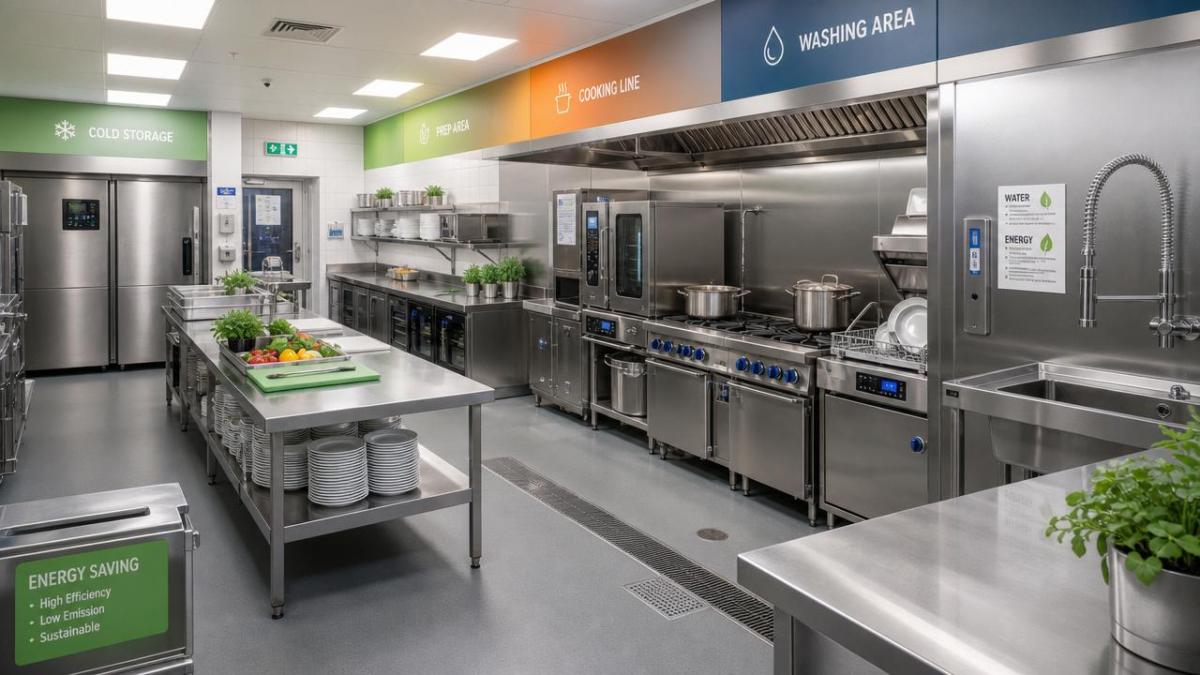
A clear trend signal: layout decisions are moving from static plans to performance-based design
One of the biggest changes in the market is the move from static planning to performance-based design. Instead of asking only where equipment can fit, operators are asking how each zone performs during peak service, how many touches each ingredient requires, how staff move under pressure, and how utilities behave over time. This is a major shift in how kitchen design for restaurants is evaluated.
This trend is being reinforced by the growing availability of smarter kitchen equipment. Programmable cooking systems, energy-monitoring devices, modular prep solutions, and connected refrigeration units make it easier to align design with measurable outcomes. A kitchen can now be planned around service speed, temperature control, cleaning efficiency, and future expansion instead of relying on assumptions alone.
What is driving the shift in kitchen design for restaurants
Several forces are shaping this shift, and they come from both the market and the technology side. First, labor pressure is forcing operators to design kitchens that reduce unnecessary motion and simplify repetitive tasks. If training is expensive and turnover remains high, every avoidable movement becomes a hidden cost.
Second, food safety expectations continue to rise. Whether the operation is a standalone restaurant, a hotel kitchen, or a high-volume central kitchen, regulators and customers expect cleaner separation of raw and cooked flows, easier sanitation, and reliable temperature control. Poor kitchen design for restaurants increases exposure not just to inspection issues, but to operational inconsistency.
Third, energy and sustainability concerns are influencing capital decisions. Energy-efficient kitchen solutions are no longer niche. They are becoming part of mainstream procurement strategy because utility costs affect margins directly. Ventilation, heat load, refrigeration placement, and equipment utilization all influence total operating expense.
Fourth, digitalization is changing expectations. The rise of smart kitchen technologies means operators increasingly want data visibility, preventive maintenance, production consistency, and integration between equipment and management systems. That creates demand for layouts that support connected devices rather than obstruct them.
Who is most affected by these design changes
Although all foodservice businesses are touched by these developments, the impact is not equal. Some business models and stakeholders feel the consequences of weak planning faster than others.
For enterprise decision-makers, this means kitchen design for restaurants should be evaluated differently depending on business format, growth plans, and service model. A design that supports one concept may weaken another, even when the square footage is similar.
The new priorities smart operators are using to judge kitchen design
In the current environment, stronger kitchen planning usually reflects five practical priorities. The first is flow clarity: ingredients, staff, tools, and waste should move through the kitchen with minimal conflict. The second is clean zoning: prep, cooking, cold holding, dishwashing, and waste areas should reduce contamination risks and support sanitation routines.
The third priority is equipment fit rather than equipment quantity. Many kitchens lose efficiency because they buy too much capacity in the wrong format. Right-sized commercial kitchen equipment often performs better than oversized systems that consume more energy and reduce working space. The fourth priority is adaptability. Menus evolve, service channels expand, and labor availability changes. Kitchen design for restaurants should allow reconfiguration without major structural disruption.
The fifth priority is data and lifecycle awareness. Operators increasingly want layouts that make cleaning, servicing, monitoring, and equipment replacement easier over time. That is especially relevant as smart kitchen technologies and digital kitchen management solutions become more common in restaurant operations.
Warning signs that a restaurant kitchen layout may already be outdated
Some operational symptoms suggest that an existing layout is no longer aligned with current business needs. Leaders should pay attention if staff regularly backtrack between stations, if cold storage is distant from prep, if peak-hour service depends on workarounds, or if cleaning routines require excessive manual effort. These are not minor annoyances; they are signals that the kitchen is absorbing cost every day.
Other warning signs include frequent equipment downtime due to poor placement, poor air balance around hot-line appliances, underused stations occupying valuable room, and rising energy bills without a matching increase in output. In many cases, these issues are not solved by replacing one appliance. They point to a deeper need to rethink kitchen design for restaurants as an integrated system.
How decision-makers should respond over the next planning cycle
The most effective response is not to chase every new technology, but to build a structured review process. Start by mapping actual service flow rather than relying on original floor plans. Compare menu requirements, production peaks, labor patterns, and sanitation routines against the current layout. This reveals where bottlenecks are operational, not theoretical.
Next, review kitchen equipment strategy together with layout strategy. The kitchen equipment industry is moving toward automation, intelligence, and energy efficiency, but those benefits depend on placement and integration. A smart combi oven, automated prep unit, or connected refrigeration system only delivers full value when the surrounding workflow supports it.
Decision-makers should also assess flexibility. If the business may expand delivery, increase semi-prepared items, or centralize part of production, the kitchen should not be locked into a rigid arrangement. Modular stations, adaptable utility connections, and balanced storage planning can reduce the cost of future change.
Questions worth asking before the next kitchen investment
Before approving a redesign, expansion, or equipment upgrade, leadership teams should verify a few core points. Does the current kitchen design for restaurants support today’s service mix, not last year’s? Which steps create the most delay during peak production? Are energy-intensive appliances placed and sized appropriately? Can cleaning and maintenance happen without stopping too much work? Is the design ready for smarter equipment and digital monitoring?
These questions help shift the conversation from appearance to performance. They also align kitchen planning with broader business goals such as cost control, compliance, quality consistency, and scalable growth. In a market shaped by changing labor conditions, smarter equipment, and stronger operational scrutiny, restaurant kitchens that fail to solve pain points will fall behind faster than many operators expect.
A practical direction for companies evaluating the next move
The strongest takeaway is simple: kitchen design for restaurants should be treated as a strategic operating system, not just a construction decision. The trend across the foodservice and kitchen equipment sectors is clear—layouts must now support speed, safety, energy efficiency, technology adoption, and long-term adaptability at the same time. Businesses that recognize this shift early are better positioned to improve productivity and protect margin.
If a company wants to judge how these trends affect its own operations, it should focus first on workflow friction, utility performance, sanitation risk, and future menu or channel changes. Those four areas usually reveal whether the current kitchen is still fit for purpose. From there, investment decisions become more precise, and the path toward a more resilient restaurant operation becomes easier to define.
Popular Tags
Kitchen Industry Research Team
Dedicated to analyzing emerging trends and technological shifts in the global hospitality and foodservice infrastructure sector.
Industry Insights
Join 15,000+ industry professionals. Get the latest market trends and tech news delivered weekly.
No spam. Unsubscribe anytime.
Contact With us
Contact:
Anne Yin (Ceramics Dinnerware/Glassware)
Lucky Zhai(Flatware)