
Meat Grinder Capacity Guide: How Much Is Enough
Choosing the right meat grinder capacity is not about buying the biggest machine you can afford. In most cases, the right choice is the grinder that can handle your real peak-hour output without slowing production, overheating, or forcing staff to work in batches all day. If capacity is too small, output becomes a bottleneck. If it is too large, you may overspend on equipment, energy, space, and maintenance. For restaurants, food processors, and equipment evaluators, the best decision comes from matching grinding capacity to daily volume, peak demand, product type, workflow, and future growth.
How do you know how much meat grinder capacity is enough?
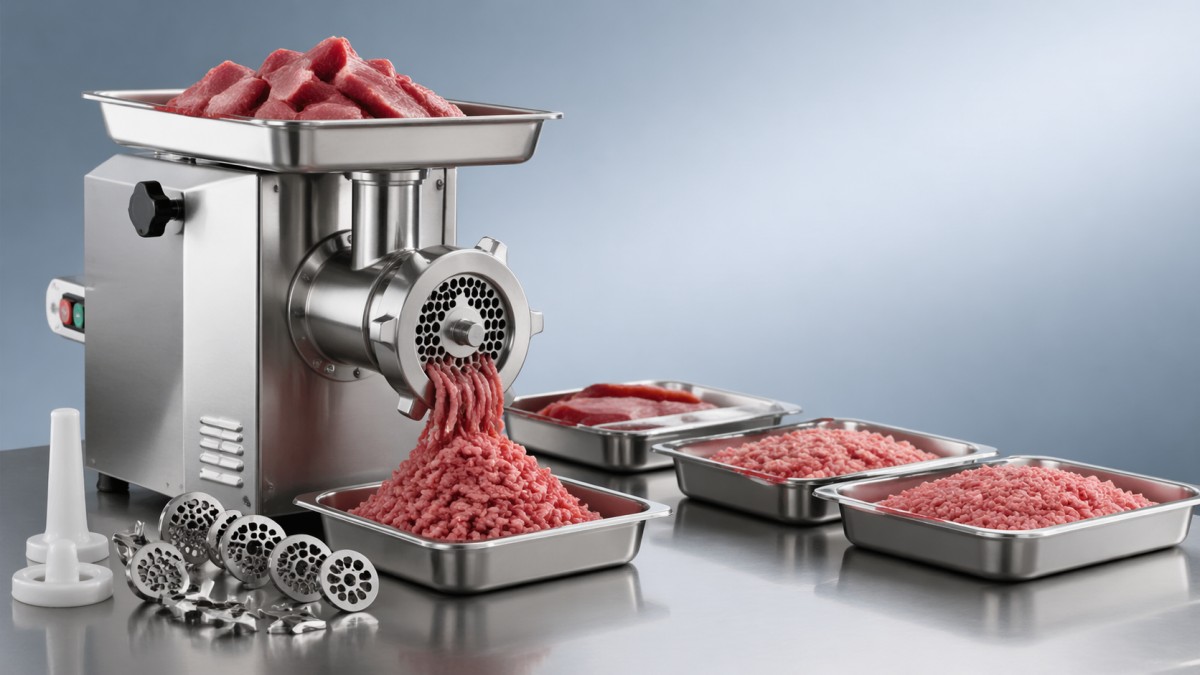
The simplest answer is this: enough capacity means your meat grinder can process your required volume within your available production time, with a safety margin for peak periods.
Many buyers focus only on the published hourly output, but that number alone does not tell the full story. A grinder rated for high output may still be the wrong fit if your operation has limited counter space, short production runs, mixed products, or frequent cleaning cycles. On the other hand, a smaller commercial meat grinder may look economical at first but create labor delays and inconsistent product flow during busy periods.
To judge capacity correctly, decision-makers should evaluate five practical questions:
- How many kilograms or pounds of meat do you need to grind per day?
- How much of that volume must be processed during peak hours?
- Are you grinding soft fresh meat only, or tougher products with fat, sinew, or partial chilling?
- How often will the machine run continuously?
- Do you expect production growth in the next 12 to 24 months?
For most professional buyers, grinder capacity should be sized around actual operating conditions, not ideal lab conditions or maximum advertised throughput.
What capacity factors matter most in real kitchen and processing environments?
When users search for a meat grinder capacity guide, they are usually trying to avoid two risks: underbuying and overbuying. The most useful way to assess capacity is to look beyond a single specification and consider the full operating environment.
1. Daily production volume
Start with your average daily grinding requirement. A small butcher counter, restaurant kitchen, or hotel operation may only need moderate output. A central kitchen or food processing line may require much higher capacity and longer duty cycles.
2. Peak-hour demand
Peak demand matters more than total daily volume. If your team must grind 100 kg in one hour before service, a machine that can theoretically process 100 kg across an entire shift is not enough. Capacity planning should reflect when the work must be completed, not just how much work exists.
3. Meat type and grind consistency
Different products place different loads on a grinder. Boneless fresh meat is easier to process than dense or partially frozen material. If you need a consistent grind for sausages, patties, fillings, or processed products, the grinder must maintain stable performance under load.
4. Continuous versus intermittent use
Some operations grind only occasionally. Others run multiple batches every day. A machine suitable for light-duty use may not perform well in a commercial environment where staff expect continuous operation.
5. Labor efficiency
A larger-capacity machine can reduce handling time, staff waiting time, and repeated loading cycles. This may create more value than the machine specification alone suggests.
6. Cleaning and sanitation downtime
In real-world food production, every cleaning cycle reduces effective output. If sanitation requirements are strict, your practical capacity is lower than the rated number. This is especially important for businesses handling multiple recipes or allergens.
What are typical capacity ranges for different types of users?
Although exact requirements vary by product and workflow, the following ranges can help readers build an initial reference point.
Light-duty use
Suitable for small restaurants, cafés, test kitchens, and low-volume shops. These users usually need limited daily output, shorter operating periods, and flexible equipment rather than maximum throughput.
Medium-duty commercial use
Common in busy restaurants, butcher shops, hotels, and catering kitchens. These operations typically need dependable output, better durability, and the ability to handle daily repeated grinding tasks without frequent pauses.
Heavy-duty commercial or industrial use
Best for central kitchens, meat processing facilities, and high-volume food production businesses. These users need stable high-output performance, stronger motors, durable feeding systems, and equipment designed for long production windows.
For many buyers, the right approach is to first classify the operation by actual usage level instead of jumping directly to a machine model. Once usage level is clear, comparing motor power, feed throat size, grinding head design, and hourly output becomes much easier.
How can buyers calculate the right grinder size more accurately?
A practical sizing method is to work backward from production goals.
Step 1: Estimate required volume
Calculate how much meat you grind on an average day and on your busiest day.
Step 2: Identify the real processing window
Determine how much time is actually available for grinding. A kitchen may operate 10 hours, but only have 1 to 2 hours available for prep.
Step 3: Add a buffer
Include a reserve margin for rush orders, staff interruptions, product variation, and machine wear. A 20% to 30% capacity buffer is often a practical starting point.
Step 4: Adjust for product difficulty
If the meat is colder, denser, fattier, or tougher to process, reduce your expected effective throughput.
Step 5: Compare rated output with usable output
Do not assume the maximum rated number reflects daily real-world performance. Ask suppliers about tested conditions, continuous duty performance, and recommended operating loads.
For example, if your operation needs to grind 300 kg during a 3-hour prep window, your baseline requirement is 100 kg per hour. After adding a 25% buffer, you should evaluate machines capable of about 125 kg per hour under realistic working conditions.
When does a bigger meat grinder make business sense?
A larger grinder is justified when it improves total operating efficiency, not simply when it offers a higher specification.
For enterprise buyers and technical evaluators, a larger-capacity machine may be the better investment when:
- Labor costs are high and faster throughput reduces working hours
- Peak production regularly causes prep delays
- Demand is growing and replacement in the near term would be costly
- Product consistency affects food quality or brand reputation
- The grinder is part of a broader food processing workflow that depends on stable throughput
In these cases, the value of more capacity is not just output. It also includes smoother kitchen operations, more predictable production planning, lower risk of bottlenecks, and less pressure on staff.
However, bigger is not always better. Oversized equipment can increase purchase cost, use more space, consume more energy, and create inefficiency if the machine is frequently underused. For smaller kitchens, this can hurt return on investment.
What mistakes should buyers avoid when comparing meat grinder capacity?
One of the most common mistakes is treating grinder capacity as an isolated number. In reality, performance depends on the entire system around the machine.
Buyers should avoid these frequent errors:
- Choosing only by maximum hourly output without considering actual duty cycle
- Ignoring cleaning frequency and sanitation downtime
- Overlooking product type and texture requirements
- Failing to account for future growth in menu expansion or processing volume
- Underestimating workflow impact on upstream prep and downstream forming, mixing, or packing
- Comparing machines without checking motor durability, build quality, and parts availability
For technical assessment teams, it is also useful to compare the grinder with adjacent solutions such as a commercial food processor or integrated food processing equipment. In some applications, grinding is only one step in a larger production chain, so line compatibility matters as much as standalone output.
How should restaurants, processors, and decision-makers make the final choice?
The final decision should connect capacity to business reality. Restaurants need a grinder that supports service speed and menu consistency. Operators need equipment that is easy to run and clean. Technical evaluators need reliable performance data. Business decision-makers need a machine that balances cost, productivity, and future flexibility.
A strong purchase decision usually comes from asking suppliers these practical questions:
- What is the tested output under normal commercial conditions?
- Is the machine designed for light, medium, or heavy-duty use?
- How long can it run continuously?
- What types of meat and product conditions are recommended?
- How easy is it to clean, maintain, and service?
- What spare parts and technical support are available?
- What capacity range do similar customers typically choose?
This approach helps buyers move from broad specification comparison to more reliable equipment selection.
Conclusion: the right capacity is the one that matches your workflow
If you are deciding how much meat grinder capacity is enough, the best answer is not the largest model or the cheapest option. It is the machine that can meet your peak production needs efficiently, safely, and consistently, while leaving room for realistic growth. Capacity should be evaluated through daily volume, peak-hour demand, product type, continuous use requirements, labor efficiency, and sanitation downtime.
For kitchens, butcher operations, and food processing businesses, the smartest investment is a grinder sized for real operating conditions. When capacity is matched correctly, you gain better workflow, steadier output, improved food quality, and stronger cost control.
Popular Tags
Kitchen Industry Research Team
Dedicated to analyzing emerging trends and technological shifts in the global hospitality and foodservice infrastructure sector.
Industry Insights
Join 15,000+ industry professionals. Get the latest market trends and tech news delivered weekly.
No spam. Unsubscribe anytime.
Contact With us
Contact:
Anne Yin (Ceramics Dinnerware/Glassware)
Lucky Zhai(Flatware)