
Are modular restaurant supplies worth the extra cost
Are modular restaurant supplies worth the extra cost for buyers evaluating long-term kitchen investments? For commercial foodservice operations, the answer often depends on efficiency, scalability, maintenance, and total lifecycle value. As kitchens move toward smarter, more flexible layouts, modular restaurant supplies are gaining attention for their ability to support changing workflows, improve space utilization, and strengthen operational consistency.
Why the conversation is changing now
For many years, restaurant equipment purchasing was driven mainly by upfront price, brand familiarity, and basic durability. That decision model is now shifting. Foodservice operators face tighter labor markets, rising energy costs, stricter food safety expectations, and more frequent menu changes. In that environment, kitchen layouts that were once treated as fixed assets are increasingly being evaluated as flexible operating systems.
This is why modular restaurant supplies are receiving more serious attention from business evaluators. The extra cost is no longer judged only against standard stainless-steel tables, shelving, prep stations, or cooking line components. Buyers are comparing the long-term value of adaptability, easier replacement of parts, workflow redesign, and compatibility with digital kitchen management trends.
In practical terms, the market is moving away from one-time static installation toward investment models that support change over five to ten years. That trend is especially relevant in restaurants, hotels, central kitchens, ghost kitchens, and food processing environments where production needs are evolving faster than before.
The market signals behind rising interest in modular restaurant supplies
Several visible signals explain why modular restaurant supplies are being discussed more often in procurement reviews and facility planning meetings. These signals are not isolated. Together, they indicate a broader shift in the kitchen equipment industry toward flexibility, integration, and lifecycle efficiency.
These signals matter because they change the definition of value. Buyers are no longer asking only, “How much does this unit cost today?” They are also asking, “How expensive will it be to adapt this kitchen later?”
What is driving the premium beyond the product itself
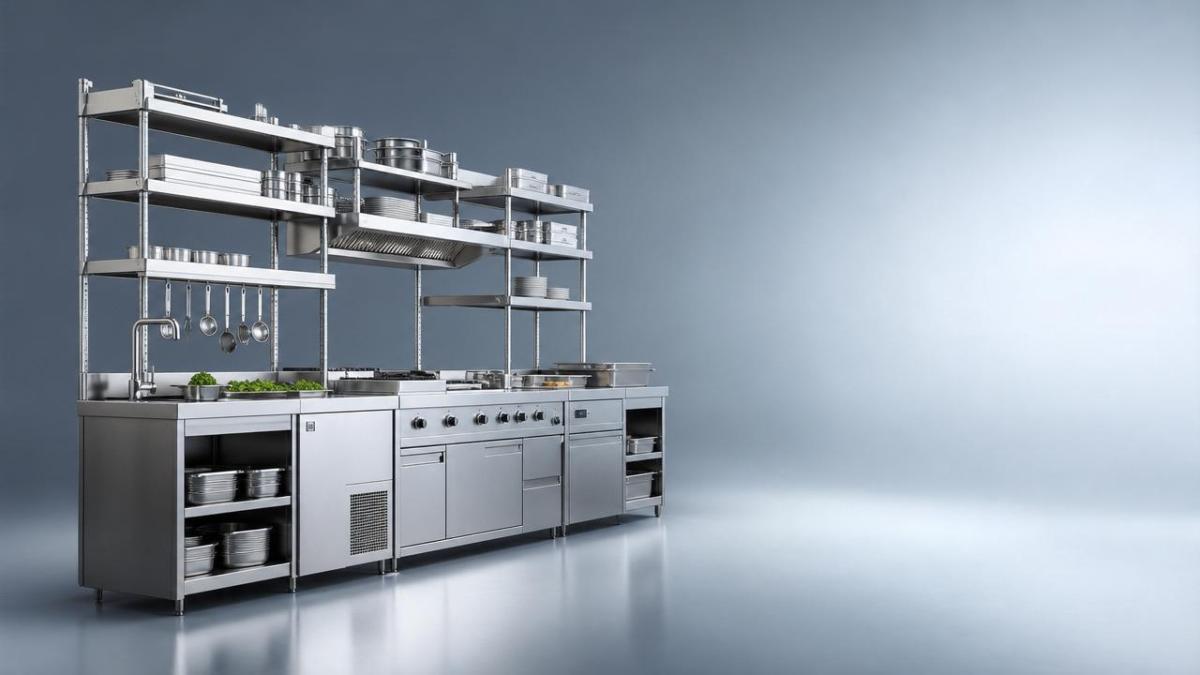
The higher price of modular restaurant supplies usually comes from design complexity, material consistency, interchangeability, and engineering that allows components to connect, detach, expand, or relocate more easily. In many cases, the premium also reflects better compatibility with ventilation planning, utility access, sanitation design, and maintenance pathways.
That cost premium should not be viewed only as a markup on metalwork or fabrication. It often represents lower friction across the operating life of the kitchen. For example, a modular prep line may reduce downtime during a layout update. A modular shelving system may scale with inventory turnover. A modular cooking battery may allow selective replacement instead of a complete line overhaul.
This matters in the broader kitchen equipment industry, where automation, intelligent systems, and energy-efficient configurations are becoming more common. Equipment is increasingly purchased as part of an operational ecosystem rather than as isolated units. In that context, modular design can support future upgrades more effectively than fixed-format alternatives.
Who feels the impact most strongly
The value of modular restaurant supplies is not identical for every buyer. The extra cost can be highly justified for some operations and less compelling for others. Business evaluation teams should focus on where change pressure is highest.
This pattern is important for procurement strategy. The more uncertain the future operating model, the more valuable modular restaurant supplies tend to become. In contrast, if an operation has a highly stable menu, fixed output, and no realistic plan for reconfiguration, the return may be slower.
The hidden economics: where buyers often undercalculate value
When buyers compare quotes, they often focus on purchase price and basic warranty terms. That approach can miss several economic factors that increasingly matter in commercial kitchens.
1. Reconfiguration cost
A fixed setup may be cheaper at installation, but expensive to modify later. Demolition, relocation, utility changes, and production interruption can easily outweigh the initial savings.
2. Downtime risk
If one part of a traditional integrated setup fails, replacement may be slower or broader than necessary. Modular restaurant supplies can sometimes isolate the affected section and reduce operational disruption.
3. Space productivity
As rents rise and kitchen footprints become more compressed, every square meter must perform. Modular designs can support denser, cleaner, and more purposeful use of available space.
4. Standardization across sites
For chains and expanding operators, repeatable layouts help with training, maintenance, spare parts planning, and opening timelines. The value compounds with each additional location.
5. Lifecycle sustainability
Sustainability is no longer only a branding topic. Buyers increasingly consider repairability, replacement by section, and lower material waste over time. Modular restaurant supplies fit well with that direction.
How industry technology trends make modular choices more relevant
The kitchen equipment sector is moving toward intelligent cooking equipment, automated systems, and digital management tools. That evolution increases the importance of infrastructure flexibility. As smart appliances, monitoring devices, and energy-management systems become more common, kitchens may need layout adjustments to support connectivity, ventilation, workflow sequencing, and service access.
Modular restaurant supplies are well aligned with this direction because they make incremental modernization easier. Instead of replacing an entire setup in one capital event, operators may be able to upgrade step by step. This staged investment model is attractive for businesses that want to reduce capital shock while keeping pace with technology change.
Another factor is the rise of integrated kitchen systems. Commercial kitchens are increasingly judged as connected environments where prep, cooking, storage, cleaning, and dispatch must work together. Modular planning helps decision-makers adjust individual zones without breaking the whole operational structure.
What buyers should verify before accepting the premium
Not every product labeled modular creates real long-term value. Business evaluation teams should examine the quality of the modular logic, not just the marketing language.
- Check whether components are truly interchangeable or only loosely grouped.
- Confirm spare parts availability and replacement lead times.
- Review whether utility connections allow practical future changes.
- Assess sanitation design, especially at joints, seams, and movable interfaces.
- Ask whether the system supports phased expansion across multiple sites.
- Evaluate compatibility with energy-efficient and smart kitchen upgrades.
This evaluation is essential because the premium is justified only when adaptability is real, maintainable, and operationally useful. A poorly designed modular system can introduce complexity without delivering meaningful flexibility.
A practical way to judge whether modular restaurant supplies are worth it
Rather than asking whether modular restaurant supplies are universally worth the extra cost, buyers should ask a sequence of business questions tied to future change. The strongest decisions usually come from scenario thinking, not from simple price comparison.
What to watch in the next stage of the market
Looking ahead, several developments could make modular restaurant supplies even more relevant. First, kitchen automation will continue to reshape line design, especially in high-volume and labor-sensitive operations. Second, sustainability pressures will push buyers toward equipment systems that can be repaired, reconfigured, and partially upgraded. Third, international sourcing and export competition may improve access to more standardized modular formats, especially from major kitchen equipment manufacturing centers.
At the same time, buyers should watch for two cautions. One is overengineering: paying for flexibility that the business will never use. The other is fragmented compatibility: choosing systems that appear modular but do not integrate well across brands, utilities, or site conditions. The best outcomes usually come from matching modular investment to a realistic operating roadmap.
Final judgment for business evaluators
In today’s kitchen equipment market, modular restaurant supplies are often worth the extra cost when a business expects operational change, expansion, technology upgrades, or space optimization pressure. Their value is strongest where flexibility reduces future disruption and supports a longer, more efficient asset life. They are less compelling when the kitchen model is highly stable and capital budgets are tightly limited.
If your organization wants to judge the opportunity more accurately, focus on a few key questions: how often the layout may change, how expensive downtime would be, whether multi-site standardization matters, and how likely smart kitchen upgrades are in the next few years. Those answers usually reveal whether modular restaurant supplies are a premium expense or a strategic investment.
Popular Tags
Kitchen Industry Research Team
Dedicated to analyzing emerging trends and technological shifts in the global hospitality and foodservice infrastructure sector.
Industry Insights
Join 15,000+ industry professionals. Get the latest market trends and tech news delivered weekly.
No spam. Unsubscribe anytime.
Contact With us
Contact:
Anne Yin (Ceramics Dinnerware/Glassware)
Lucky Zhai(Flatware)