
What a restaurant supplies factory must prove before expansion
Before scaling into new markets, a restaurant supplies factory must prove more than production capacity. Decision-makers need evidence of compliance, quality consistency, supply chain resilience, and the ability to support smart, energy-efficient kitchen solutions at scale. In a fast-changing global foodservice market, expansion succeeds only when a factory can demonstrate reliability, adaptability, and long-term value for commercial buyers.
What must a restaurant supplies factory prove before expansion?

For enterprise buyers, expansion is not just a growth story. It is a risk question. When a restaurant supplies factory enters a new region, commercial kitchen distributors, hotel groups, central kitchen operators, and food processing investors want proof that the factory can deliver the same standards across larger volumes, more complex compliance rules, and tighter delivery expectations.
In the kitchen equipment industry, that proof has become more demanding. Buyers now evaluate not only stainless steel workmanship, heating performance, or appliance durability, but also digital control capability, energy efficiency, traceability, maintenance support, and responsiveness to local market requirements. A factory that was competitive in one country may still fail in another if its systems are not scalable.
This matters because the sector serves many use environments at once: restaurants, hotels, food processing facilities, institutional catering, and increasingly integrated smart kitchens. Expansion therefore requires a broader operating model. A restaurant supplies factory must show it can support traditional volume procurement and newer demands such as connected equipment, automated workflows, and lower operating energy consumption.
- Can production remain stable when order quantity increases suddenly?
- Can quality stay consistent across multiple product categories and shipment batches?
- Can the factory meet destination-market certification, labeling, electrical safety, and food-contact expectations?
- Can after-sales documentation, spare parts, and technical communication support long-term commercial use?
If the answer is unclear, expansion becomes a cost center rather than a growth engine. That is why a structured evaluation framework is essential before any buyer approves a long-term supplier relationship.
Why capacity alone is not enough in the modern kitchen equipment market
Many factories highlight workshop size, machine count, or monthly output. These indicators matter, but they are only the starting point. In today’s global foodservice environment, demand is shifting toward higher reliability, shorter lead times, lower lifecycle cost, and equipment that supports safer and smarter operations.
Expansion pressure comes from both demand and regulation
As restaurant chains expand, hotels renovate, and central kitchens automate, procurement teams expect standardized supply from fewer, stronger partners. At the same time, different export markets may require different electrical configurations, food-contact material declarations, packaging marks, user manuals, or testing documents. A restaurant supplies factory that lacks process discipline can easily create delays, claims, or customs issues.
Smart and energy-efficient products raise the bar
The industry is moving toward intelligent cooking equipment, automated processing systems, and energy-conscious kitchen solutions. That means the factory must coordinate mechanical production with electronics integration, software logic, sensor reliability, and maintenance planning. Buyers are not only purchasing equipment. They are investing in uptime, operating efficiency, and future adaptability.
- A conventional fabrication shop may handle simple stainless-steel products well but struggle with connected controls.
- A factory with strong assembly lines may still underperform if supplier qualification and incoming inspection are weak.
- A low-price exporter may win first orders but fail repeat business due to spare-part delays or unstable specifications.
For decision-makers, the takeaway is clear: expansion readiness is a system capability, not a volume claim.
The proof points buyers should verify before approving a factory for expansion
The most practical way to assess a restaurant supplies factory is to convert broad claims into verifiable proof points. Procurement leaders should require evidence that links production, quality, compliance, delivery, and technical support into one operational picture.
The table below gives a decision-oriented framework for evaluating whether a factory is truly ready for expansion into new markets or larger account programs.
A restaurant supplies factory that can answer these questions with documents, process visibility, and consistent communication is far more expansion-ready than one relying on general assurances. Buyers should treat undocumented claims as unverified risk, especially when projects involve chains, tenders, or multi-site rollouts.
Which certifications and compliance capabilities matter most?
Compliance expectations vary by product category and destination market, so decision-makers should avoid one-size-fits-all assumptions. A restaurant supplies factory may produce gas equipment, electric cooking appliances, stainless-steel preparation units, food-contact accessories, or automated processing systems. Each category can trigger different documentation and testing needs.
Focus on fit-for-market compliance, not generic paperwork
What matters is whether the factory understands the target market and can support the relevant compliance path. That may include electrical safety conformity, food-contact material suitability, factory quality management procedures, environmental or energy-related declarations, and correct packaging or instruction labeling.
The table below summarizes the types of compliance evidence commercial buyers often review when evaluating a restaurant supplies factory for international expansion.
This kind of compliance review helps buyers separate factories that simply manufacture from those that can support real market entry. It also reduces risk when products are sold into hotels, chain restaurants, central kitchens, or food processing facilities where audits and operating accountability are stricter.
How decision-makers should assess quality consistency and process control
A restaurant supplies factory may ship an acceptable sample and still fail under full-scale production. The real test is repeatability. Commercial buyers should therefore focus on how the factory controls the process from raw material intake to packing, not only on the appearance of finished goods.
Key process questions to ask
- How are incoming stainless steel, electrical parts, thermostats, burners, or control boards verified before use?
- What dimensions, pressure values, temperature accuracy points, or finish tolerances are inspected during production?
- How are rework, rejected units, and field-return feedback documented and translated into process improvement?
- Can the factory maintain traceability by lot, component batch, or production date if a problem appears after delivery?
These questions become even more important when the factory supplies mixed categories such as cooking lines, preparation tables, refrigeration support units, food processing equipment, and kitchen electrical appliances. Multi-category production often introduces hidden variation unless procedures are standardized and operator training is disciplined.
Quality consistency is commercial protection
For enterprise buyers, quality variation is not a technical inconvenience. It can delay kitchen opening dates, increase service dispatches, trigger franchise complaints, and raise inventory carrying costs. A restaurant supplies factory that proves stable process control reduces these downstream costs and becomes a more strategic supply partner.
Can the factory support smart, automated, and energy-efficient kitchen solutions?
The future of kitchen equipment is not defined by metal fabrication alone. Buyers increasingly want equipment that can improve labor efficiency, standardize output, reduce utility consumption, and fit into digital kitchen management practices. This is especially relevant for chains, cloud kitchens, food processing units, and large hospitality operators.
- Smart controls can help standardize temperature settings and cooking cycles across sites.
- Automated systems can reduce manual handling in repetitive food preparation tasks.
- Energy-efficient design can lower operating cost through better insulation, standby logic, and optimized heat transfer.
- Integrated monitoring can support maintenance planning and reduce unplanned downtime.
A restaurant supplies factory does not need to offer the most advanced automation in every product line, but it should prove that it understands where the market is moving. Buyers should ask whether the factory can adapt electrical systems, control interfaces, communication modules, and component sourcing to support future product development.
This capability is particularly important in expansion because new markets may be less tolerant of outdated specifications. A factory that can align with smart kitchen trends is better positioned to serve large accounts seeking long-term standardization and lower total cost of ownership.
Procurement checklist: how to compare one restaurant supplies factory with another
When procurement teams compare suppliers, price often dominates too early. A better approach is to score the factory against operational, commercial, and technical criteria before negotiating cost. This creates a more defensible sourcing decision and reduces unpleasant surprises after onboarding.
A practical buyer checklist
- Product fit: Does the factory specialize in the kitchen equipment categories your business actually buys?
- Engineering clarity: Are drawings, specifications, and customization limits clearly defined before order confirmation?
- Lead time reliability: Is there evidence that planned delivery dates match historical shipment performance?
- Service readiness: Can the factory support manuals, spare parts, troubleshooting, and replacement workflows?
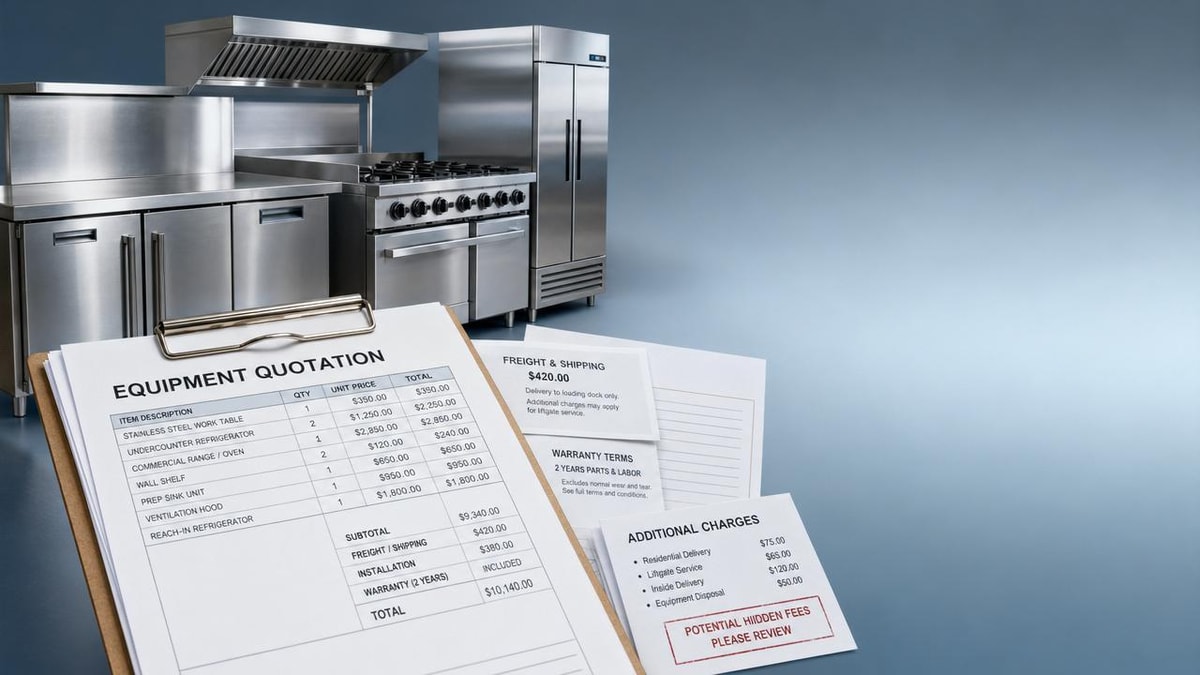
- Cost transparency: Are tooling, packaging, certification support, and customization charges explained in advance?
For expansion programs, it is also wise to start with a pilot order or category-specific trial rather than a full basket conversion. This lets buyers validate packaging strength, installation experience, documentation quality, and field performance before moving higher-volume projects to the same restaurant supplies factory.
Common mistakes buyers make when evaluating expansion-ready suppliers
Even experienced sourcing teams can misread supplier readiness. In the kitchen equipment industry, the most expensive problems often come from assumptions made too early in the process.
Mistakes to avoid
- Assuming factory size equals process maturity. Large workshops do not automatically mean strong quality systems.
- Approving based on sample quality alone. Expansion risk appears in repeat production, not single units.
- Ignoring documentation capability. Missing manuals, labels, or parts lists can slow projects as much as product defects.
- Underestimating after-sales structure. Restaurants and hotels need timely support because downtime affects revenue directly.
- Choosing the lowest quote without lifecycle analysis. Lower purchase price can produce higher warranty, energy, and replacement costs.
A disciplined evaluation protects budget, brand reputation, and opening schedules. It also helps procurement teams explain their supplier choice to finance, operations, and project stakeholders in a measurable way.
FAQ: questions buyers often ask about a restaurant supplies factory before expansion
How do I know whether a restaurant supplies factory can handle larger orders?
Ask for evidence of capacity planning, peak-load handling, subcontracting policy, and actual lead time differences between sample, pilot, and bulk orders. The right supplier should explain how it protects critical processes such as fabrication, assembly, testing, and packing when order volume increases.
What should I prioritize: price, compliance, or delivery speed?
For expansion, compliance and delivery reliability usually come before unit price. If the equipment fails inspection, arrives late, or lacks proper documents, the total project cost rises quickly. Price still matters, but it should be evaluated together with operating life, service burden, and consistency.
Are smart kitchen features necessary for every project?
Not always. Smaller or simpler installations may not need advanced connectivity. However, the restaurant supplies factory should still show that it can support energy-efficient design, control upgrades, or future integration if your business expands into chain operations, central kitchens, or more automated workflows.
How important is spare-parts support in supplier evaluation?
It is essential. A factory that can ship equipment but cannot support replacement parts, technical diagrams, or troubleshooting creates long-term operational risk. Buyers should confirm spare-parts availability, recommended stock lists, and expected response times before approving the supplier.
Why choose us for your next expansion-stage sourcing project
If you are evaluating a restaurant supplies factory for new-market entry, distributor expansion, or multi-site procurement, the right conversation should begin with facts, not promises. We support buyers with practical pre-order communication focused on technical fit, compliance expectations, delivery planning, and commercial feasibility.
You can contact us to discuss product selection across commercial kitchen equipment, restaurant appliances, food processing machinery, kitchen electrical products, and supporting tools or utensils. We can also help clarify specification matching for voltage, material, usage intensity, and project environment.
- Parameter confirmation for product size, power, control type, and installation conditions
- Factory evaluation support for product categories, process capability, and documentation readiness
- Lead time and delivery discussion for pilot orders, bulk projects, and phased rollout plans
- Customization planning for branding, packaging, configuration, and market-specific requirements
- Certification and compliance communication based on target market expectations
- Sample support and quotation discussion for serious procurement evaluation
For enterprise decision-makers, expansion works best when supply capability, product strategy, and market requirements are aligned early. If you are comparing options and need a clearer path on selection, technical review, delivery timing, or quoting, contact us with your project scope and target market. A structured discussion now can save significant cost and delay later.
Popular Tags
Kitchen Industry Research Team
Dedicated to analyzing emerging trends and technological shifts in the global hospitality and foodservice infrastructure sector.
Industry Insights
Join 15,000+ industry professionals. Get the latest market trends and tech news delivered weekly.
No spam. Unsubscribe anytime.
Contact With us
Contact:
Anne Yin (Ceramics Dinnerware/Glassware)
Lucky Zhai(Flatware)