
Commercial Griddle Heat Control Problems and How to Avoid Them
Commercial griddle heat control problems rarely stay “small” for long. In a busy kitchen, poor temperature control leads directly to uneven cooking, ticket delays, wasted energy, inconsistent food quality, and more frequent service calls. For operators, technical evaluators, and business decision-makers, the key issue is not just why a griddle overheats or develops cold spots, but how to identify the root cause quickly and prevent repeat failures through better equipment selection, maintenance, calibration, and kitchen workflow planning.
In most cases, heat control problems come from a combination of thermostat inaccuracy, uneven plate heating, sensor failure, poor operator habits, grease buildup, voltage or gas supply instability, and using the griddle beyond its intended production load. When these issues are addressed systematically, commercial griddle performance becomes more predictable, food quality improves, and the entire professional kitchen equipment line—from the commercial deep fryer to commercial refrigeration equipment—works more efficiently together.
Why commercial griddle heat control problems matter more than many kitchens expect
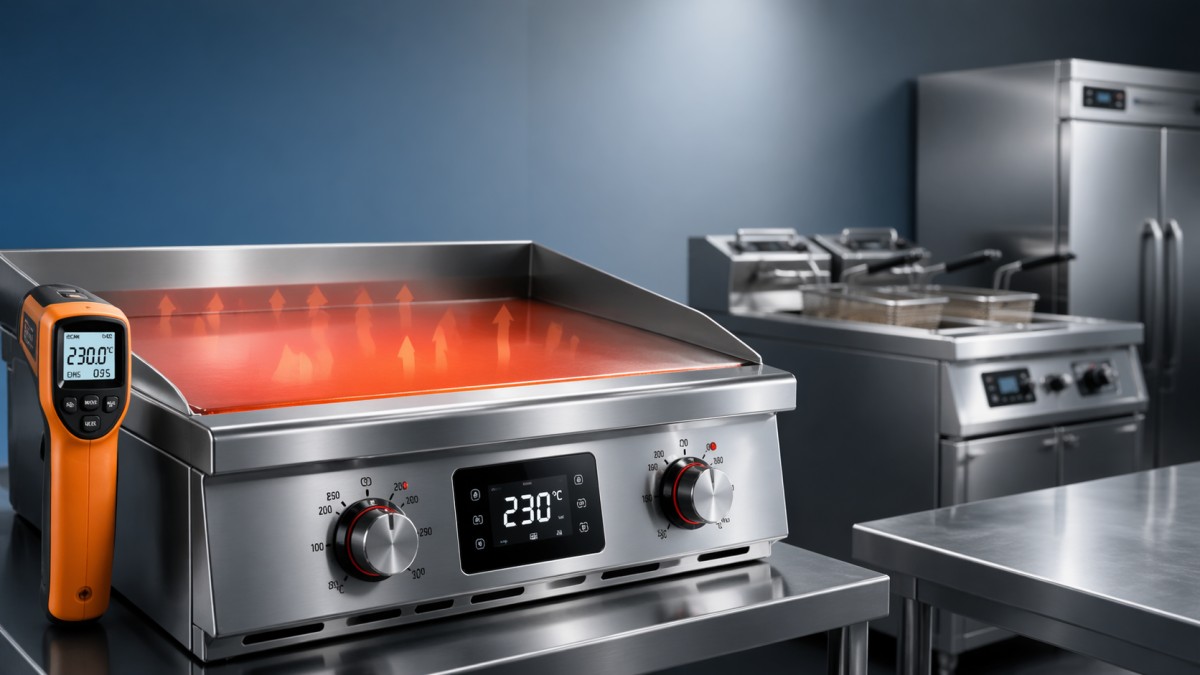
A commercial griddle is often one of the most heavily used stations in a restaurant kitchen. Unlike equipment used for a single cooking method or limited menu item, the griddle may handle breakfast service, burgers, sandwiches, proteins, vegetables, and high-volume batch cooking throughout the day. That means even minor heat instability can create broad operational problems.
When heat control is poor, the first visible symptom is usually inconsistent food. One side of the griddle browns too fast while another area cooks too slowly. Pancakes may come out pale in one batch and over-dark in the next. Burgers may appear properly seared outside but remain undercooked in the center because the surface temperature rose unevenly. In high-output operations, this inconsistency affects guest satisfaction, labor efficiency, and food safety confidence.
For managers and buyers, there is also a cost issue. A griddle that cycles incorrectly, stays hotter than required, or struggles to recover temperature after each batch can consume more energy and slow production. It may also force staff to compensate manually, which increases training difficulty and creates process variation between shifts. In a kitchen equipment strategy, heat control reliability should be evaluated as seriously as cooking capacity and purchase price.
The most common signs your commercial griddle has a heat control problem
Many kitchens notice performance decline before they identify it as a heat control issue. The most common warning signs include:
- Food cooking unevenly across different zones
- Surface temperature not matching dial or digital setting
- Long recovery time after loading food
- Hot spots or cold spots on the plate
- Frequent overcooking during peak periods
- Unexpected shutdowns or unstable burner/heating element behavior
- Excessive energy use without corresponding output
- Operators constantly adjusting controls to “guess” the right setting
For technical teams, these symptoms point to a need for measured verification rather than assumption. Surface temperature checks with an infrared thermometer, contact probe testing, recovery-time observation, and comparison against manufacturer specifications can quickly show whether the issue is mechanical, electrical, gas-related, or operational.
What usually causes uneven or unstable heat on a commercial griddle
Most commercial griddle heat control problems fall into a few root-cause categories.
1. Faulty thermostat or temperature sensor
If the thermostat is inaccurate or the sensor no longer reads surface conditions correctly, the unit may overheat, undershoot, or cycle at the wrong intervals. This is one of the most common reasons operators feel the control setting “does not match reality.”
2. Heating element or burner imbalance
On electric units, worn or partially failing heating elements can create weak zones. On gas griddles, burner blockage, low gas pressure, or ignition inconsistency can lead to uneven heating patterns. Even if the unit still operates, output may no longer be balanced across the cooking surface.
3. Grease, carbon, and debris buildup
A poorly maintained griddle plate does not transfer heat efficiently. Carbonized residue creates localized barriers that affect browning, response time, and temperature consistency. Internal grease buildup can also interfere with performance and create safety risks.
4. Inadequate calibration
Some units drift over time. Without periodic calibration or performance checks, kitchens may continue using a griddle that has gradually moved away from the intended setpoint range.
5. Power supply or gas supply issues
Fluctuating voltage, undersized electrical infrastructure, unstable gas pressure, or poor installation can all affect heating behavior. This is especially relevant in larger commercial kitchen design projects where multiple high-demand appliances operate simultaneously.
6. Overloading and improper use
Even a well-built commercial griddle can struggle if staff load too much cold product at once, use the wrong zone for the wrong item, or constantly scrape and clean in ways that disrupt production timing. A heat control “problem” is sometimes actually a workflow problem.
How to diagnose the problem before calling for replacement
Not every griddle with inconsistent results needs to be replaced. In many cases, a structured check can separate a maintenance issue from an equipment failure.
- Verify actual plate temperature. Compare the set temperature with measured readings in multiple zones.
- Check for zone deviation. If one side differs significantly from another, inspect burners, elements, or heat distribution components.
- Observe recovery time. Cook a normal batch load and measure how quickly the plate returns to working temperature.
- Inspect controls and indicators. If the thermostat cycles irregularly or the digital control display seems inaccurate, sensor or controller issues may be present.
- Review cleaning condition. Surface contamination and grease accumulation can distort performance more than many teams expect.
- Confirm utility stability. Check electrical supply, gas pressure, regulator condition, and ventilation impact.
- Compare against production demands. If menu volume has expanded, the unit may no longer match the current load profile.
This approach helps operators and service technicians make better repair-or-replace decisions. It also gives purchasing teams better evidence when evaluating warranties, service contracts, or equipment upgrades.
How to avoid commercial griddle heat control problems in daily operation
The most effective prevention strategy combines proper equipment choice, routine verification, and better operating habits.
Train staff to use heat zones correctly
Many commercial griddles are designed for multi-zone use. When staff understand which areas are for searing, holding, finishing, or lower-temperature cooking, overall surface performance improves and unnecessary thermostat adjustments decrease.
Standardize preheat and batch-loading procedures
A griddle needs consistent preheat time and disciplined loading practices. Dropping too much refrigerated product onto the plate at once can cause temperature collapse and inconsistent recovery. This is especially important when the griddle works in coordination with commercial refrigeration equipment, since product temperature entering the line directly affects cooking stability.
Clean correctly and consistently
Routine scraping, end-of-shift cleaning, grease management, and scheduled deep cleaning help preserve heat transfer and sensor accuracy. Poor cleaning is not only a hygiene issue; it is also a temperature performance issue.
Schedule preventive maintenance
Regular inspection of thermostats, wiring, burners, sensors, valves, and plate condition reduces surprise downtime. In many operations, preventive service costs far less than the losses caused by a griddle failure during peak service.
Use temperature verification as a management habit
Instead of relying only on operator feel, kitchens should periodically verify actual surface temperature. This creates a performance record and helps catch drift before it turns into food quality complaints.
What buyers and decision-makers should evaluate before choosing a new griddle
If replacement is under consideration, heat control performance should be evaluated beyond basic size and price. The right buying decision depends on menu type, peak-hour volume, service model, and broader restaurant kitchen planning.
Key evaluation factors include:
- Temperature accuracy: How closely does the unit hold the selected setpoint?
- Heat distribution: Does the plate deliver even cooking across the usable surface?
- Recovery speed: Can it maintain throughput during rush periods?
- Control type: Mechanical thermostats may be simpler, while digital controls may provide tighter management and diagnostics.
- Plate thickness and material: These influence heat retention and evenness.
- Serviceability: Are replacement parts, technicians, and support readily available?
- Energy efficiency: Lower waste can improve long-term operating cost.
- Integration with kitchen line: The griddle should fit workflow alongside a commercial deep fryer, prep stations, holding systems, and refrigeration equipment.
For technical evaluators, it is also useful to request performance data, warranty terms, maintenance recommendations, and expected calibration intervals. A lower upfront cost may not be the best investment if heat consistency is poor under real production conditions.
When repair is enough and when replacement is the smarter choice
Repair is often the better choice when the unit has a good structural condition and the issue is limited to controls, sensors, burners, wiring, or calibration. If parts are accessible and service downtime is manageable, restoring proper function can deliver strong value.
Replacement becomes more attractive when heat inconsistency is chronic, the plate is damaged, utility efficiency is poor, spare parts are difficult to source, or production needs have outgrown the original unit. For enterprise buyers or multi-site operators, standardizing on more reliable and easier-to-maintain griddles may also simplify training and reduce operating variation.
In other words, the decision should not be based only on whether the griddle still turns on. It should be based on whether it supports stable output, predictable food quality, manageable maintenance, and cost-effective kitchen operations.
Conclusion
Commercial griddle heat control problems affect much more than the cooking surface. They influence food consistency, labor efficiency, service speed, energy use, maintenance cost, and overall kitchen reliability. The best way to avoid these problems is to combine accurate diagnosis, disciplined cleaning and maintenance, proper staff training, and smarter equipment evaluation.
For operators, the immediate priority is to identify symptoms early and standardize usage practices. For technicians and evaluators, the goal is to verify root causes with real temperature and performance checks. For business decision-makers, the focus should be on long-term value: choosing commercial kitchen equipment that delivers stable heat control, supports workflow, and fits the broader needs of modern restaurant kitchen planning.
When a commercial griddle performs consistently, the benefits extend across the entire kitchen line—improving coordination with commercial deep fryer stations, prep areas, and commercial refrigeration equipment while helping the operation run faster, cleaner, and more profitably.
Popular Tags
Kitchen Industry Research Team
Dedicated to analyzing emerging trends and technological shifts in the global hospitality and foodservice infrastructure sector.
Industry Insights
Join 15,000+ industry professionals. Get the latest market trends and tech news delivered weekly.
No spam. Unsubscribe anytime.
Contact With us
Contact:
Anne Yin (Ceramics Dinnerware/Glassware)
Lucky Zhai(Flatware)