
How to Choose a Stoneware Soup Bowl That Lasts
Choosing a durable stoneware soup bowl means balancing material quality, heat retention, glaze safety, and everyday performance. Whether you source tableware for home use, hospitality, or retail, understanding how a stoneware soup bowl compares with products like a ceramic rice plate, porcelain baking dish, or stoneware cereal bowl can help you make a smarter, longer-lasting investment.
For researchers, kitchen operators, procurement teams, and business decision-makers, bowl selection is not a minor tabletop detail. In restaurants, hotels, central kitchens, and retail channels, tableware affects serving temperature, breakage rates, replacement budgets, food presentation, and customer perception. A bowl that chips after 3 months or crazes after repeated dishwasher cycles creates avoidable cost and service risk.
Stoneware remains a practical option because it sits between delicate porcelain and lighter everyday ceramics. It is typically thicker, better at retaining heat, and suitable for soups, stews, noodles, and mixed-grain meals. The key is knowing which specifications actually indicate durability and which claims are only surface-level marketing.
Why Material Structure Matters More Than Appearance
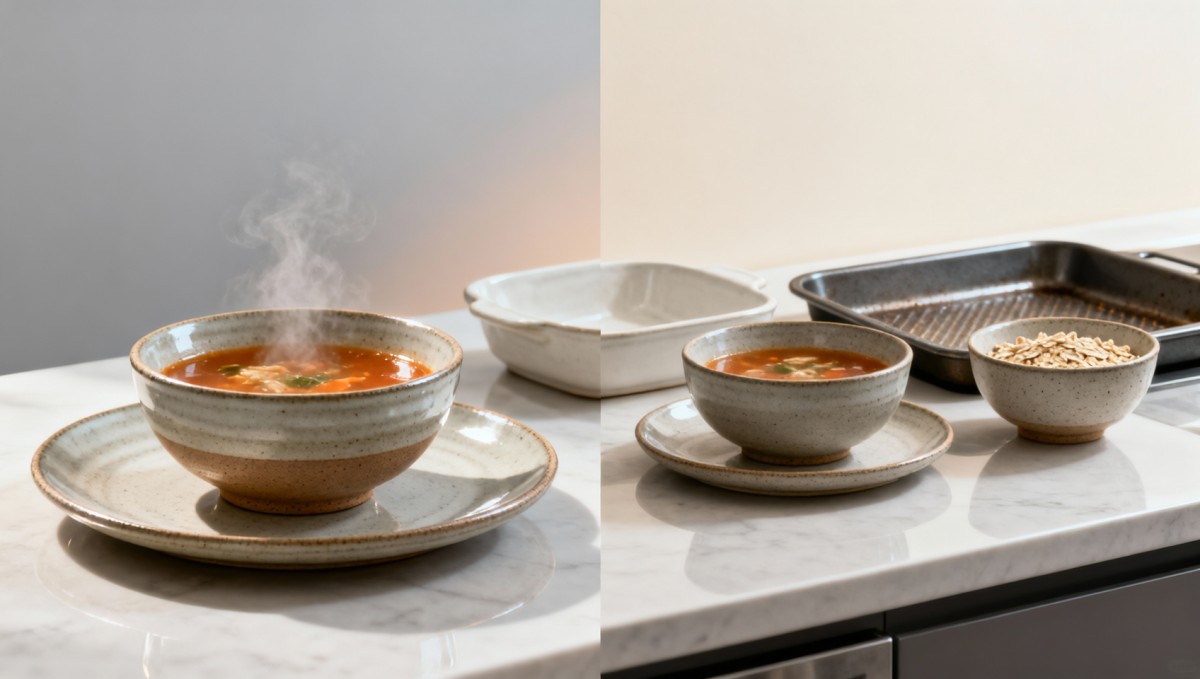
A stoneware soup bowl may look similar to many other ceramic products on a shelf, but durability starts with body composition and firing temperature. In general industry practice, stoneware is fired at roughly 1,150°C to 1,300°C, which creates a denser body than low-fired earthenware. That density directly affects water absorption, thermal stability, and resistance to daily wear.
For commercial kitchens and hospitality buyers, low water absorption is especially important. A well-made stoneware soup bowl often has a water absorption rate below 3%, while lower-grade ceramic products may absorb more moisture over time. Higher absorption increases the chance of odor retention, staining, glaze stress, and cracking when bowls move between refrigeration, hot filling, and washing cycles.
Wall thickness also influences performance. A soup bowl designed for long service usually has a balanced wall thickness in the range of 4 mm to 7 mm. If it is too thin, edge chipping becomes more likely during stacking and transport. If it is too thick, the bowl becomes unnecessarily heavy, which can slow service, increase freight cost, and raise operator fatigue in high-volume environments.
Buyers should also check the foot ring and rim. The rim is the highest impact zone during dishwashing, tray loading, and table clearing. Reinforced or gently rounded rims tend to last longer than sharp decorative edges. The foot ring should be smooth and stable, reducing scratching on tabletops and improving stack safety when 10 to 20 units are stored together.
Stoneware vs. Other Common Tableware Types
The comparison below helps procurement teams evaluate where a stoneware soup bowl fits within a broader tabletop assortment. This is especially useful when sourcing coordinated ranges that may also include a ceramic rice plate, a porcelain baking dish, and a stoneware cereal bowl.
The key takeaway is that durability is not defined by the word “ceramic” alone. Stoneware generally performs well for hot liquid service because body density and thermal mass support repeated daily use. For buyers managing mixed product lines, aligning function with vessel type reduces replacement cost over a 12- to 24-month cycle.
Quick material checks before shortlisting
- Ask for firing range or production specification rather than relying only on a catalog photo.
- Check whether the bowl body feels dense and stable without being excessively heavy for front-of-house staff.
- Inspect the rim, base, and glaze transition points for uneven finishing or pinholes.
- Review whether the product is intended for dishwasher, microwave, or oven-adjacent use.
Key Buying Criteria for Long-Term Commercial and Household Use
When choosing a stoneware soup bowl that lasts, buyers should move beyond color and shape and evaluate measurable criteria. Capacity is one of the first filters. For most soup, ramen, stew, and grain-bowl applications, practical capacity ranges from 450 ml to 900 ml. A smaller 500 ml bowl may suit side soup service, while 700 ml to 850 ml is more suitable for main-course portions in hospitality and casual dining.
Glaze safety is another essential factor. The glaze should be smooth, food-contact appropriate, and consistent across the interior surface. Buyers should ask suppliers about glaze stability under acidic foods, such as tomato soup or broth with vinegar-based seasoning. A bowl used 2 to 5 times per day in foodservice must resist staining and surface wear, not just look attractive in new-condition photography.
Stackability can reduce breakage and storage inefficiency. In a restaurant or hotel operation, bowls are often stacked in batches of 12, 24, or more. Poorly designed rims and unstable foot rings increase chipping during storage and machine unloading. A good stoneware soup bowl should stack securely without excessive contact pressure on the glazed lip.
Procurement teams should also evaluate compatibility with existing service systems. If the bowl is too wide for shelving, too deep for standard dish racks, or too heavy for repetitive handling, the total operating cost increases. In many commercial settings, a difference of 80 g to 120 g per bowl becomes significant when staff handle hundreds of pieces during a single service shift.
Checklist for selecting the right bowl
- Define the serving use: side soup, entrée soup, noodle bowl, buffet use, or retail sale.
- Set target capacity and weight range, such as 600–750 ml and 550–800 g.
- Confirm dishwasher and microwave suitability if relevant to operations.
- Review surface finish for glaze consistency, pinholes, or color variation beyond tolerance.
- Test stacking stability and rim clearance before full-volume purchasing.
- Request a sample batch and run 7- to 14-day internal handling trials.
Practical specification comparison
The table below shows how specification choices align with common use cases across kitchens, hospitality environments, and retail sourcing programs.
A buyer does not need every bowl to meet the highest possible specification. The better approach is matching performance level to real usage frequency. A retail household line may prioritize aesthetics and moderate weight, while a hotel breakfast operation may value stackability and dishwasher resilience above decorative variation.
Operational Risks, Testing Methods, and Common Mistakes
Many durability failures happen after purchase because buyers skip practical testing. A bowl can appear premium during sample review but fail under repeated thermal and handling stress. Before ordering large volumes, it is wise to conduct at least 4 basic checks: visual inspection, stack test, wash-cycle observation, and hot-fill handling evaluation. These steps usually take 7 to 10 days and can prevent months of replacement issues.
One common mistake is choosing purely by visual style. Reactive glazes, rustic textures, and hand-finished looks can be attractive in retail and hospitality settings, but some finishes are less consistent in high-turnover kitchens. Rough exterior surfaces may show metal marks faster, and heavily textured rims may be more vulnerable to edge wear. This does not make them unsuitable, but it means operators should align style with actual service intensity.
Another mistake is ignoring thermal transition. Even durable stoneware can be damaged by sudden temperature shock, such as moving a bowl from chilled storage directly into very hot filling conditions. In most operations, gradual temperature handling is safer than abrupt transitions above 120°C difference. If the bowl is expected to handle varied service modes, this should be clarified during sourcing.
Breakage is not always caused by manufacturing defects. Packaging method, storage height, rack fit, and staff handling also matter. In B2B procurement, even a well-made stoneware soup bowl can show elevated loss rates if cartons lack internal separation or if bowls are stacked beyond stable limits during transport and back-of-house storage.
Common risk points to review
- Rim chipping caused by tight stacking or poor dish rack spacing.
- Surface crazing after repeated hot-cold cycles and aggressive detergent use.
- Glaze inconsistency, including pinholes, color deviation, or uneven finish.
- Excessive unit weight leading to operator fatigue and accidental drops.
- Carton damage during shipment when inner protection is insufficient for 6-piece or 12-piece packs.
A practical sample test process
- Inspect 6 to 12 sample units under direct light for glaze, wobble, and base finish.
- Run 20 to 30 dishwasher cycles if the bowl is intended for commercial washing.
- Test hot holding with soup or water for 15 to 20 minutes to evaluate temperature retention and handling comfort.
- Stack, unstack, and move the bowls in a real service environment for at least 3 shifts.
- Record any chips, scratches, staining, or instability before final approval.
This type of controlled testing gives procurement managers evidence-based input instead of relying on assumptions. It also helps decision-makers compare multiple vendors more fairly, especially when price differences are small but long-term performance differences are likely to be much larger.
How to Source the Right Stoneware Soup Bowl for B2B Purchasing
For distributors, hospitality groups, restaurant chains, and import buyers, sourcing a stoneware soup bowl involves more than choosing a shape. The purchasing process should connect product specification, packaging, lead time, and replenishment planning. In many supply chains, the practical buying cycle runs 3 to 8 weeks depending on sample approval, production scheduling, decoration complexity, and shipping method.
MOQ, finish consistency, and replacement planning are especially important. A low initial price may become less competitive if the supplier cannot maintain stable glaze tone across reorder batches or cannot support top-up orders below a certain quantity. Buyers should ask not only about the first order, but also about reorder terms after 3 months, 6 months, and 12 months.
Packaging specification should be reviewed early. For wholesale and export programs, standard options may include 6-piece, 12-piece, or bulk packed cartons. Strong dividers, edge protection, and barcode labeling can reduce warehouse handling errors and in-transit damage. This is especially relevant when products are distributed through retail, e-commerce, or multi-site hospitality operations.
It is also wise to align the soup bowl with adjacent tabletop categories. If a buyer is sourcing a full line that includes a ceramic rice plate, porcelain baking dish, and stoneware cereal bowl, color matching, stack footprint, and merchandising consistency become part of the value equation. Cross-category coordination can improve display quality and simplify purchasing decisions across departments.
Supplier evaluation matrix
The following matrix can help procurement teams compare suppliers using operational criteria rather than price alone.
A structured sourcing process typically produces better total cost outcomes than selecting by unit price alone. Even a 5% to 10% difference in purchase cost may be justified if the product lowers breakage, performs more consistently, and integrates smoothly with real kitchen workflows.
Maintenance, Service Life, and FAQ for End Users and Buyers
A durable stoneware soup bowl still needs proper handling to reach its expected service life. In household use, a quality bowl can remain functional for years with normal care. In high-frequency foodservice environments, lifespan depends on daily cycle count, washing intensity, storage practices, and how often bowls are moved between kitchen and dining areas. Simple procedures often make a noticeable difference in replacement frequency.
Operators should avoid metal-on-metal impact during storage and use dish racks that support the bowl profile correctly. After washing, bowls should be allowed to dry fully before dense stacking. This reduces moisture trapping and friction wear. In central kitchens or hotels, routine spot checks every 30 days can help identify early chipping patterns before losses escalate.
For retail buyers or home users, the same principles apply on a smaller scale. Avoid sudden temperature shifts, inspect the glaze periodically, and replace units that develop visible cracks or deep rim damage. A bowl used for soup, noodles, and grain dishes should stay functionally stable, easy to clean, and comfortable to handle throughout repeated weekly use.
How should a stoneware soup bowl be maintained?
Use non-abrasive cleaning tools, avoid dropping bowls into deep sinks, and do not expose chilled bowls to immediate high heat. For commercial operations, standardizing loading and unloading procedures can reduce accidental rim contact by a meaningful margin over a 6-month period.
What capacity works best for different serving needs?
A 450–550 ml bowl suits side soups and lighter portions. A 600–750 ml range is often the most versatile for restaurants and home use. For noodle soups or meal bowls, 800–900 ml is more practical, especially when broth, toppings, and grains are served together.
Is stoneware better than porcelain for soup service?
Not always better in every case, but often more forgiving for hot liquid service and everyday handling. Stoneware generally offers stronger heat retention and a substantial feel, while porcelain may provide a lighter and more refined appearance. The right choice depends on menu style, handling intensity, and desired presentation.
What should procurement teams ask before placing an order?
Ask about capacity, weight, wall thickness, glaze stability, dishwasher suitability, packaging details, sample lead time, and reorder consistency. It is also smart to request a small trial batch or at least 6 to 12 samples before confirming volume procurement.
Choosing a stoneware soup bowl that lasts comes down to matching material density, capacity, glaze quality, stackability, and supply reliability to the real demands of kitchens, hospitality service, and retail distribution. A well-selected bowl supports daily performance, protects presentation quality, and reduces replacement cost across the full usage cycle.
If you are comparing tableware options for home collections, restaurant programs, hotel service, or broader kitchen equipment sourcing, a structured evaluation will deliver better long-term value than appearance-led buying alone. Contact us to discuss product details, request a tailored sourcing recommendation, or explore more tableware and kitchen equipment solutions for your business.
Popular Tags
Kitchen Industry Research Team
Dedicated to analyzing emerging trends and technological shifts in the global hospitality and foodservice infrastructure sector.
Industry Insights
Join 15,000+ industry professionals. Get the latest market trends and tech news delivered weekly.
No spam. Unsubscribe anytime.

Contact With us
Contact:
Anne Yin (Ceramics Dinnerware/Glassware)
Lucky Zhai(Flatware)