
Restaurant Kitchen Equipment for Food Trucks: What Fits
Choosing restaurant kitchen equipment for a food truck is not just a matter of finding smaller appliances. The real question is which equipment fits your menu, your service speed, your power capacity, and your sanitation requirements without slowing the team down. In most cases, the best setup is not the one with the most machines, but the one that supports a tight workflow, safe food handling, and reliable output during peak hours.
For operators, buyers, and decision-makers, the challenge is balancing limited square footage with commercial performance. A food truck still functions like a commercial restaurant kitchen, but it must do so in a far more compressed environment. That means every choice matters: restaurant kitchen storage must reduce clutter, restaurant kitchen stainless steel surfaces must support hygiene and durability, and restaurant kitchen appliances must be compact enough to fit without creating bottlenecks.
This guide explains what actually fits in a food truck kitchen, how to choose equipment based on menu and operations, and where layout planning makes the biggest difference. Whether you are launching a first truck, upgrading an existing unit, or comparing suppliers, the goal is the same: build a mobile kitchen that works under real service conditions.
What equipment really fits in a food truck kitchen?
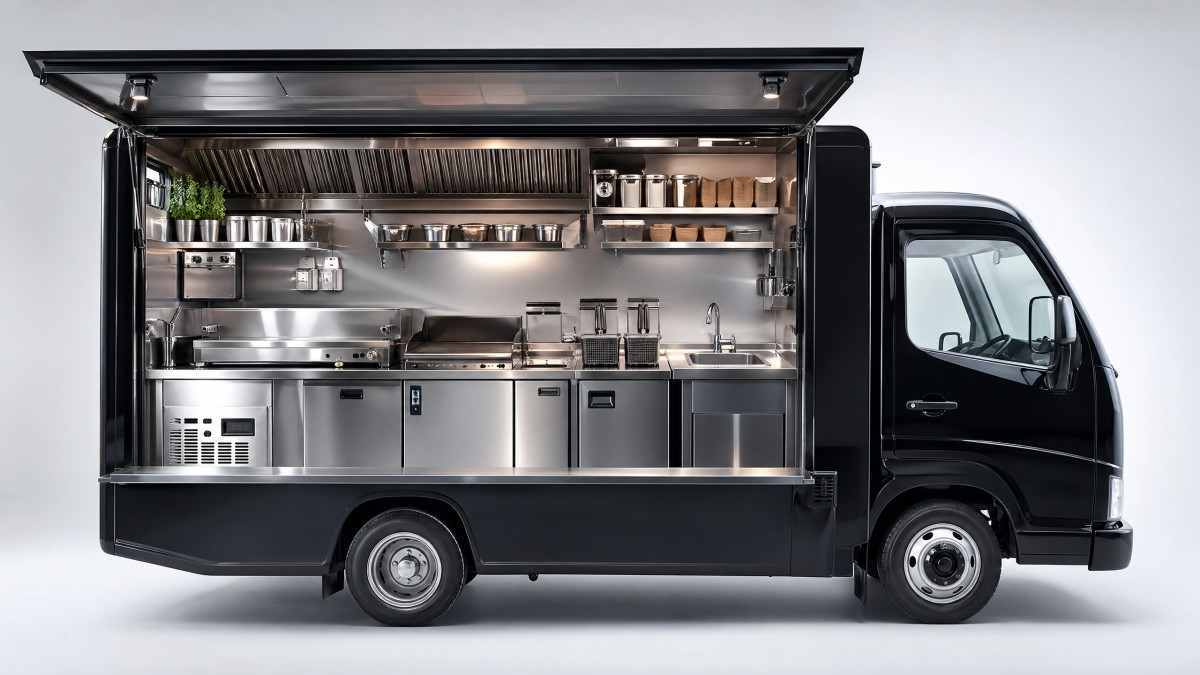
The short answer is this: only equipment that earns its footprint should go into a food truck. Space is too limited for oversized machines, duplicate functions, or appliances selected only because they are common in a full-size restaurant kitchen. In a truck, the best equipment is usually compact, multi-functional, easy to clean, and designed for continuous commercial use.
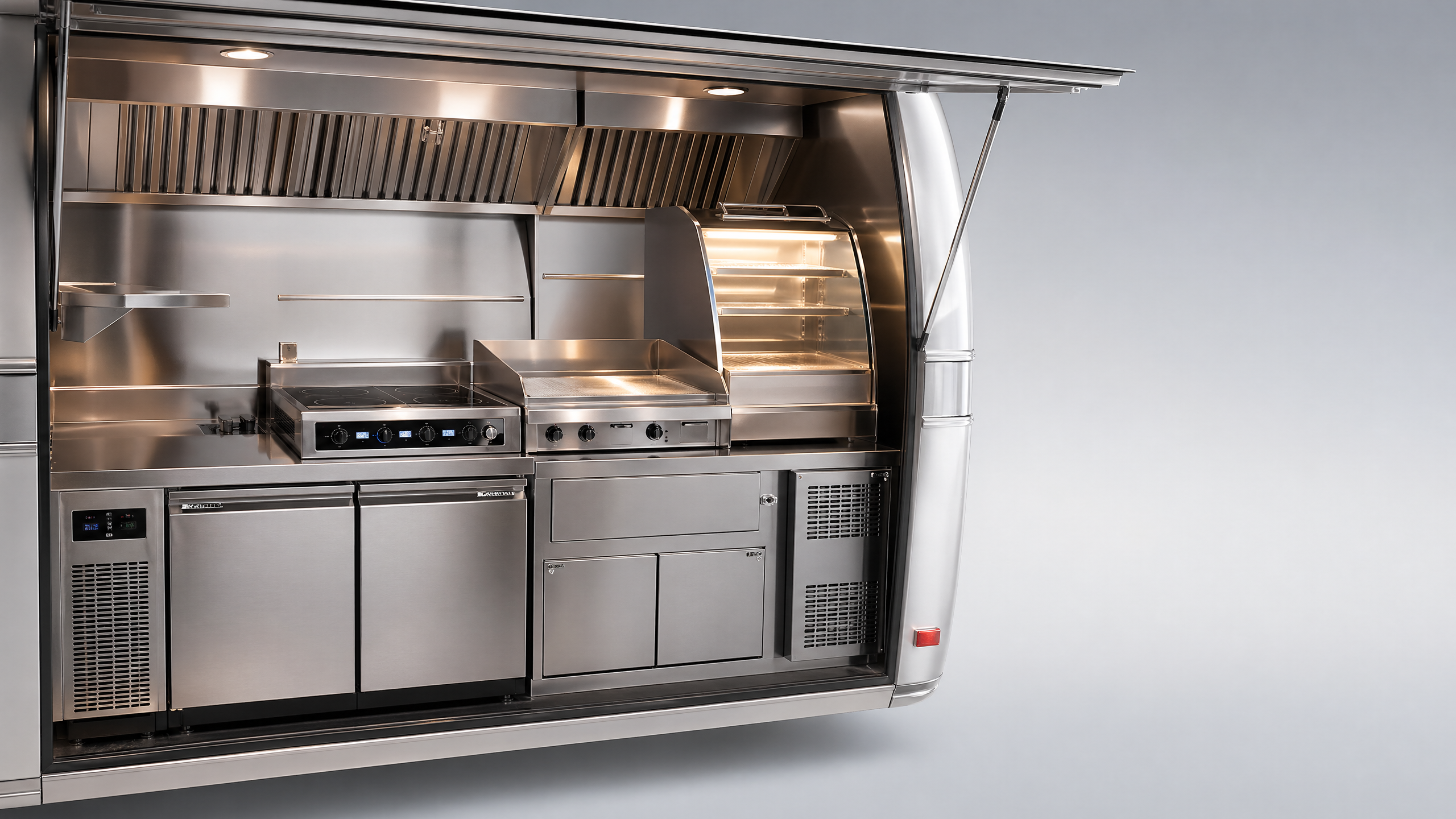
A practical food truck kitchen usually includes a cooking line, cold storage, handwashing and warewashing stations, prep surfaces, ventilation, point-of-sale integration, and restaurant kitchen storage. The exact combination depends on the menu. A burger truck needs griddles, fryers, and refrigerated prep tables. A coffee truck needs espresso equipment, undercounter refrigeration, and water systems. A taco or rice bowl truck may prioritize steam tables, hot holding, and ingredient rails.
What fits physically is only one part of the decision. Operators also need to check power draw, gas connections, water supply, drainage, ventilation, and local code compliance. A piece of restaurant kitchen equipment may fit dimensionally, but still be a poor choice if it creates heat buildup, overloads the generator, or interrupts staff movement during rush periods.
Start with the menu, not the catalog
The biggest equipment planning mistake is shopping by product category before defining production needs. Food trucks succeed when the kitchen is built around a focused menu with repeatable steps. Before buying anything, list the top-selling items, cooking methods, prep sequence, storage needs, and expected ticket volume per hour. That gives a much clearer basis for selecting restaurant kitchen appliances.
For example, if most menu items share the same base ingredients, a refrigerated prep station with organized inserts may be more valuable than adding another cooking appliance. If your menu relies on fried items but service speed is inconsistent, a better fryer recovery rate and improved holding strategy may matter more than increasing prep space. The right decision is always tied to output and workflow.
Procurement teams and business owners should also distinguish between startup ambition and daily operational reality. A broader menu may look attractive on paper, but in a mobile kitchen it often leads to more SKUs, more storage pressure, more employee training, and slower service. Equipment selection becomes much easier when the menu is streamlined and engineered for the truck format.
Which equipment categories deserve priority?
In most food trucks, the highest-priority investments are cooking equipment, refrigeration, ventilation, sinks, and durable prep surfaces. These are the systems that directly affect food safety, consistency, and speed. Decorative add-ons or low-usage specialty appliances should come later, if at all.
Cooking equipment should match both your menu and production pattern. Compact griddles, charbroilers, induction units, countertop fryers, combi-speed ovens, and salamanders can all work in the right application. The key is choosing units that heat quickly, recover well during rushes, and can handle commercial duty cycles. In a food truck, weak performance becomes visible fast because there is no extra line capacity to absorb delays.
Refrigeration is equally critical. Undercounter refrigerators, refrigerated prep tables, compact freezers, and drawer refrigeration systems are often better choices than larger reach-in units. They support efficient ingredient access while reducing unnecessary movement. Buyers should evaluate usable interior layout, temperature stability, ease of cleaning, and how the unit fits into the restaurant kitchen layout without blocking service positions.
Restaurant kitchen stainless steel worktables, shelves, cabinets, and splash-protected surfaces also deserve attention. Stainless steel is especially important in food trucks because the environment is high-touch, high-moisture, and exposed to grease, vibration, and frequent cleaning. Surfaces must stay sanitary while standing up to constant use in a confined mobile workspace.
How should a food truck kitchen layout be planned?
Restaurant kitchen layout planning matters even more in a food truck than in a fixed restaurant. In a small mobile unit, one bad placement decision can reduce service speed all day long. The best layouts support a straight or near-straight workflow: storage to prep, prep to cook, cook to assemble, assemble to service, with cleaning functions separated as much as possible.
A useful planning method is to map every staff movement during your busiest hour. Where do ingredients start? How many steps are needed to reach cold storage, hot equipment, toppings, packaging, and the service window? If two workers repeatedly cross paths, your layout may be creating hidden labor waste. Good food truck design reduces turning, reaching, and waiting.
Height and access also matter. Vertical restaurant kitchen storage can save floor space, but shelves should not interfere with ventilation, safety, or fast retrieval. Frequently used items should stay between waist and shoulder height. Heavy products should remain low and secure. If employees need to bend, twist, or reach around hot equipment too often, productivity and safety both suffer.
For decision-makers comparing suppliers, layout planning should be tested with actual dimensions, not rough assumptions. Cardboard mockups, tape outlines, or 3D design drawings can reveal conflicts before installation. This is especially useful when combining custom fabrication, restaurant kitchen appliances, and local compliance requirements in one limited space.
What role do storage and stainless steel solutions play?
Many food truck operators underestimate how much performance depends on restaurant kitchen storage. In a truck, poor storage design leads to clutter, slower prep, ingredient loss, and sanitation risks. Good storage is not just about fitting items inside cabinets. It is about making inventory visible, accessible, secure, and easy to restock.
Open shelving can work for lightweight dry goods and disposables, but enclosed cabinets are often better for protecting supplies during transit. Drawer systems, undercounter storage, wall-mounted racks, and ingredient bins can improve organization while minimizing wasted motion. A small truck with smart storage often performs better than a larger truck with a disorganized layout.
Restaurant kitchen stainless steel remains the preferred material for worktops, sink areas, cabinets, shelving supports, and wall protection. It is durable, corrosion-resistant, and easier to sanitize than many alternatives. In a mobile environment, it also handles repeated vibration and intensive cleaning better than lower-grade materials. Operators should look at gauge, weld quality, edge finishing, and how easily corners and joints can be cleaned.
How do power, water, and ventilation limit equipment choices?
One reason food truck equipment planning goes wrong is that operators focus on dimensions and ignore utility constraints. Commercial restaurant kitchen equipment must work within the truck’s real electrical load, gas supply, fresh water tank, wastewater capacity, and hood or ventilation setup. Without this utility planning, even a well-chosen appliance can become impractical.
Electrical planning is especially important when using multiple restaurant kitchen appliances at once. Refrigeration, lighting, POS systems, water pumps, and cooking units all compete for power. A compact high-performance oven may look ideal, but if it causes frequent overloads, it becomes a liability. Buyers should confirm voltage, wattage, startup surge, and whether the system will run on shore power, generator power, or both.
Water and drainage systems also shape what fits. Hand sinks, compartment sinks, prep sinks, and cleaning routines all depend on tank size and refill frequency. Menu design affects this too. A truck serving highly greasy or sauce-heavy foods may need a more robust cleaning process than one serving packaged beverages or reheated items. The better the utility planning, the more reliable daily operations become.
Ventilation affects both compliance and comfort. Excess heat in a compact kitchen slows staff, impacts food quality, and increases maintenance demands. Equipment that produces heavy smoke, grease, or heat must be matched with the right hood and airflow strategy. In many cases, a slightly different appliance category can achieve similar menu results with fewer ventilation challenges.
How can buyers compare equipment beyond price?
For procurement teams and owners, price alone is a poor decision tool. In food trucks, the lowest-cost equipment may fail faster, clean less easily, or work less efficiently under rush conditions. The better comparison method is total operating value: durability, energy use, footprint efficiency, maintenance access, spare part availability, and consistency during service.
Ask suppliers practical questions. Is the unit designed for commercial continuous use? How easy is it to service in a tight installation? Are replacement parts readily available in your market? Can the manufacturer provide dimensional drawings, utility specs, and cleaning guidance? If the answers are vague, the product may not be suitable for a high-demand mobile kitchen.
It is also useful to prioritize equipment that simplifies training and reduces operator error. In a food truck, teams often work in intense conditions with little room for correction. Controls should be easy to understand, temperatures should remain stable, and daily cleaning should not require excessive disassembly. These details influence labor performance and uptime more than many first-time buyers expect.
What common mistakes should food truck operators avoid?
The first common mistake is over-equipping. Too many appliances reduce workspace and create operational friction. The second is buying residential or light-duty units that cannot withstand commercial volume. The third is ignoring service flow and placing equipment where it technically fits but operationally fails.
Another mistake is neglecting cleaning access. If staff cannot easily wipe behind, under, or around a machine, sanitation standards decline over time. In a food truck, where every surface is close to food production, this risk increases. Equipment should be chosen and installed with daily cleaning in mind, not just installation convenience.
Operators also sometimes underestimate future growth. If you expect higher volume, catering jobs, or menu expansion, think about whether the equipment platform can scale. That does not mean overbuilding from the start. It means choosing a layout and core systems that leave room for practical upgrades, better workflow, or more efficient replacement later.
Final thoughts: what fits is what supports performance
The best restaurant kitchen equipment for food trucks is not defined by size alone. What truly fits is equipment that matches the menu, supports fast workflow, meets utility limits, and helps the team maintain food safety under pressure. Compact restaurant kitchen appliances, well-planned restaurant kitchen storage, and durable restaurant kitchen stainless steel surfaces all contribute to a stronger mobile operation.
For operators and buyers, the smartest path is to evaluate equipment through the lens of output, labor efficiency, cleaning, compliance, and long-term value. For business decision-makers, the real return comes from shorter ticket times, fewer breakdowns, easier staff training, and a kitchen layout that can sustain revenue during busy service windows.
In a food truck, every inch has a cost and every piece of equipment must justify its place. When restaurant kitchen layout planning is done carefully, the result is not just a kitchen that fits inside the truck, but one that performs like a disciplined commercial restaurant kitchen on wheels.
- kitchen appliances
- cooking equipment
- restaurant kitchen
- Griddle
- Charbroiler
- Freezer
- Stainless Steel Worktable
- kitchen equipment
- restaurant kitchen equipment
- restaurant kitchen layout planning
- restaurant kitchen equipment for food trucks
- commercial restaurant kitchen
- restaurant kitchen layout
- restaurant kitchen appliances
- restaurant kitchen stainless steel
- restaurant kitchen storage
Popular Tags
Kitchen Industry Research Team
Dedicated to analyzing emerging trends and technological shifts in the global hospitality and foodservice infrastructure sector.
Industry Insights
Join 15,000+ industry professionals. Get the latest market trends and tech news delivered weekly.
No spam. Unsubscribe anytime.
Contact With us
Contact:
Anne Yin (Ceramics Dinnerware/Glassware)
Lucky Zhai(Flatware)