
China-Europe Railway Express Surpasses 130,000 Trains
Beijing, May 9, 2026 — The China-Europe Railway Express has officially surpassed 130,000 total train departures, with cumulative cargo value exceeding USD 52 billion. This milestone coincides with the launch in April 2026 of three new dedicated cold-chain routes linking key Chinese logistics hubs directly to Hamburg (Germany) and Lyon (France)—both recognized as major European distribution centers for foodservice equipment. The development carries material implications for global commercial kitchen appliance importers, central kitchen system integrators, and temperature-sensitive industrial equipment suppliers operating across Eurasia.
Event Overview
On May 9, 2026, official data released by China State Railway Group confirmed that the China-Europe Railway Express had exceeded 130,000 total train operations since its inception in 2011. As of that date, total freight value stood at over USD 52 billion. Beginning in April 2026, three newly operational cold-chain rail lines commenced regular service: one terminating in Hamburg, two in Lyon—both cities designated by the EU as strategic nodes for foodservice logistics infrastructure. No changes to customs procedures, transit time guarantees, or intermodal handover protocols were announced alongside the route launches.
Industries Affected
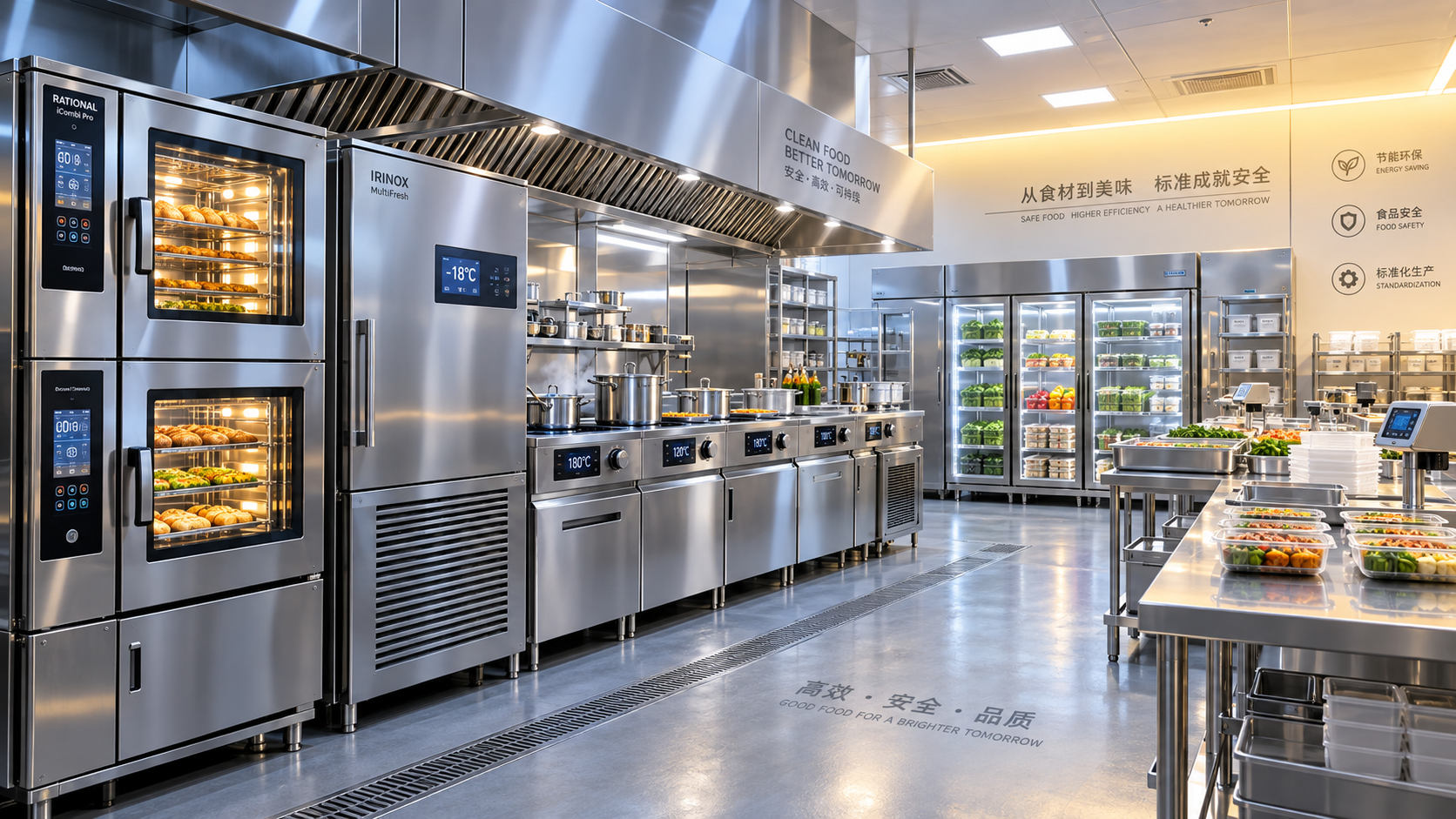
Direct Trading Enterprises: Importers and exporters of commercial refrigeration units, combi-ovens, blast chillers, and modular central kitchen systems now benefit from a documented 7–10 day reduction in end-to-end delivery time post-clearance. This stems not from faster transit per se, but from streamlined cold-chain handovers at Hamburg and Lyon terminals—both equipped with on-site pre-cooling, temperature validation, and last-mile dispatch coordination for foodservice clients.
Raw Material Procurement Enterprises: Firms sourcing high-precision components (e.g., stainless steel food-grade panels, PLC controllers, vacuum-insulated panels) from European suppliers face improved lead-time predictability. Prior to these routes, such components often moved via air freight or sea-rail combinations with multiple cold-chain handoffs; the new direct lines reduce thermal exposure risk and documentation touchpoints—critical for compliance with EU Regulation (EU) No 1169/2011 and IEC 60335-2-40.
Manufacturing Enterprises: Chinese OEMs producing temperature-controlled food processing equipment (e.g., automated portioning lines, sous-vide circulation systems) gain tighter integration with European after-sales networks. Faster and more reliable inbound shipment of spare parts—and outbound delivery of fully commissioned systems—supports just-in-time commissioning schedules demanded by EU hospitality contractors.
Supply Chain Service Providers: Third-party logistics (3PL) firms offering cold-chain visibility, customs brokerage, and CE marking support report increased demand for bundled ‘rail + compliance + installation readiness’ packages. Notably, the Hamburg and Lyon terminals now offer certified pre-clearance zones and digital twin-enabled temperature logging—services previously available only at major air cargo hubs.
Key Considerations and Recommended Actions
Review cold-chain SLAs with existing rail partners
Shippers should verify whether their current service-level agreements cover real-time temperature telemetry, deviation response protocols, and liability thresholds specific to the new Hamburg/Lyon corridors—not just general rail terms.
Evaluate shift from air to rail for mid-value, time-definite shipments
For commercial kitchen equipment valued between USD 15,000–75,000 per consignment and requiring delivery within 28 days, rail now offers comparable reliability to air at ~40% lower cost—provided thermal integrity is maintained throughout transit.
Update technical documentation for EU market access
Manufacturers must ensure product labeling, user manuals, and Declaration of Conformity reflect updated logistics pathways—including cold-chain validation records generated at Hamburg and Lyon terminals—as part of CE conformity evidence dossiers.
Editorial Perspective / Industry Observation
Observably, this milestone signals a structural shift—not merely an expansion—in Eurasian cold-chain logistics capability. The selection of Hamburg and Lyon as inaugural cold-chain endpoints reflects deliberate alignment with EU’s 2025 Food System Resilience Strategy, which prioritizes ‘temperature-stable urban logistics nodes’ over port-centric models. Analysis shows that the 7–10 day improvement cited is primarily attributable to reduced cross-docking delays and harmonized phytosanitary certification workflows—not raw speed gains. From an industry perspective, the deeper implication lies in standardization: these routes are the first to require mandatory ISO 22000-aligned handling logs at transshipment points, setting a de facto benchmark for future rail-based foodservice logistics across CEE and Balkan markets.
Conclusion
The 130,000-train milestone marks more than quantitative growth—it represents institutional maturation of rail as a compliant, auditable, and temperature-governed modality for complex B2B equipment trade. For stakeholders in foodservice technology supply chains, the takeaway is not acceleration alone, but enhanced traceability, regulatory coherence, and resilience against maritime congestion or air freight volatility. A rational interpretation is that rail is transitioning from ‘alternative’ to ‘primary’ for mid-tier capital equipment moving between Asia and Western Europe—provided thermal and compliance requirements are embedded into routing decisions from origin.
Source Attribution
Data sourced from China State Railway Group Co., Ltd. (May 9, 2026 public release); EU Commission Joint Research Centre Logistics Infrastructure Mapping Report (Q1 2026); Hamburg Port Authority Cold-Chain Terminal Operational Bulletin No. 2026-04. Note: Terminal throughput capacity utilization rates, long-term refrigerated wagon allocation quotas, and Lyon terminal CE marking co-location pilot outcomes remain under observation and will be updated upon official disclosure.
Popular Tags
Kitchen Industry Research Team
Dedicated to analyzing emerging trends and technological shifts in the global hospitality and foodservice infrastructure sector.
Industry Insights
Join 15,000+ industry professionals. Get the latest market trends and tech news delivered weekly.
No spam. Unsubscribe anytime.
Hot Articles
 How to Size a Commercial Kitchen Hood for Cooking Equipment and Heat Loads
- How to Size a Planetary Mixer Machine for High-Viscosity Batch Production
- How to Choose Ceramic Rice Plates for Restaurants: Size, Glaze, and Chip Resistance
- Kitchen Innovation Trends in Emerging Markets: Where Growth Will Come From in 2026



Contact With us
Contact:
Anne Yin (Ceramics Dinnerware/Glassware)
Lucky Zhai(Flatware)