
How cafeterias reduce safety risks with better supplies choices
In busy cafeteria environments, safety depends not only on staff training but also on choosing the right restaurant supplies for cafeterias. From food-contact materials to storage, serving, and cleaning tools, every supply decision can affect hygiene, reduce contamination risks, and support smoother daily operations. For quality control and safety managers, smarter supply choices are a practical way to build a safer, more efficient foodservice environment.
Cafeterias operate at a demanding pace, often serving hundreds or even thousands of meals within 2 to 4 peak service hours. In that setting, supply quality directly influences food safety, cross-contact prevention, cleaning consistency, and staff handling behavior.
For buyers and safety teams, the challenge is not simply to purchase more items. It is to select restaurant supplies for cafeterias that match risk level, workflow, cleaning protocols, and replacement cycles while supporting cost control and regulatory readiness.
Why Supply Selection Is a Core Safety Control in Cafeterias
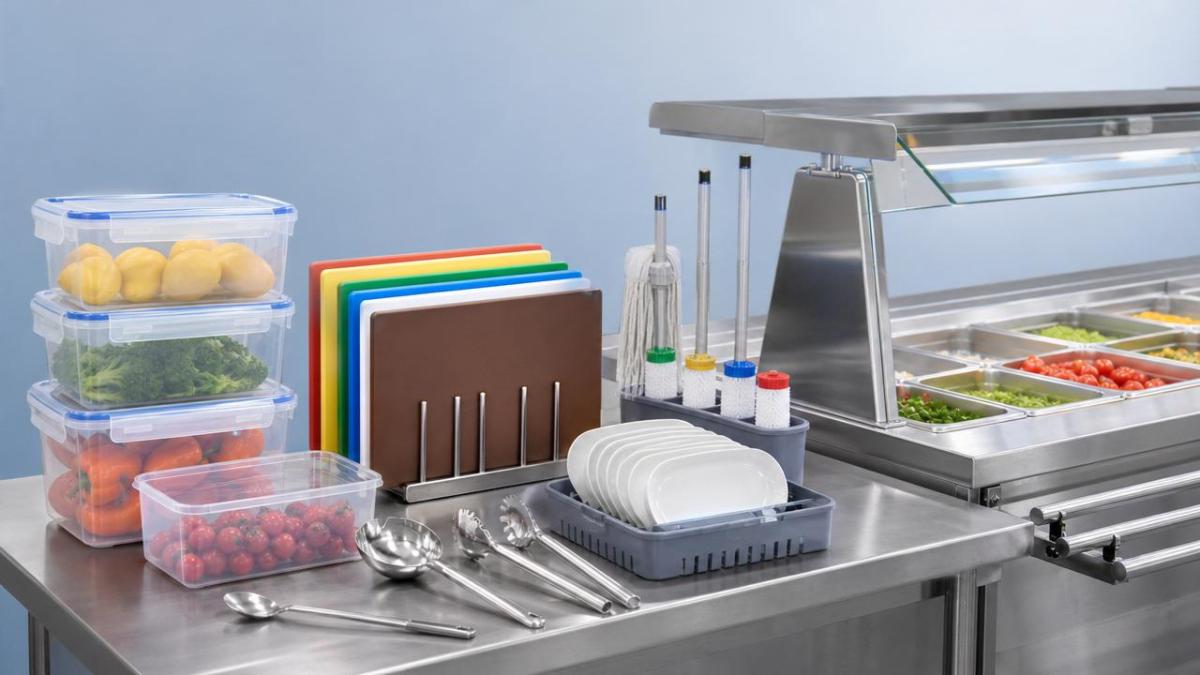
Unlike smaller kitchens, cafeterias usually rely on repeated batch preparation, self-service lines, and multiple food zones. That means one weak point in supply selection can affect 3 critical areas at once: food contact safety, temperature control, and sanitation execution.
Quality control managers often focus on process audits, but the supplies themselves shape whether those procedures are realistic. If containers crack after 6 months, if utensils are hard to sanitize, or if trays cannot tolerate high-frequency washing, safety programs become harder to maintain.
Common risk points linked to poor supply choices
- Damaged food pans and bins that trap residue in seams or scratches
- Cutting boards without color coding, increasing cross-contact risk between raw and ready-to-eat foods
- Storage containers with poor lid seals, causing moisture entry or allergen mix-ups
- Serving utensils that are too short, leading to hand contact with food
- Cleaning tools that cannot be separated by area, such as restroom, floor, and food-prep use
Why this matters during peak volume
A cafeteria serving 500 to 1,500 meals per day handles supplies far more intensively than many traditional restaurants. Small defects become major hygiene concerns when an item is touched 50 to 200 times in a single shift.
In high-turnover service, durable and easy-to-clean restaurant supplies for cafeterias reduce operational shortcuts. This is especially important where staff teams change across breakfast, lunch, and dinner windows within 8 to 16 hours.
The table below shows how common supply categories influence cafeteria safety outcomes and what quality teams should review before procurement.
The main lesson is simple: supply selection is not a back-office purchase decision. It is a frontline safety control. The best restaurant supplies for cafeterias reduce failure points before they become audit findings, product waste, or injury incidents.
Key Supply Categories That Lower Safety Risks
For cafeteria operations, not all supplies carry the same risk weight. Quality teams should prioritize the categories that affect food contact, time-temperature handling, allergen control, and sanitation frequency at least once per shift.
Food-contact materials and prep tools
Prep tables, cutting boards, spatulas, scoops, and ingredient bins should be selected for non-porous surfaces, impact resistance, and cleaning compatibility. In many kitchens, boards and tools should be reviewed every 30 to 90 days for grooves, warping, or staining.
Color-coded systems are especially useful in cafeterias handling meat, vegetables, dairy, and allergen-sensitive menu items in the same production cycle. A 4-color or 6-color separation plan is often easier to enforce than written reminders alone.
Storage and transport supplies
Storage bins, food boxes, insulated carriers, and shelving supports help preserve safe product condition between receiving, prep, holding, and service. Poorly matched containers can increase exposure time, stacking instability, and mislabeling risk.
For cold foods, containers should support quick transfer and clear date marking. For hot transport, carriers should fit operational holding periods such as 15, 30, or 60 minutes without frequent lid opening that weakens temperature retention.
Serving line and self-service supplies
Serving spoons, tongs, sneeze guard accessories, tray slides, and dish return components all affect guest-facing risk. Self-service areas need supplies that are easy to reset, easy to sanitize, and hard to misuse during rush periods.
Utensil replacement should not wait for breakage. In high-volume cafeterias, a planned rotation every 3 to 6 months for heavily used serving tools is often more reliable than reactive replacement after visible wear appears.
Cleaning and sanitation supplies
Mops, brushes, squeegees, wiping cloth systems, chemical dispensers, and drain tools should be chosen as part of a zone-based hygiene plan. A strong program usually separates at least 3 zones: food prep, dining/service, and non-food utility areas.
This is where restaurant supplies for cafeterias have a direct effect on execution. If tools are easy to identify, store, and inspect, compliance improves. If they are mixed, worn out, or slow to dry, contamination risk rises quickly.
How to Evaluate Restaurant Supplies for Cafeterias Before Purchase
Safety managers should evaluate supplies through a structured lens rather than relying only on unit price. A lower-cost product may need replacement twice as often, create cleaning delays, or fail under commercial dishwashing conditions after repeated cycles.
Four practical evaluation criteria
- Material suitability for food contact, moisture, heat, or chemical exposure
- Cleanability, including smooth surfaces, minimal joints, and drying speed
- Durability under expected daily use, washing frequency, and handling volume
- Traceability through labels, color codes, lot control, or inspection records
Questions to ask suppliers
Before ordering, procurement and QA teams should ask how the item performs in a commercial cafeteria setting, not only in general foodservice use. This is particularly important for products exposed to 1 to 3 wash cycles per day and frequent stacking or transport.
- What is the typical replacement interval under heavy use?
- Can the product tolerate repeated machine washing or sanitizing chemicals?
- Are replacement parts available within 7 to 15 days?
- Does the design support labeling, segregation, and routine inspection?
The following comparison framework helps decision-makers review restaurant supplies for cafeterias in a way that balances safety, usability, and lifecycle value.
A safety-focused approach usually creates fewer emergency purchases, fewer unusable items, and more stable hygiene performance. For large sites, this also improves supplier standardization across multiple meal periods and multiple service lines.
Implementation Steps for Quality and Safety Managers
Even strong products fail when rollout is unstructured. To lower risk effectively, supply upgrades should be introduced through a clear 5-step process that links purchasing, operations, and sanitation verification.
Step 1: Map high-risk touchpoints
Review prep, hot holding, cold holding, self-service, warewashing, and waste-return points. List the supplies used in each zone and rank them by contact frequency, contamination potential, and cleaning difficulty.
Step 2: Define replacement and inspection rules
Set practical intervals such as daily visual checks, weekly functional checks, and monthly condition reviews. High-use items like ladles, trays, and bins may need fixed retirement thresholds based on chips, cracks, discoloration, or handle looseness.
Step 3: Standardize by zone and task
Use the same storage labels, the same color logic, and the same utensil types across similar stations. Standardization reduces staff confusion and lowers training time, especially where temporary or rotating employees support peak shifts.
Step 4: Test with one service line first
A pilot period of 2 to 3 weeks can reveal design issues before a full rollout. During the test, measure cleaning time, breakage count, labeling accuracy, and staff handling errors. This is often more useful than selecting products from catalog specifications alone.
Step 5: Build supply data into audits
Internal inspections should include supply condition as a measurable item, not a casual observation. A 6-point checklist can cover cleanliness, integrity, labeling compatibility, storage fit, area segregation, and replacement status.
Common implementation mistakes
- Buying mixed product types that increase training complexity
- Ignoring spare stock for critical utensils and containers
- Overlooking dishmachine and chemical compatibility
- Using one cleaning tool set across multiple hygiene zones
- Replacing supplies only after complaint or visible failure
What to Look for in a Supply Partner
For B2B cafeteria buyers, the supplier relationship matters almost as much as the item specification. A dependable partner should support product consistency, reorder clarity, and practical recommendations based on commercial kitchen realities.
This is increasingly important in the kitchen equipment industry, where automation, digital inventory tracking, and more energy-efficient operations are shaping procurement decisions. Supplies are no longer isolated accessories. They are part of integrated kitchen performance and risk management.
Supplier capabilities that add value
- Clear product specifications for commercial use environments
- Stable lead times, often within 7 to 30 days depending on category
- Support for standardization across multiple cafeteria locations
- Availability of matching accessories, lids, racks, or replacement parts
- Ability to advise on workflow fit, not just item availability
Long-term value over short-term purchasing
The most effective restaurant supplies for cafeterias help safety teams maintain control over time. That means fewer rushed substitutions, less variability between shifts, and better alignment between kitchen equipment, storage systems, and sanitation practice.
When supply decisions are tied to risk prevention, cafeterias gain more than compliance support. They improve workflow reliability, reduce avoidable waste, and create a safer operating environment for both staff and diners.
Choosing restaurant supplies for cafeterias should be treated as a safety strategy, not a routine ordering task. The right materials, storage tools, serving utensils, and cleaning systems help quality control and safety managers reduce contamination risks, support faster sanitation, and strengthen daily consistency across busy meal periods.
If you are reviewing cafeteria procurement standards, upgrading kitchen support items, or planning a safer supply system for high-volume foodservice, now is the right time to assess your current gaps. Contact us to discuss product details, request a tailored solution, or learn more about practical supply options for safer, more efficient cafeteria operations.
Popular Tags
Kitchen Industry Research Team
Dedicated to analyzing emerging trends and technological shifts in the global hospitality and foodservice infrastructure sector.
Industry Insights
Join 15,000+ industry professionals. Get the latest market trends and tech news delivered weekly.
No spam. Unsubscribe anytime.
Hot Articles
Contact With us
Contact:
Anne Yin (Ceramics Dinnerware/Glassware)
Lucky Zhai(Flatware)