
Choosing Energy-Efficient Cooking Systems for High-Volume Commercial Kitchens
The best energy-efficient cooking systems are those that meet peak production demand with the lowest practical energy use across an entire working day. Rated power alone cannot identify them. A powerful appliance may finish batches quickly and shut down between tasks, while a lower-powered alternative may run continuously and still create a bottleneck.
For a high-volume commercial kitchen, the decision starts with the menu, production schedule, and building services. Compare cooking performance, idle consumption, recovery time, ventilation needs, and operating costs together. Induction equipment, combi ovens, efficient fryers, and other technologies each have useful roles, but their value depends on how the kitchen actually works.
Define the production requirement before comparing equipment
Daily meal counts provide too little detail for equipment selection. A kitchen serving meals over several hours has different capacity requirements from one dispatching most orders within a short service window. Record the busiest production period, the foods prepared, batch sizes, starting temperatures, and acceptable cooking times.
Translate that information into a duty profile: when each appliance preheats, cooks, waits, recovers, and shuts down. Include preparation before service and cleaning afterward. Equipment that looks efficient during continuous cooking may consume substantial energy while waiting between orders.
Define capacity in terms of acceptable finished food. For an oven, that means usable tray loads that achieve consistent results. For a fryer, it means product output while maintaining the required oil temperature. For an induction station, it means the actual pans and cooking methods needed during service.
Also identify dependencies between stations. Increasing oven capacity has limited value if staff cannot portion, chill, or dispatch the additional food. Conversely, removing a cooking bottleneck may reduce overtime and prolonged hot holding, creating benefits beyond the appliance itself.
Compare performance data that describe real work
Ask suppliers for model-specific performance reports using recognized test methods appropriate to the equipment category. Independent test results provide a stronger basis for comparison than broad claims such as “high efficiency.” An applicable energy certification can help establish a shortlist, but it does not show whether a unit fits a particular menu.
Several measurements deserve separate attention:
- Cooking energy efficiency: how much input energy reaches the food under defined test conditions.
- Idle energy consumption: the energy required to keep equipment ready without producing food.
- Production capacity: acceptable output over time, including loading and unloading.
- Recovery performance: how quickly the appliance returns to useful operating conditions after a load.
- Preheat energy and time: the resources needed to reach operating temperature.
Compare results only when the test conditions are compatible. Food type, batch weight, starting temperature, cooking endpoint, and operating mode can change the outcome. A full-load result does not establish efficiency at partial load, and a steam-mode result does not describe every combi oven program.
A useful operating metric is energy consumed per unit of acceptable output, such as per kilogram cooked or per standardized meal component. Keep portion size, doneness, and quality consistent. Otherwise, a lower energy figure may simply reflect less cooking or a different product.
Match each technology to the cooking task
These options are not direct substitutes. A well-designed kitchen may combine several technologies, assigning each to the work it handles efficiently.
Induction: evaluate the pan and power system together
Induction heats compatible cookware directly, offering responsive control and reducing heat released around the cooking vessel. It can suit stations where cooks repeatedly start, adjust, and stop heating. The benefit depends on cookware that couples effectively with the unit and supports the required production volume.
Test the pans intended for daily use, including their base dimensions, flatness, and loaded weight. A unit that performs well with a small demonstration pan may behave differently with a large stockpot. On multi-zone equipment, establish whether available power is shared when several zones operate together.
Induction does not eliminate ventilation needs. Frying and searing still produce grease-laden vapors and smoke. Hood requirements follow the cooking process, appliance listing, and applicable installation rules.
Combi ovens: consolidation works when schedules align
A combi oven can support several cooking processes through controlled heat and humidity. Its flexibility is valuable when production can be organized into compatible batches. Programmable recipes can improve repeatability, provided loading patterns and food preparation remain consistent.
However, replacing several appliances with one oven may concentrate competing tasks in the same chamber. Foods requiring different temperatures, humidity levels, or service times can create scheduling conflicts. Frequent door opening and lightly loaded cycles may also reduce the expected energy benefit.
Assess the full operating cycle, including water treatment, cleaning chemicals, cleaning time, and access for maintenance. Chamber capacity alone does not describe the equipment’s useful daily output.
Dedicated equipment can be the better choice
For a narrow, continuous workload, a dedicated appliance may outperform a flexible system operationally. A kettle may suit large liquid batches, while a zoned griddle can match active surface area to demand. Fryer selection should emphasize recovery with the intended food load, especially where frozen products arrive in rapid succession.
Avoid assuming that an oversized appliance provides harmless spare capacity. Larger heated surfaces, chambers, or oil volumes can increase standing losses. Capacity should cover realistic peaks with a deliberate operating margin.
Treat ventilation and building services as part of the system
Appliance energy is only part of kitchen energy use. Exhaust systems remove air that must be replaced, and that replacement air may need heating or cooling. Equipment choices can affect sensible heat, moisture, and exhaust requirements, changing the wider operating cost.
Lower heat release into the kitchen does not automatically allow a smaller hood or lower airflow. Capture performance depends on appliance duty, hood geometry, installation, and the cooking emissions produced. Evaluate any ventilation change as an engineered system.
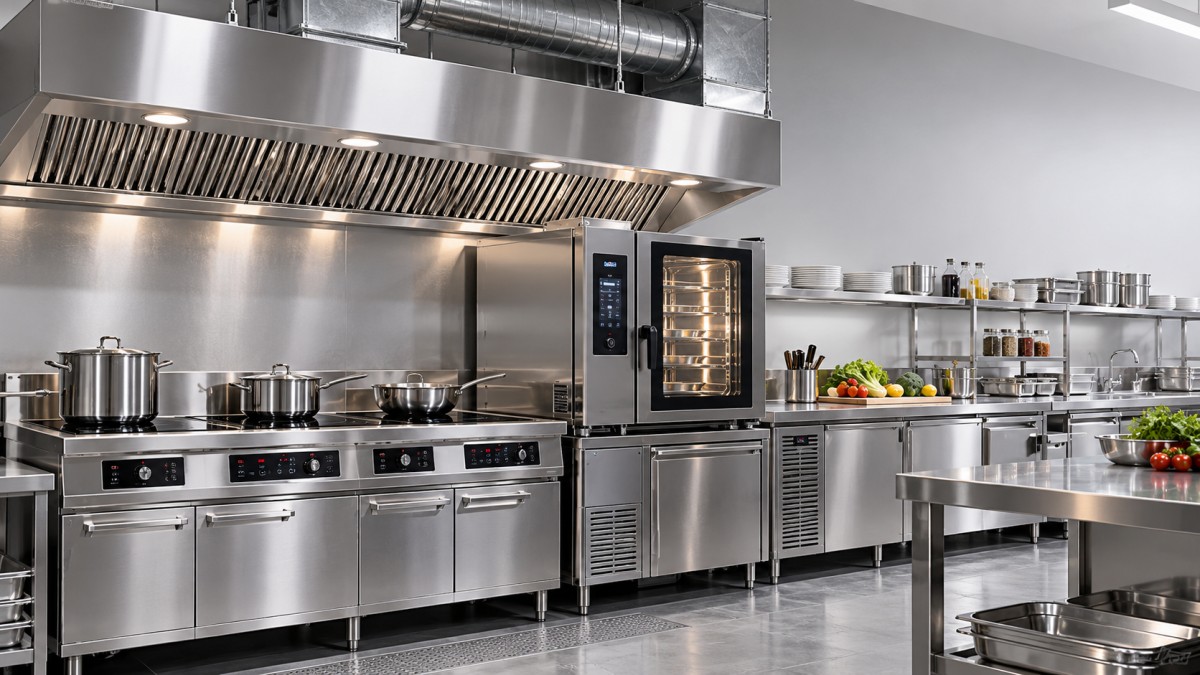
Demand-controlled kitchen ventilation can reduce unnecessary fan operation where the system is suitable. Its performance depends on correctly positioned sensors, responsive controls, balanced replacement air, and proper commissioning. Include these conditions when estimating savings.
Electrical conversions require particular care. Check supply voltage, phase, available capacity, protective devices, cable routes, and simultaneous demand. A design based only on individual appliance ratings may miss the moment when ovens preheat, induction stations operate, and warewashing equipment runs together.
Water quality, pressure, drainage, and maintenance access also influence reliability. Steam-producing equipment may require treatment to manage scale. Include the space, servicing, and consumables associated with that treatment in the installation plan.
Build the cost comparison around the duty profile
Purchase price is a weak basis for comparing commercial cooking equipment. Use lifecycle cost to combine acquisition, installation, energy, water, consumables, maintenance, and expected downtime over a consistent evaluation period.
Start with measured operating hours and realistic production schedules. Separate preheating, cooking, idle operation, cleaning, and shutdown. Apply the relevant energy consumption to each state, taking care not to double-count energy already included in a full-cycle measurement.
A practical comparison should include:
- Installed cost: equipment, delivery, electrical or gas work, ventilation changes, water treatment, and commissioning.
- Utility cost: electricity, fuel, water, sewer charges, and applicable demand charges.
- Routine operating cost: cleaning products, filters, planned servicing, and other consumables.
- Operational exposure: repair access, service availability, likely downtime, and backup capacity.
Keep electricity and gas comparisons consistent. Convert energy quantities to common units when comparing consumption, then apply the actual tariff structure when comparing cost. Lower energy use does not necessarily mean lower utility bills where rates and demand charges differ.
Run the comparison under more than one workload. An appliance may perform well during busy service but poorly during long quiet periods. Test how the financial result changes with lower production, different energy prices, and higher maintenance costs. A purchase that remains attractive across plausible conditions is easier to justify than one dependent on a single optimistic forecast.
If carbon reduction is part of the decision, calculate it separately using relevant electricity and fuel emissions factors. Energy efficiency, operating cost, and emissions are related measures, but they answer different questions.
Use a production trial to resolve the remaining uncertainty
A demonstration should reproduce the work that could cause the equipment to fail its operational purpose. Use the intended ingredients, starting temperatures, cookware, batch sizes, and staffing arrangements. Include a peak sequence and a quieter period, rather than testing only continuous full-load production.
Record total energy, elapsed time, acceptable output, temperature recovery, and finished-food consistency. Include unloading, transfers, and cleaning where they affect throughput. Assess food safety at the relevant cooking and holding stages; a programmed cycle still needs to deliver the required result with the actual load.
Pay attention to operator behavior. Controls that encourage unnecessary preheating or make standby settings awkward can undermine efficient hardware. Useful automation should make correct loading, recipe selection, and shutdown easier. Remote monitoring is valuable when someone uses the information to correct operating problems.
Before ordering, turn the trial findings into acceptance criteria: required output, acceptable product quality, utility compatibility, cleaning access, and service support. Record the tested configuration, including accessories and software settings, so the delivered equipment can be assessed on the same basis.
Begin the purchase process with a production schedule and a building-services assessment. Those two documents establish which options are feasible. Comparable performance reports, lifecycle costing, and a realistic cooking trial can then identify the system that reduces energy use while keeping the kitchen ready for its busiest service.
Popular Tags
Kitchen Industry Research Team
Dedicated to analyzing emerging trends and technological shifts in the global hospitality and foodservice infrastructure sector.
Industry Insights
Join 15,000+ industry professionals. Get the latest market trends and tech news delivered weekly.
No spam. Unsubscribe anytime.



Contact With us
Contact:
Anne Yin (Ceramics Dinnerware/Glassware)
Lucky Zhai(Flatware)