
Which kitchen tools for small spaces solve daily storage pain?
Limited counter space, crowded drawers, and hard-to-reach essentials can make a small kitchen feel harder to use than it should. The good news is that the best kitchen tools for small spaces do not simply look compact. They actively remove friction from daily cooking.
For most home cooks, the real solution is not buying more gadgets. It is choosing tools that stack, fold, nest, hang, or perform several jobs well. When every item earns its place, storage becomes easier and cooking feels faster.
This guide focuses on what matters most to end consumers: which tools actually reduce clutter, how to choose them, and which features prevent regret. If your kitchen feels full but still inefficient, these are the tools worth considering.
What small-kitchen shoppers really need from their tools
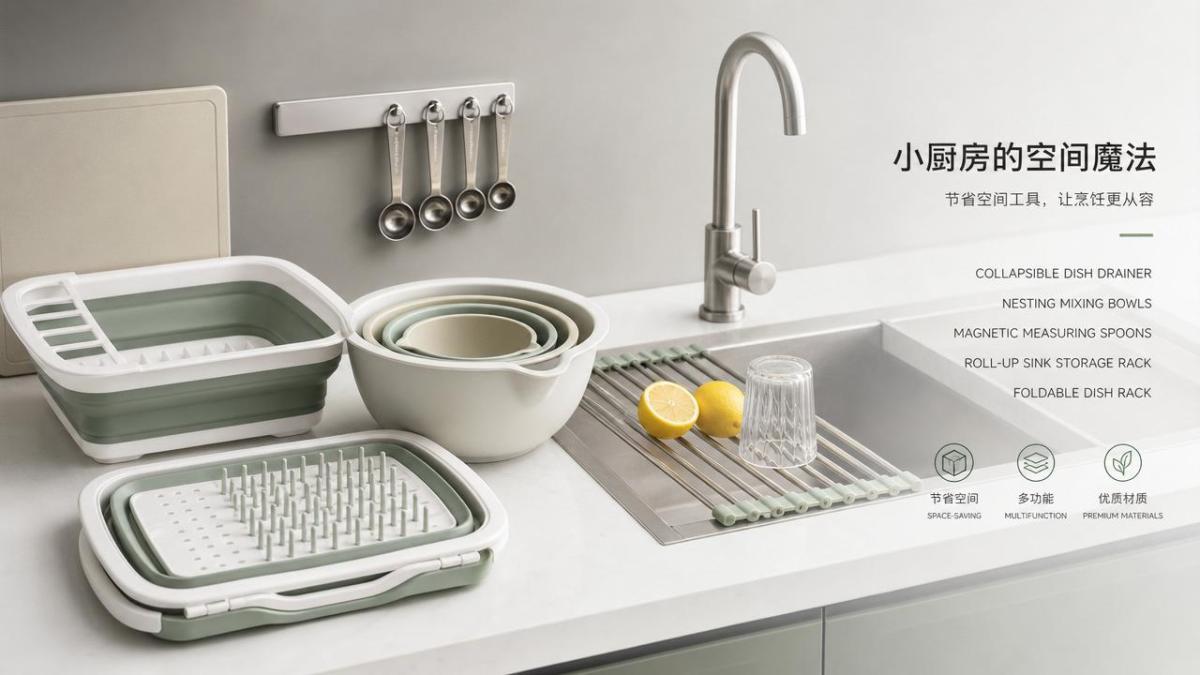
People searching for kitchen tools for small spaces usually want relief from daily storage pain, not abstract design ideas. They need products that fit tight cabinets, free up counters, and keep frequently used items easy to reach.
The biggest concerns are simple. Will this tool save space? Will it replace more than one item? Will it be annoying to clean or put away? And will it still work well enough for everyday cooking?
That means the best products combine three benefits at once: compact size, practical function, and easy storage. A small tool that performs poorly is still a waste. A capable tool that is hard to store creates the same problem.
Before buying anything new, it helps to judge each tool by one standard: does it solve a repeated problem in your kitchen at least several times a week? If not, even a clever design may become clutter.
Choose collapsible tools that disappear when you are done
Collapsible kitchen tools are often the fastest win in a small home. They give you full working size during prep or washing, then fold down flat enough to slide beside a refrigerator or into a narrow cabinet.
Collapsible colanders are especially useful because standard strainers can be awkward to store. A fold-flat silicone colander handles pasta, fruit, and vegetables, then compresses into a fraction of the original size.
Folding dish racks also help if you do not want a permanent counter setup. In a compact kitchen, a rack that expands only when needed keeps your workspace open for cooking and meal assembly.
Another practical option is a collapsible mixing bowl set. If the bowls have measurement marks and secure bases, they can serve for prep, marinating, rinsing, and serving without occupying much drawer or shelf space.
When shopping, check stability carefully. Some collapsible designs save space but wobble during use. Look for reinforced rims, heat-resistant materials, and hinges or folding points that feel durable rather than flimsy.
Nesting sets reduce cabinet clutter better than single-purpose pieces
Nesting tools are among the most reliable kitchen tools for small spaces because they solve storage at the design stage. Instead of scattering bowls, cups, strainers, and containers, they stack into one compact footprint.
Nesting mixing bowls are a strong choice for households that cook often. The best sets include pour spouts, lids, grater inserts, or non-slip bottoms, which adds function without forcing you to store extra accessories separately.
Measuring cups and spoons should also nest tightly. Large ringed sets often become drawer tangles. Magnetic or snap-together versions stay organized and are much easier to grab when you need one size quickly.
Food storage containers matter even more in small kitchens because loose lids create chaos fast. Choose a set with standardized shapes and truly nestable bodies. If lids also stack neatly, cabinets become far easier to manage.
Even cookware can be nesting. Pots and pans with removable handles or compact stacking systems work well in apartments, studios, and RV kitchens. They cost more upfront, but they can release an entire shelf.
Multi-use tools help more than trendy gadgets
In small kitchens, one excellent multi-use tool usually beats three specialized gadgets. This is where buyers can make the biggest difference, because many storage problems come from items that perform only one narrow task.
A box grater, for example, can replace several prep tools if it includes slicing, coarse grating, fine grating, and zesting functions. A version with a storage base adds even more value in a limited workspace.
Kitchen shears are another underrated choice. Good shears can trim herbs, open packaging, cut poultry, portion flatbreads, and even substitute for a knife in quick prep situations. They take less space than extra blades.
An immersion blender is often smarter than a full-size blender in a small home. It can blend soups, sauces, smoothies, and dressings, especially if it comes with a whisk or mini chopper attachment.
Consider a cutting board that doubles as a serving tray, sink cover, or prep station. Over-the-sink boards are especially useful because they create temporary workspace where none existed before, which matters in narrow kitchens.
The key is restraint. If a tool promises ten functions but does each one badly, it creates frustration instead of efficiency. Prioritize products that handle two to four common jobs extremely well.
Vertical storage tools can open up hidden space instantly
When floor plans are tight, the most underused area is often vertical. Tools designed for hanging, mounting, or standing upright can free drawers and counters without requiring a full kitchen renovation.
A rail system with hooks can hold ladles, spatulas, tongs, and small pans. This keeps daily-use tools visible and accessible while removing bulky utensil crocks that consume precious counter width.
Magnetic knife strips are another smart option if installed safely. They replace countertop knife blocks, which are surprisingly space-hungry. In a small kitchen, reclaiming that section of counter can improve workflow immediately.
Wall-mounted paper towel holders, under-shelf mug hooks, and adhesive caddies can also help. These items may seem minor, but together they shift frequently used objects out of drawers that are already overfilled.
Even a slim tiered shelf for spices or oils can improve storage pain. Instead of losing bottles in deep cabinets, vertical risers let you see everything at once, reducing duplicates and wasted time during cooking.
If you rent, look for removable or low-damage systems. The best storage solution is one you can realistically install and maintain without turning a small upgrade into a stressful home project.
Drawer-friendly tools make everyday access much easier
Small kitchens do not only suffer from lack of space. They also suffer from bad access. Deep, messy drawers make simple tasks feel harder, so compact tools that stay organized can improve daily use immediately.
Flat or slim utensils are often better than oversized silicone sets sold for spacious kitchens. If you cook mainly for one or two people, narrower turners, spoons, and tongs can still perform well while storing more efficiently.
Look for utensils with hanging loops or stackable shapes. Rounded handles and irregular heads often waste drawer volume. Tools designed with straight profiles usually fit dividers and trays much more neatly.
Mini tools also deserve attention. A small whisk, short rolling pin, compact ladle, or half-sheet pan can be more practical than full-size versions if your kitchen and cooking habits are both limited in scale.
For drawer order, modular organizers are often better than fixed inserts. They let you build around your actual tools instead of forcing tools into a layout that creates dead space.
The best countertop-saving tools create temporary workspace
Many small kitchens feel cramped because the usable prep area is too small, not because there are too many belongings. Some of the most valuable tools solve this by creating workspace only when needed.
An over-the-sink drying rack is a strong example. It can hold washed produce, drying dishes, or hot pans, then roll up and disappear. That gives you flexible use of the sink zone throughout the day.
Stovetop covers can also add prep area when burners are not in use. Some models work as cutting boards or serving surfaces, which makes them especially useful in studio apartments and compact homes.
A slim utility cart on wheels is another option if you need mobile storage plus workspace. It can store oils, towels, produce, or appliances, then move aside when not needed. This is helpful in rental kitchens with poor layouts.
Even a well-designed tray can help. If your coffee gear, spices, or breakfast items live on one tray, you can move them as a unit to reclaim surface space quickly instead of handling many small objects individually.
How to tell if a compact tool is actually worth buying
Not every compact product is a smart purchase. Some are simply smaller, while others are truly better for storage and workflow. A few buying checks can help you avoid filling your kitchen with disappointing solutions.
First, measure the storage space before you shop. Know the height of your drawers, the depth of your shelves, and the clearance under cabinets. A tool that looks compact online may still not fit your real layout.
Second, match the tool to your cooking frequency. If you make rice weekly, a compact rice cooker may be justified. If you bake twice a year, a bulky specialty pan set probably does not deserve space.
Third, evaluate cleanup. In small kitchens, hard-to-clean tools often end up left on counters or in sinks, creating visual and practical clutter. Dishwasher-safe, smooth-surface designs are usually easier to live with.
Fourth, be honest about duplicates. If a new item does the same job as something you already own, decide which one stays. Space-saving works best when each purchase also replaces an older, less efficient product.
Finally, read reviews with a storage mindset. Many buyers comment on performance but not stowability. Look specifically for notes about nesting quality, collapsed dimensions, lid organization, and real-life durability.
A practical small-kitchen toolkit for most homes
If you want a starting point, focus on a short list of high-impact items rather than a total kitchen reset. A few well-chosen tools can solve most daily storage pain without requiring a large budget.
A strong basic setup might include a collapsible colander, nesting bowls, stackable food containers, magnetic measuring spoons, kitchen shears, an over-the-sink rack, and a cutting board that expands prep space.
Add a wall hook rail or magnetic knife strip if your counters are crowded. If cabinets are the main issue, prioritize removable-handle cookware or better nesting storage sets before buying any new standalone gadgets.
This kind of toolkit works because it addresses the real bottlenecks: too little prep space, poor drawer access, messy cabinets, and tools that consume room without being used often enough.
Final thoughts: buy fewer tools, but choose smarter ones
The best kitchen tools for small spaces solve more than storage. They make the kitchen easier to use every day. That is what matters most when you are cooking in a tight apartment, condo, or compact home.
If you remember one rule, make it this: choose tools that are compact in storage, effective in use, and relevant to your actual habits. Collapsible, nesting, multi-use, and vertical-storage-friendly designs usually deliver the biggest gains.
Instead of chasing every clever gadget, build a kitchen where each tool has a clear purpose and an easy home. When clutter drops and access improves, even a very small kitchen can feel calm, efficient, and enjoyable.
Popular Tags
Kitchen Industry Research Team
Dedicated to analyzing emerging trends and technological shifts in the global hospitality and foodservice infrastructure sector.
Industry Insights
Join 15,000+ industry professionals. Get the latest market trends and tech news delivered weekly.
No spam. Unsubscribe anytime.

Contact With us
Contact:
Anne Yin (Ceramics Dinnerware/Glassware)
Lucky Zhai(Flatware)