
Commercial Cooking Equipment Buying Guide: Key Specs, Output, and Fuel Options
Commercial Cooking Equipment Buying Guide: Key Specs, Output, and Fuel Options
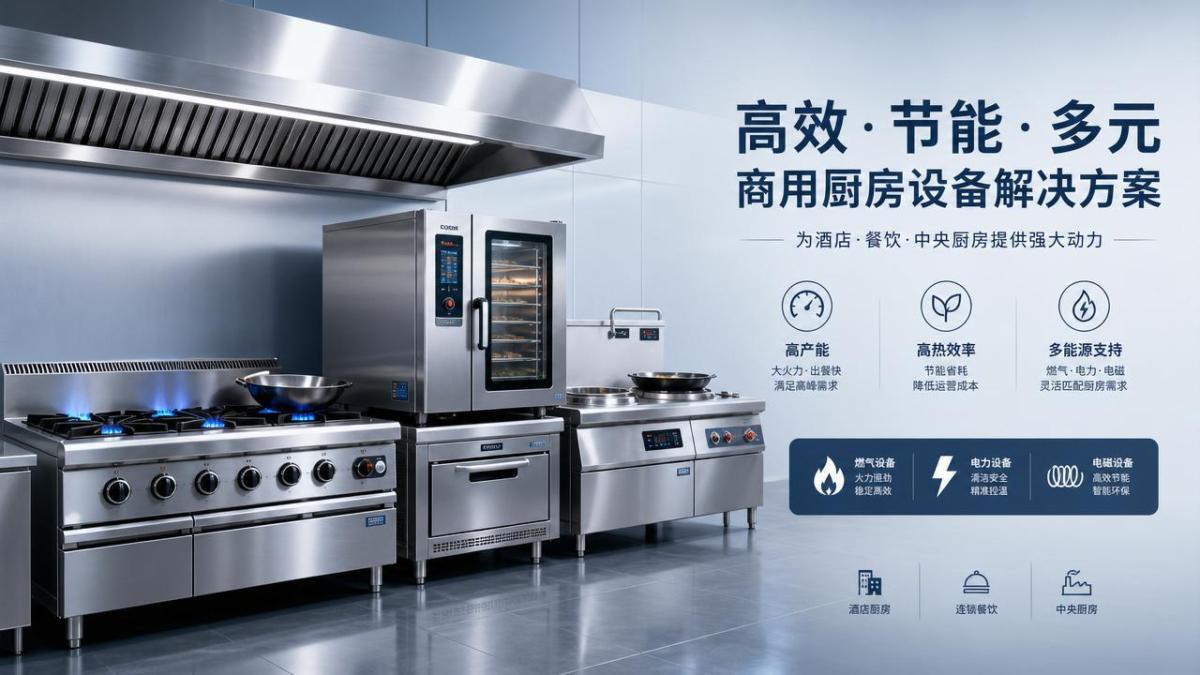
Choosing commercial cooking equipment is rarely a simple price comparison.
Performance, output, fuel type, and installation conditions usually decide long-term value.
In real operations, the wrong unit often creates bottlenecks before anyone notices the purchase cost.
That is why commercial cooking equipment selection should start with production targets and site constraints.
This guide focuses on the specs that matter most when comparing commercial cooking equipment for restaurants, hotels, and central kitchens.
It also reflects broader industry shifts toward automation, energy efficiency, and smarter kitchen management.
Start with Output, Not Equipment Type
A common mistake is choosing equipment by category first.
A better approach is to define required output per hour, peak meal period, and menu mix.
For example, a hotel breakfast line needs consistent batch recovery.
A quick-service kitchen may need faster heat response and shorter cook cycles.
A food processing site may prioritize repeatable temperature control over front-line speed.
When reviewing commercial cooking equipment, match output metrics to actual service demand.
- Meals per hour during peak periods
- Batch size and recovery time
- Cooking cycle duration
- Usable cooking area or chamber volume
- Expected daily operating hours
These figures create a more reliable starting point than brand preference alone.
Key Specifications That Affect Real Kitchen Performance
Spec sheets can look similar, but operating results often differ sharply.
The most useful commercial cooking equipment data usually falls into five technical groups.
Heat Input and Thermal Efficiency
Heat input shows maximum power, but not how effectively that energy reaches the product.
Thermal efficiency matters more when comparing long-term operating cost.
High-input commercial cooking equipment can still underperform if heat transfer is poor.
Temperature Range and Stability
Wide temperature range is useful, but stability is often the real differentiator.
For proteins, baked items, sauces, and reheating, repeatability protects both quality and food safety.
Recovery Time
Recovery time measures how quickly equipment returns to target conditions after loading.
This is critical for high-turnover kitchens and batch production environments.
Control System and Automation
Modern commercial cooking equipment increasingly includes programmable controls, recipe memory, and diagnostic alerts.
These features reduce operator variation and support digital kitchen workflows.
Footprint and Utility Demand
Capacity is meaningless if the unit does not fit the kitchen or utility infrastructure.
Always verify dimensions, clearance, ventilation, power load, gas pressure, and drainage needs.
Comparing Fuel Options for Commercial Cooking Equipment
Fuel choice affects speed, control, utility planning, safety protocols, and lifetime cost.
The best commercial cooking equipment option depends on local energy prices and kitchen workflow.
Gas
Gas remains popular for strong heat output and responsive flame control.
It often suits high-volume line cooking, wok applications, and operations that value visible heat adjustment.
However, gas commercial cooking equipment may require more ventilation and combustion safety planning.
Electric
Electric models support stable heating, cleaner indoor conditions, and simpler combustion-free installation.
They fit sites focused on energy monitoring, precise control, and lower hood demand in some applications.
The tradeoff is that peak electrical load and local tariffs may raise operating cost.
Induction
Induction commercial cooking equipment offers fast response, high efficiency, and cooler ambient conditions.
That can improve staff comfort and reduce wasted heat during long service windows.
Still, cookware compatibility and purchase price need close review.
Installation Factors That Change Buying Decisions
From recent project changes, installation issues are becoming a bigger decision factor.
This is especially true for retrofit kitchens and mixed-use foodservice sites.
Before shortlisting commercial cooking equipment, confirm these conditions early:
- Available electrical capacity and phase configuration
- Gas type, pressure, and line routing
- Exhaust hood compatibility and airflow capacity
- Water supply and drainage points
- Floor loading and access path dimensions
- Local fire, sanitation, and safety codes
This step prevents expensive redesign after the order is placed.
It also makes commercial cooking equipment comparisons more realistic across suppliers.
How to Evaluate Total Cost of Ownership
Purchase price is only one part of the decision.
For commercial cooking equipment, total cost of ownership often changes the final ranking.
A cheaper unit may cost more through downtime, cleaning labor, or poor energy performance.
A more efficient system may justify its price through lower utility use and better consistency.
Cost Areas to Compare
- Energy consumption at typical load
- Maintenance frequency and spare parts availability
- Cleaning time and sanitation design
- Expected service life
- Training needs for operators
- Warranty scope and service response time
In practice, service support is often the hidden risk.
Commercial cooking equipment with strong local support can reduce disruption during peak seasons.
Use-Case Matching for Better Equipment Selection
The clearest decisions usually come from matching equipment to kitchen reality.
Different operations can choose very different commercial cooking equipment, even with similar menu items.
Restaurants
Restaurants often need flexibility, fast response, and simple line integration.
Menu changes and variable traffic favor adaptable commercial cooking equipment with easy controls.
Hotels
Hotels usually need multi-shift reliability and broader menu coverage.
They benefit from commercial cooking equipment that handles banquet peaks and à la carte service equally well.
Central Kitchens and Food Processing Sites
These sites focus on consistency, throughput, labor efficiency, and traceable control.
Commercial cooking equipment with automation, data logging, and repeatable cycles often brings the strongest value.
Practical Questions Before Final Approval
Before signing off, use a short decision checklist.
It keeps commercial cooking equipment evaluation grounded in measurable outcomes.
- Does actual hourly output match peak demand with safety margin?
- Does the fuel option fit local utility cost and site infrastructure?
- Can the control system support consistency across operators?
- Will ventilation, power, water, and drainage needs be easy to deliver?
- Are cleaning and maintenance realistic for daily operations?
- Is local technical support available for urgent service needs?
This final screen helps separate attractive specifications from workable purchasing decisions.
Conclusion
The best commercial cooking equipment is the option that fits output goals, fuel strategy, utility conditions, and operating discipline at the same time.
As kitchens move toward smarter and more efficient systems, selection decisions are becoming more technical, not less.
A careful review of specs, recovery, control, installation, and total ownership cost leads to better results than focusing on upfront price.
Use this framework to compare commercial cooking equipment with confidence, and narrow options based on production reality rather than assumptions.
Popular Tags
Kitchen Industry Research Team
Dedicated to analyzing emerging trends and technological shifts in the global hospitality and foodservice infrastructure sector.
Industry Insights
Join 15,000+ industry professionals. Get the latest market trends and tech news delivered weekly.
No spam. Unsubscribe anytime.
Hot Articles
 How to Size a Commercial Oven for Peak Production Without Wasting Energy
- How to Evaluate Foodservice Equipment Suppliers for Reliability, Service, and Total Cost
- How to Choose a Cutlery Set for Restaurants: Material, Durability, and Cost
- How to Evaluate Restaurant Supplies Distributors for Reliable Multi-Location Delivery
Contact With us
Contact:
Anne Yin (Ceramics Dinnerware/Glassware)
Lucky Zhai(Flatware)