
How Often Should Commercial Cooking Equipment Be Professionally Serviced?
A fryer that struggles to recover temperature or an oven that heats unevenly can turn a busy service into a scramble. The cost is not limited to repairs: delayed orders, wasted ingredients, and uncertainty about cooking temperatures can put pressure on the entire kitchen.
So, how often should commercial cooking equipment be professionally serviced? Many kitchens use a six- to twelve-month preventive maintenance schedule as a starting point. Heavily used appliances may need attention every three to six months, while certain components require more frequent care. The correct interval depends on the manufacturer’s instructions, operating hours, equipment condition, and applicable local requirements—not simply the date of the last repair.
The questions below explain how to set a practical schedule, what a service visit should cover, and when waiting for the next appointment is the wrong decision.
Is servicing commercial cooking equipment once a year enough?
Annual servicing may be appropriate for some lightly used equipment, provided the manufacturer allows that interval and routine cleaning and inspections are consistently completed. It should not be treated as a universal standard for every appliance in a commercial kitchen.
A restaurant serving dinner five nights a week places different demands on its equipment than a hotel kitchen preparing breakfast, banquets, and room-service orders throughout the day. Even identical ovens can need different maintenance schedules when one operates occasionally and the other runs almost continuously.
Use the manufacturer’s maintenance schedule as your baseline. Then ask a qualified service provider whether your workload, kitchen environment, and service history justify shorter intervals. Where local rules require particular inspections or competent persons, those obligations take precedence over a general maintenance calendar.
Preventive servicing is also different from a breakdown call. Having a technician replace a failed thermostat does not necessarily mean the rest of the appliance has received a full inspection.
What service intervals make sense for different cooking appliances?
The following intervals are planning guides, not manufacturer specifications or legal requirements. Some models have tasks scheduled by operating hours, cooking cycles, or component condition rather than calendar months.
A fryer in constant use may warrant quarterly checks, while a backup oven may remain on an annual schedule. However, low use does not eliminate maintenance needs. Seals can deteriorate, pests can damage wiring, and equipment left idle can develop problems that only become apparent when it is needed.
For connected appliances, maintenance alerts can help identify issues between visits. They do not replace physical inspection, cleaning, or safety checks.
What determines whether a kitchen needs servicing more often?
Looking at operating conditions is more useful than choosing an interval based only on equipment age. Discuss these factors with your technician:
- Actual workload: Record approximate operating hours and peak-demand periods. A long opening day matters, but so does how hard the appliance works during it.
- Grease, heat, and airflow: Grease deposits and restricted ventilation can affect burners, cooling fans, controls, and electrical components.
- Water quality: Steam-producing equipment may need water treatment and descaling tailored to measured water conditions.
- Age and repair history: Repeated faults or deteriorating components justify closer monitoring. A relatively new appliance can also need frequent care under intensive use.
- Business dependence: If one oven handles most of the menu and there is no backup, its failure carries greater operational risk.
Seasonal demand matters too. A catering kitchen may benefit from servicing before its busiest event period rather than following an anniversary date that falls halfway through it. Schedule early enough to allow time for replacement parts and any follow-up work.
What should a professional service visit include?
A useful service visit should do more than confirm that the appliance turns on. Its scope should be appropriate to the model, fuel source, and manufacturer’s procedures.
For gas equipment, a suitably qualified technician may inspect burners, ignition systems, flame-safety devices, connections, and combustion performance where required. Gas pressure, leak testing, and adjustments should only be handled by personnel authorized and qualified for that work.
For electric equipment, checks may cover connections, heating elements, controls, cooling systems, and signs of overheating. Electrical testing and internal access require appropriate competence and safe isolation.
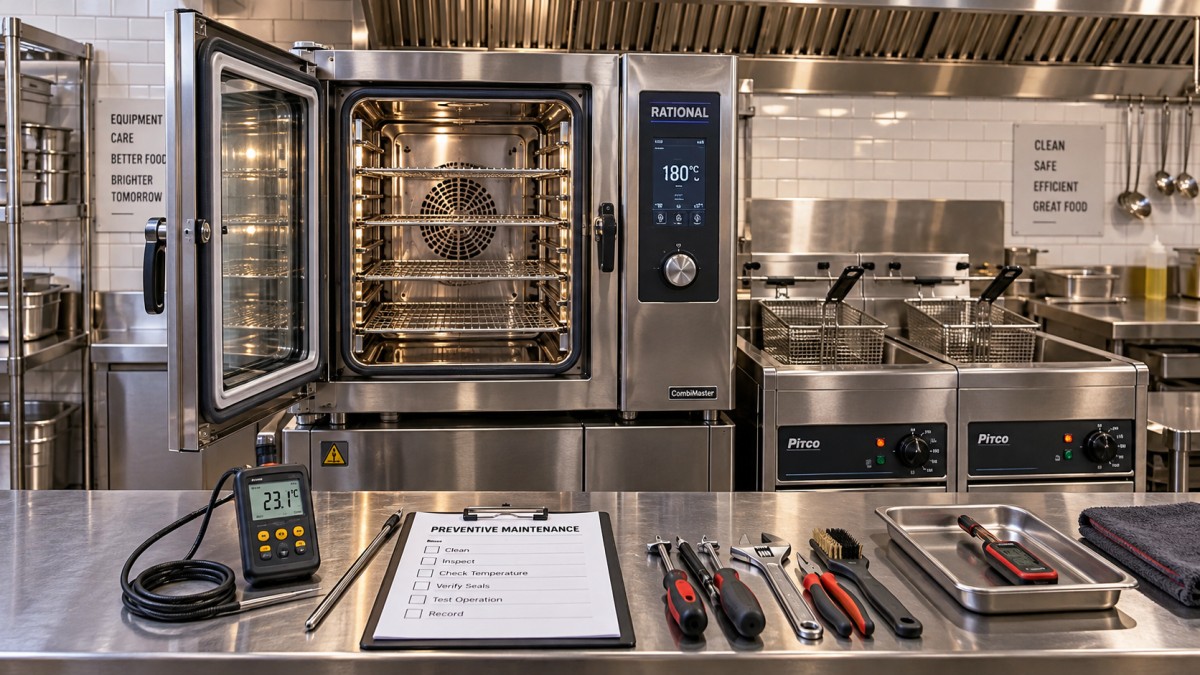
Depending on the appliance, a preventive maintenance visit may also include:
- Checking temperature control and verifying calibration where appropriate.
- Inspecting door seals, hinges, latches, fans, and other moving parts.
- Cleaning accessible service components within the agreed scope.
- Examining water inlets, drains, steam systems, and scale-related problems.
- Testing safety functions using the manufacturer’s procedures.
- Identifying worn parts and distinguishing urgent repairs from items to monitor.
Ask for a written report showing what was inspected, what was measured, any deficiencies found, and recommended actions. “Service completed” provides little help when you are trying to understand recurring faults or plan replacement expenditure.
Which warning signs mean service cannot wait?
A maintenance calendar is for prevention, not permission to keep using faulty equipment. Unexpected changes in performance should be investigated even if the next scheduled visit is months away.
Arrange prompt assessment if you notice persistent uneven heating, slow recovery, repeated ignition failures, unusual noises, damaged seals, water leaks, or recurring error messages. Unexpected increases in energy use can also justify investigation, although workload and utility-rate changes should be considered before blaming the equipment.
Stop using equipment when there is a suspected safety fault. Gas odors, smoke from electrical components, sparking, damaged power cables, repeated breaker trips, or uncontrolled overheating require immediate action. Follow the site’s emergency procedures and contact the appropriate emergency service or qualified professional. If gas is suspected, avoid ignition sources and do not attempt your own diagnosis.
If an appliance may not be achieving safe cooking temperatures, remove it from use until assessed and follow your food safety procedures for affected food. Do not rely on a control-panel reading alone to confirm that food has been cooked safely.
Can daily cleaning replace professional maintenance?
No. Daily care and professional servicing address different problems, and a reliable kitchen needs both.
Kitchen staff can usually handle manufacturer-approved tasks such as cleaning cooking surfaces, emptying grease trays, inspecting visible damage, running prescribed cleaning cycles, and keeping permitted air openings clear. These routines reduce buildup and make changes easier to spot.
They do not replace internal electrical inspection, gas-system testing, safety-device assessment, or technical calibration. Equally, a technician’s twice-yearly visit cannot compensate for grease and food debris left to accumulate every night.
Keep operator tasks realistic. A short closing checklist that is consistently completed is more valuable than a lengthy document nobody has time to follow. Make clear which cleaning chemicals and methods are approved; unsuitable products or pressure washing can damage controls, seals, and electrical parts.
Staff should not remove service panels, adjust gas valves, bypass interlocks, or repeatedly reset a fault without understanding its cause. Train them to record symptoms and report problems instead.
Do extraction systems and fire suppression follow the same schedule?
Not necessarily. Cooking equipment, exhaust hoods, ductwork, and fire suppression systems are connected operationally, but they have different maintenance needs and may be covered by separate rules.
Extraction cleaning frequency depends on cooking volume, cooking methods, grease accumulation, and applicable requirements. Solid-fuel cooking and heavy charbroiling can create different risks from a lightly used kitchen. Fire suppression inspection and servicing must follow the relevant local rules and system requirements.
Do not assume an appliance service includes duct cleaning or fire suppression maintenance. Confirm the scope and use appropriately qualified providers. A well-maintained range still cannot perform safely in an environment with inadequate extraction.
How can a manager build a workable maintenance calendar?
Start with an equipment register: appliance type, model, serial number, installation date, location, warranty details, and maintenance instructions. Add typical operating hours and previous service reports. This gives the service provider enough information to recommend intervals rather than guess.
Assign each appliance a schedule based on its requirements and risk. You can group visits to reduce disruption, but avoid delaying a high-use fryer simply because the oven is not yet due.
A practical routine is to:
- Separate daily operator care from professional maintenance and statutory inspections.
- Book servicing around quieter periods, allowing safe cooling and technician access.
- Keep a simple fault log with dates, symptoms, error codes, and operational impact.
- Track recommended repairs until they are completed, not merely noted.
- Review intervals when workloads, menus, water conditions, or equipment change.
For hotels, central kitchens, and multi-site restaurants, digital maintenance records can make overdue tasks and recurring faults easier to see. Smaller businesses may manage perfectly well with a shared calendar and an organized service folder.
How do you choose a service provider—and know when to replace equipment?
Choose a provider with experience in your appliance types and access to the relevant technical information. Confirm qualifications for gas or electrical work, familiarity with specialist equipment, parts availability, and what the quoted visit includes. Emergency response arrangements are worth discussing before a breakdown occurs.
If equipment is under warranty, check maintenance conditions and authorization requirements. Keep records, but do not assume every fault will be covered simply because scheduled servicing was completed.
Repeated repairs should also trigger a replacement discussion. Consider repair history, downtime, parts availability, energy performance, and whether the appliance still suits the kitchen’s workload. Maintenance can extend useful life; it cannot make worn-out or undersized equipment indefinitely dependable.
The practical answer is to start with manufacturer guidance, use six to twelve months as a common planning range, and shorten the interval when operating conditions justify it. Pair that schedule with daily care and prompt action on warning signs. The aim is not to collect service appointments—it is to keep the cooking line dependable when the next rush arrives.
Popular Tags
Kitchen Industry Research Team
Dedicated to analyzing emerging trends and technological shifts in the global hospitality and foodservice infrastructure sector.
Industry Insights
Join 15,000+ industry professionals. Get the latest market trends and tech news delivered weekly.
No spam. Unsubscribe anytime.

Contact With us
Contact:
Anne Yin (Ceramics Dinnerware/Glassware)
Lucky Zhai(Flatware)