
Restaurant kitchen equipment accessories worth stocking early
For after-sales maintenance teams, stocking the right restaurant kitchen equipment accessories early can prevent costly downtime, speed up repairs, and keep commercial kitchens running safely and efficiently. From seals and thermostats to valves, filters, and electrical parts, having essential components on hand supports faster service response and better equipment performance in restaurants, hotels, and food processing environments.
In commercial kitchens, a failed accessory often causes more disruption than a major machine fault because service stops immediately while technicians wait for small parts. A damaged door gasket on a reach-in refrigerator, a blocked burner nozzle, or a faulty contactor in a combi oven can interrupt production within minutes. For maintenance teams responsible for restaurant chains, hotel kitchens, or centralized foodservice sites, early spare-parts planning is not optional. It is part of risk control, service quality, and operating continuity.
This article explains which restaurant kitchen equipment accessories are worth stocking early, how to prioritize them by failure risk and equipment criticality, and how after-sales teams can build a practical inventory strategy that balances uptime, budget, and response speed.
Why Early Stocking Matters in Commercial Kitchen Maintenance
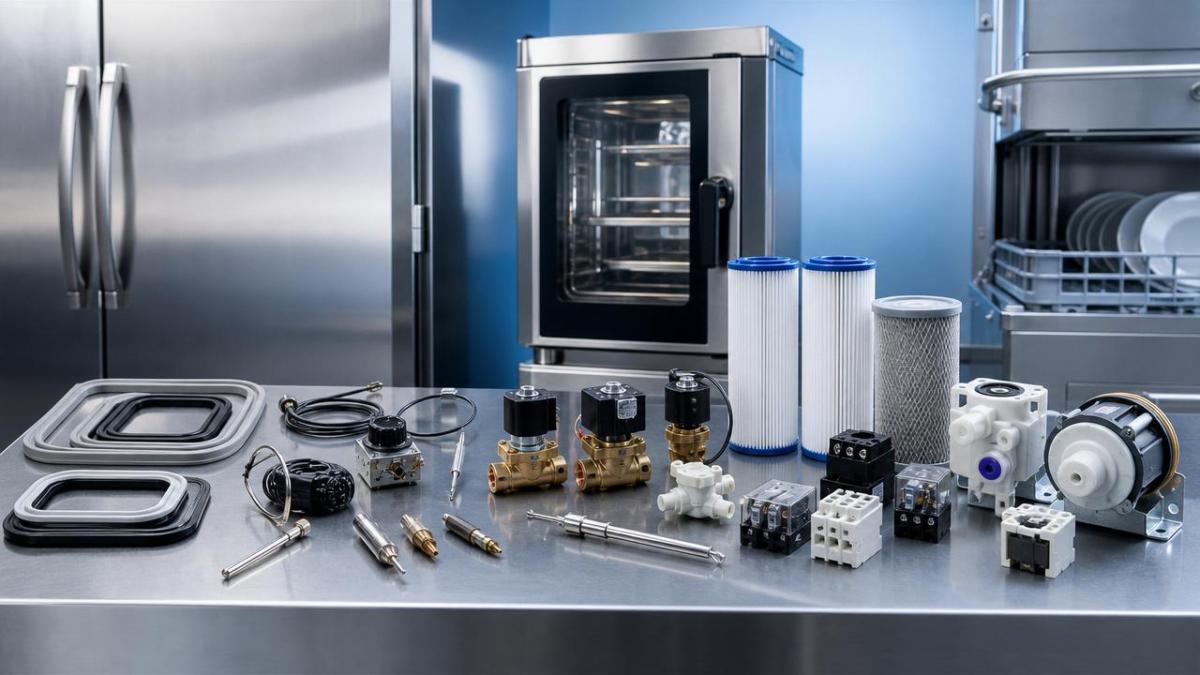
Restaurant equipment operates under high heat, moisture, grease exposure, cleaning chemicals, and long daily runtimes. In many sites, hot-line equipment runs 8–16 hours per day, while refrigeration and ventilation systems may operate 24/7. Under these conditions, accessories such as seals, switches, probes, and filters wear out much faster than operators expect.
For after-sales maintenance teams, the challenge is not only technical repair. It is also response time. A kitchen that loses one fryer, one oven, or one refrigeration unit during peak service can face delayed orders, food safety risks, and labor inefficiency. If a low-cost spare part is unavailable, a 30-minute repair can become a 2–5 day disruption, especially when imported parts or cross-border shipments are involved.
The Real Cost of Missing Small Parts
The purchase value of accessories is usually small compared with the value of the equipment they support. However, their operational impact is high. A $10 gasket or a $25 sensor may protect a refrigerator, steamer, or dishwasher worth hundreds or thousands of dollars. Stocking accessories early reduces emergency freight, repeat technician visits, and avoidable shutdowns.
- Faster repair completion on first visit
- Lower unplanned downtime during lunch and dinner peaks
- Better food safety control for cold storage and cooking equipment
- Reduced pressure on procurement teams during urgent failures
- More predictable maintenance costs over 30, 60, and 90-day periods
Which Sites Need the Earliest Spare Coverage
Not every site needs the same spare-parts depth. A single independent restaurant may keep only essential consumables, while a hotel complex, central kitchen, or food processing line may need multi-level stock. Sites with 3 or more identical units, long operating hours, or difficult import lead times should maintain broader accessory coverage.
The table below shows how maintenance teams can align stock priority with site type and service risk.
The key takeaway is simple: the higher the service intensity and the lower the tolerance for downtime, the earlier restaurant kitchen equipment accessories should be stocked. This is particularly true where accessory lead times exceed 7–15 days or where kitchen operations cannot pause for replacement sourcing.
Restaurant Kitchen Equipment Accessories Worth Stocking Early
A smart stock list focuses on parts with four characteristics: frequent wear, short replacement time, high failure impact, and moderate shelf stability. After-sales teams should first cover accessories used across refrigeration, cooking, washing, ventilation, and food preparation equipment.
1. Seals, Gaskets, and O-Rings
These are among the most practical restaurant kitchen equipment accessories to stock early. Door gaskets in refrigerators and freezers affect temperature retention, compressor load, and food safety. Steamers, mixers, pumps, and beverage systems also depend on properly fitted seals. In high-use kitchens, inspection every 30 days is reasonable, with replacement cycles often ranging from 3 to 12 months depending on heat, cleaning routine, and door traffic.
Common failure signs
- Cold air leakage or visible door gaps
- Water drips around steam or wash systems
- Increased compressor running time
- Cracking, flattening, or hardening of rubber parts
2. Thermostats, Temperature Probes, and Sensors
Temperature accuracy is critical in commercial kitchens. Refrigeration units, fryers, ovens, dishwashers, and holding cabinets all rely on stable control. Even a deviation of 2–5°C can affect food safety, product consistency, or cleaning effectiveness. Stocking thermostats, NTC probes, and limit sensors helps maintenance teams restore operation quickly without waiting for diagnostic retesting and delayed purchasing approval.
3. Valves, Solenoids, and Water Control Parts
Ice machines, combi ovens, steamers, dishwashers, and beverage systems often fail due to water inlet issues, scale buildup, or valve wear. Solenoid valves and drain valves are compact but operationally important. In areas with hard water, maintenance teams may see shorter service intervals, sometimes under 6 months for heavily loaded wash or steam applications.
4. Filters and Routine Consumables
Filters are low-cost but high-impact accessories. Grease filters support ventilation safety, water filters protect ice and coffee quality, and air filters help cooling performance in selected units. A missed replacement can raise energy use, increase cleaning time, and shorten equipment life. Many kitchens benefit from 1-month, 3-month, or 6-month filter replacement schedules based on usage and water conditions.
5. Electrical Wear Parts
Fuses, relays, contactors, terminal blocks, switches, pilot lights, and igniters deserve space in any maintenance stockroom. They are widely used across fryers, ovens, warmers, mixers, and refrigeration control panels. For sites with mixed-voltage equipment, technicians should separate stock by voltage, phase, and current range to avoid installation errors during urgent repairs.
The following table groups common restaurant kitchen equipment accessories by application and stocking logic.
For maintenance teams, early stocking should begin with parts that fail regularly and can be installed in one visit. This approach improves first-time fix rates and reduces pressure on both procurement and operations.
How to Prioritize Accessories by Risk, Usage, and Lead Time
Not all accessories should be stocked in the same quantity. A practical method is to score each item across 4 dimensions: failure frequency, operational impact, supplier lead time, and part interchangeability. This helps avoid overstocking slow-moving items while protecting high-risk equipment.
A 4-Point Prioritization Method
- Review repair records from the last 6–12 months.
- Mark parts linked to equipment that stops production immediately.
- Check average replenishment time, especially for imported or model-specific parts.
- Separate universal accessories from brand-specific components.
For example, if a thermostat fails 4 times per quarter, affects a primary holding cabinet, and requires a 10-day lead time, it should be stocked earlier than a decorative handle with a low operational impact. Similarly, a universal fuse may be kept in larger quantities than a special PCB that requires strict model matching.
Recommended Inventory Tiers
Many after-sales teams use a 3-tier system for restaurant kitchen equipment accessories. Tier 1 includes emergency parts required within 24 hours. Tier 2 supports scheduled repair within 3–7 days. Tier 3 contains low-turn items sourced on demand. This structure is especially useful for service providers supporting multiple customer locations.
- Tier 1: fuses, switches, common probes, gaskets, igniters, filters
- Tier 2: solenoid valves, relays, fan motors, spray arms, contactors
- Tier 3: control boards, model-specific displays, custom assemblies
If a chain operates 10 identical fryers or 20 identical undercounter refrigerators, the inventory logic changes. Maintenance teams can standardize a shared spare kit and reduce unit-by-unit uncertainty. Standardization often cuts identification time and lowers the risk of ordering the wrong part.
Storage, Shelf Control, and Documentation for Spare Parts
Stocking parts early only works if the accessories remain usable, traceable, and easy to retrieve. Poor storage can damage rubber parts, confuse voltage-sensitive electrical items, or cause technicians to waste time searching for mislabeled stock. A well-run spare-parts area supports faster service as much as the stock itself.
Basic Storage Rules for Maintenance Teams
Rubber seals and gaskets should be kept away from direct sunlight, excessive heat, and chemical contamination. Electrical accessories should be stored dry, labeled by voltage and compatibility, and protected from dust and impact. Water treatment cartridges and filters should be rotated by date to prevent expired stock. In many service environments, a review cycle every 30 or 60 days is enough to identify shortages, obsolete parts, or damaged packaging.
What to record for each item
- Part name and internal stock code
- Compatible equipment category or model range
- Minimum and maximum stock level
- Supplier lead time and reorder point
- Date received and shelf review date
- Technician usage history
The table below outlines a simple control framework that fits most after-sales operations.
Even a simple spreadsheet or service management system can deliver strong results if data discipline is consistent. The goal is to make restaurant kitchen equipment accessories available at the right moment, not merely to fill shelves.
Common Mistakes When Building an Accessory Stock Plan
Many maintenance teams understand the importance of spare parts but still lose efficiency through poor selection habits. The most common mistake is buying too many low-risk items while neglecting the fast-moving components that actually stop service. Another frequent issue is storing parts without compatibility notes, which creates delays during urgent calls.
Mistakes to avoid
- Stocking parts based only on purchase price instead of downtime impact
- Ignoring replacement intervals for filters, seals, and probes
- Mixing similar electrical parts without voltage or rating labels
- Failing to review dead stock every quarter
- Depending entirely on emergency procurement for imported accessories
A better approach is to link every stocked item to a real maintenance scenario: what fails, how often it fails, how long replacement takes, and what happens if the part is unavailable. When this logic is followed, accessory planning becomes a service strategy rather than a warehouse task.
Building a More Responsive After-Sales Support Model
The kitchen equipment industry is moving toward smarter systems, higher energy efficiency, and more connected operations. Even so, the daily reliability of commercial kitchens still depends on practical maintenance basics. For after-sales teams, the right restaurant kitchen equipment accessories remain the foundation of fast response, stable uptime, and safer operation across restaurants, hotels, and food processing sites.
If your service team is reviewing spare-part policy, start with high-use accessories such as seals, thermostats, valves, filters, and electrical wear parts. Prioritize by failure frequency, operational impact, and lead time. Then build a simple 3-tier inventory system with regular review intervals and clear compatibility records.
A well-planned accessory stock program can shorten repair cycles, improve first-visit completion, and support better equipment life across demanding foodservice environments. To optimize your spare-parts list, get a customized stocking plan, consult product details, or contact us now to explore more maintenance-focused kitchen equipment solutions.
Popular Tags
Kitchen Industry Research Team
Dedicated to analyzing emerging trends and technological shifts in the global hospitality and foodservice infrastructure sector.
Industry Insights
Join 15,000+ industry professionals. Get the latest market trends and tech news delivered weekly.
No spam. Unsubscribe anytime.
Contact With us
Contact:
Anne Yin (Ceramics Dinnerware/Glassware)
Lucky Zhai(Flatware)