
Restaurant Kitchen Equipment Design Trends Shaping New Builds
Restaurant kitchen equipment design is evolving rapidly as new builds prioritize efficiency, safety, sustainability, and smart integration. From automated cooking systems to energy-saving layouts, today’s projects demand solutions that support faster workflows and consistent food quality. Understanding the latest restaurant kitchen equipment design trends helps operators, developers, and planners create future-ready spaces that meet both operational goals and changing market expectations.
Why a checklist approach works better for new kitchen projects
For information researchers comparing options, restaurant kitchen equipment design can quickly become overwhelming. A new build involves layout logic, equipment sequencing, code compliance, labor efficiency, utility loads, cleaning access, and long-term operating cost. Looking at trends without a checklist often leads to a surface-level view: people notice smart ovens or sleek stainless finishes, but miss workflow conflicts, maintenance issues, and hidden energy demands.
A checklist-based review makes the topic more practical. It helps decision-makers separate trends that improve real performance from trends that only look modern on paper. It also supports better conversations with kitchen consultants, architects, general contractors, restaurant operators, and equipment suppliers. In short, the best restaurant kitchen equipment design decisions come from evaluating trend value against the actual menu, staff model, service speed, and expansion goals of the business.
Start here: the core trend checklist to review first
Before evaluating individual products, use the following checklist to judge whether a design direction is truly relevant for a new build. These are the priority signals shaping modern restaurant kitchen equipment design across commercial kitchens, hotels, central kitchens, and foodservice developments.
- Workflow efficiency: Check whether equipment placement reduces cross-traffic between prep, cooking, plating, warewashing, and storage. A strong design trend should shorten movement, reduce bottlenecks, and support faster service.
- Energy performance: Confirm whether equipment choices lower gas, electricity, water, or ventilation loads. Energy-efficient kitchen solutions are now a major factor in restaurant kitchen equipment design because utility costs directly affect profitability.
- Automation potential: Review where automated cooking systems, programmable equipment, or digital monitoring can reduce repetitive labor and improve consistency without overcomplicating operations.
- Food safety support: Evaluate whether the design separates raw and cooked zones, supports temperature control, simplifies sanitation, and minimizes contamination risk.
- Scalability: Ask whether the kitchen can handle menu expansion, peak volume changes, delivery growth, or future equipment upgrades.
- Maintenance access: Modern equipment often adds electronics and sensors. If service access is poor, downtime rises. Good design must consider cleaning space, repair reach, and replacement logistics.
- Smart integration: Confirm whether connected equipment can share data with kitchen display systems, inventory software, or energy management tools in a useful way.
- Regulatory alignment: New builds must match ventilation, fire suppression, drainage, electrical, and local foodservice compliance requirements from the start.
The most important restaurant kitchen equipment design trends to evaluate
1. Modular layouts are replacing rigid kitchen plans
One of the strongest shifts in restaurant kitchen equipment design is the move toward modularity. Instead of building around fixed production lines that are hard to change, new kitchens increasingly use flexible stations. This allows operators to adapt to dine-in fluctuations, online delivery demand, seasonal menu shifts, or changing labor availability.
The practical check is simple: can prep, hot line, cold line, and finishing functions be adjusted without a major rebuild? If the answer is yes, the design is better aligned with current market conditions.
2. Compact high-output equipment is gaining priority
Urban construction costs, smaller footprints, and pressure to maximize revenue per square foot are pushing demand for equipment that delivers more output in less space. Combination ovens, ventless units, multifunctional prep systems, and stacked cooking platforms are now central to many restaurant kitchen equipment design plans.
The key judgment standard is not just size reduction. It is whether the equipment maintains production speed, product consistency, and cleaning efficiency while saving floor area.
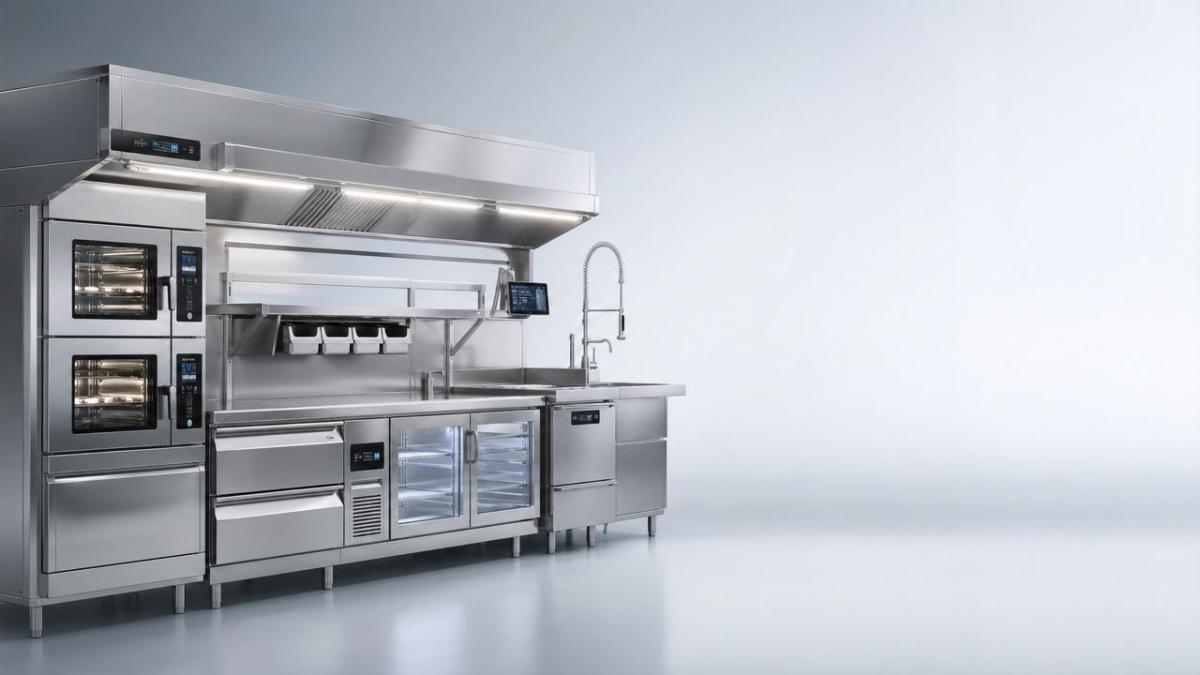
3. Smart kitchen systems are moving from optional to strategic
Connected ovens, temperature monitoring, predictive maintenance alerts, digital recipe controls, and remote diagnostics are no longer niche features. In many new builds, they are becoming a strategic part of restaurant kitchen equipment design. Their value is strongest where operators need consistency across locations, reduced training time, and tighter control of quality.
However, information researchers should verify whether the smart layer solves a real problem. The best smart kitchen technology reduces error rates, improves traceability, or shortens service response time. If it only adds interface complexity, it may not justify the investment.
4. Sustainability is shaping both equipment choice and layout planning
Sustainability in restaurant kitchen equipment design goes beyond choosing an energy-saving appliance. It includes heat load reduction, water-saving warewashing, better insulation, induction adoption, efficient refrigeration, and optimized ventilation. In some projects, sustainability goals also influence waste handling, grease management, and equipment material selection.
The right question is: where can design reduce resource use without slowing production? This is especially relevant for hotels, chain restaurants, and high-volume kitchens with long operating hours.
5. Ergonomic design is now a performance issue, not just a comfort issue
Labor shortages and retention concerns are changing design priorities. Adjustable work surfaces, easier-reach refrigeration, safer lifting positions, lower-motion prep flow, and simplified controls are all part of modern restaurant kitchen equipment design. These features help reduce fatigue, training difficulty, and repetitive strain while supporting throughput.
When comparing options, review how many steps, turns, lifts, and reach actions are required at each station. Better ergonomics often translate directly into better speed and fewer mistakes.
How trend priorities change by restaurant type
Not every trend should carry equal weight in every project. A useful restaurant kitchen equipment design review should always consider operating model differences.
Quick-service and fast-casual concepts
These projects should prioritize speed, standardized output, compact equipment, and production visibility. Ventless technology, programmable cooking platforms, pickup-zone coordination, and dual-line assembly setups are often high-impact choices.
Full-service restaurants
Here, flexibility matters more. Kitchen planners should evaluate stations that support menu variety, finishing quality, and better coordination between prep and service. Smart controls can help, but layout flow and pass-line efficiency usually create more value than adding too many digital features.
Hotels and mixed-use hospitality projects
These kitchens often require multiple production modes, from banquet service to all-day dining and room service. Restaurant kitchen equipment design in this context should focus on zoning, volume flexibility, refrigeration planning, and back-of-house coordination with storage and service elevators.
Central kitchens and delivery-focused operations
For these facilities, automation, food safety controls, traceability, batch consistency, and production scale are top priorities. Equipment should be evaluated for integration with food processing workflows, packaging stages, and cold-chain requirements.
Common gaps that weaken restaurant kitchen equipment design
Many projects adopt modern equipment but still underperform because critical details were overlooked. These are the most common risk areas to check before final specification.
- Utility mismatch: Equipment is selected before verifying gas, electric, drainage, or ventilation capacity.
- Over-automation: A kitchen invests in complex smart systems that staff do not use consistently.
- Poor cleaning clearance: Tight placement improves floor efficiency on paper but creates sanitation and service problems.
- Menu-design conflict: The equipment package does not match actual product mix, batch size, or plating speed.
- Ignoring delivery operations: New builds sometimes optimize dine-in flow while neglecting order staging, packaging, and courier pickup traffic.
- Underestimating refrigeration strategy: Cold storage location, access frequency, and temperature zoning often receive less attention than cooking equipment, even though they strongly affect food safety and labor efficiency.
A practical decision framework for evaluating new builds
If you are researching restaurant kitchen equipment design for a project pipeline, supplier comparison, or planning discussion, use this simplified decision framework.
Execution advice before selecting equipment partners
To move from trend research to project action, prepare the right information early. This will make discussions with manufacturers, kitchen equipment suppliers, designers, and contractors more productive.
Priority items to prepare include the target menu mix, expected daily covers, service model, peak-hour throughput, available utility infrastructure, staffing assumptions, cleaning standards, sustainability goals, and budget range. For larger projects, it is also helpful to define whether the goal is standardization across multiple sites or optimization for one flagship location.
When comparing restaurant kitchen equipment design proposals, ask suppliers to show not only equipment lists, but also workflow logic, maintenance implications, installation constraints, and expected operating savings. This creates a stronger basis for decision-making than comparing prices alone.
FAQ: quick questions information researchers often ask
Which trend has the biggest impact on new restaurant builds?
In most cases, it is the combination of workflow-first layout planning and multifunctional equipment. These two factors often deliver the fastest operational gains in restaurant kitchen equipment design.
Are smart kitchen systems always worth adding?
Not always. They are most valuable when they improve consistency, remote visibility, maintenance planning, or labor efficiency. Their value is weaker when the team lacks the process discipline to use the data.
What is the most overlooked issue in restaurant kitchen equipment design?
Cleaning and maintenance access is one of the most frequently overlooked areas. A design that looks efficient but is difficult to clean or repair can create long-term operational problems.
What to do next if you are narrowing options
The best way to use current restaurant kitchen equipment design trends is to treat them as decision filters, not as a shopping list. Start by ranking your project needs: throughput, food safety, labor efficiency, flexibility, sustainability, and digital control. Then test every equipment and layout decision against those priorities.
If you need to move forward, the most useful next discussion points are equipment compatibility with your menu, utility requirements, layout adaptability, installation timeline, lifecycle operating cost, maintenance support, and integration with future smart kitchen systems. Clarifying these items early will help you identify solutions that are not only modern, but also operationally reliable and commercially realistic.
Popular Tags
Kitchen Industry Research Team
Dedicated to analyzing emerging trends and technological shifts in the global hospitality and foodservice infrastructure sector.
Industry Insights
Join 15,000+ industry professionals. Get the latest market trends and tech news delivered weekly.
No spam. Unsubscribe anytime.
Contact With us
Contact:
Anne Yin (Ceramics Dinnerware/Glassware)
Lucky Zhai(Flatware)