
Kitchen Tools Distributor Trends in Cross-Border Supply
As global sourcing becomes more dynamic, every kitchen tools distributor must adapt to shifting trade policies, buyer expectations, and supply chain technology. For business evaluators, understanding these cross-border supply trends is essential to assessing supplier reliability, cost efficiency, and long-term market potential in the evolving kitchen equipment industry.
Why a checklist approach works better for cross-border evaluation
For a business evaluator, the challenge is rarely a lack of market information. The real difficulty is deciding which signals matter most when reviewing a kitchen tools distributor in international supply. Cross-border supply involves tariffs, freight volatility, compliance rules, packaging standards, lead-time risks, and channel strategy. A checklist approach helps separate attractive marketing claims from operational capability.
This matters especially in the kitchen equipment sector, where buyers expect consistent quality, food-contact safety, durable materials, and stable replenishment. Whether the distributor handles utensils, cookware accessories, preparation tools, or mixed kitchen product lines, the same question applies: can this partner deliver with predictable cost, acceptable compliance risk, and enough flexibility for different markets?
Using structured judgment criteria also improves internal comparison. Procurement, finance, and operations teams can assess one kitchen tools distributor against another using the same standards, reducing subjective decisions and making supplier shortlists easier to defend.
First signals to confirm before deeper review
Before reviewing product catalogs or price sheets, evaluators should confirm a few high-impact indicators. These first signals often reveal whether a kitchen tools distributor is prepared for long-term cross-border cooperation or only capable of short-term trading.
- Export structure: Check whether the distributor serves only one region or has diversified shipping experience across North America, Europe, the Middle East, and emerging markets.
- Product focus: Confirm whether the supplier specializes in kitchen tools or mixes unrelated product categories that may weaken sourcing depth and quality control.
- Supply chain model: Determine if the business operates as a stocking distributor, factory-linked exporter, or sourcing intermediary. Each model affects lead time, pricing, and accountability.
- Compliance readiness: Review food-contact material documentation, packaging standards, labeling adaptability, and market-specific certifications.
- Operational responsiveness: Test quotation speed, sample coordination, issue escalation, and after-sales communication. Slow response often predicts later delivery friction.
If a kitchen tools distributor performs poorly on these early points, deeper due diligence may not justify the time investment.
Core checklist: how to judge a kitchen tools distributor in cross-border supply
The following checklist is designed for practical evaluation. It focuses on the areas that most directly affect cost, continuity, and commercial viability.
1. Product and sourcing stability
A qualified kitchen tools distributor should show stable sourcing relationships, not just a broad SKU list. Evaluators should ask how many core factories support the main product range, how substitutions are managed when materials change, and whether production is concentrated in one region or spread across multiple manufacturing clusters. In kitchen tools, stainless steel grade consistency, handle materials, mold ownership, and packaging repeatability all influence long-term reliability.
2. Cost structure transparency
Low prices alone are not a reliable indicator. A strong kitchen tools distributor should explain the cost components behind FOB, CIF, or DDP quotations, including tooling, packing, inspection, inland transport, and export documentation. Evaluators should check whether pricing remains stable across reorder cycles or changes frequently due to weak procurement control. Transparent costing makes landed-cost forecasting more accurate.
3. Compliance and market access readiness
Cross-border supply is increasingly shaped by compliance. Kitchen tools often touch food directly, which means declarations on materials, migration safety, and restricted substances can become critical. The distributor should be able to prepare supporting documents for target markets and adjust labeling or packaging claims as regulations evolve. This is especially important when serving retailers, hospitality groups, or e-commerce platforms with strict documentation requirements.
4. Logistics resilience and lead-time control
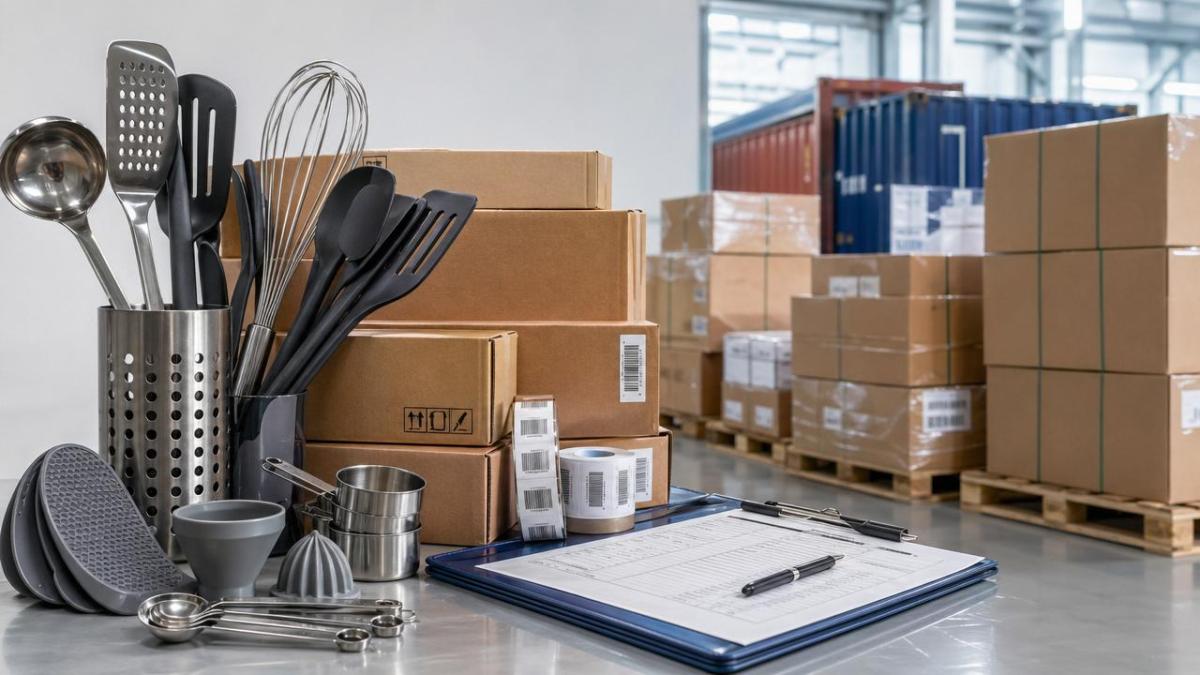
A cross-border kitchen tools distributor must manage more than factory output. Business evaluators should review average production lead times, shipment consolidation capability, packaging optimization for container use, and alternative port or route planning. For high-volume or seasonal buyers, weak freight coordination can erase any product-level savings. Ask for examples of how the distributor handled port delays, customs inspections, or sudden shipping cost increases.
5. Digital coordination capability
One of the strongest trends in cross-border supply is digital visibility. A modern kitchen tools distributor should support ERP-linked order tracking, barcode or SKU discipline, digital documentation flow, and timely inventory reporting where relevant. Even if the supplier is not fully automated, the ability to share status updates quickly reduces uncertainty and improves purchase planning.
6. Quality assurance process
Evaluators should not stop at sample quality. The key is whether inspection methods are repeatable at shipment scale. Review incoming material checks, in-line inspection points, final random inspection, defect classification standards, and corrective-action procedures. For a kitchen tools distributor, quality control should cover appearance, dimensions, mechanical strength, corrosion resistance where applicable, and carton integrity.
Cross-border trends that deserve priority attention
Not every market trend requires the same level of attention. Business evaluators should prioritize the changes that alter supplier economics or risk exposure.
- Regional diversification is accelerating. Buyers increasingly prefer a kitchen tools distributor with more than one sourcing base or backup production path.
- Energy and material costs are reshaping quotes. Stainless steel, silicone, wood, and packaging materials can create margin pressure if procurement is not locked in.
- Retail and e-commerce packaging standards are rising. Distributors now need stronger labeling accuracy, carton drop resistance, and barcode readiness.
- Traceability expectations are expanding. Buyers want clearer documentation on production origin, material declarations, and batch control.
- Smaller, faster replenishment cycles are becoming more common. This favors distributors with inventory planning discipline and mixed-order coordination.
How evaluation priorities change by buyer scenario
A kitchen tools distributor may look strong in one channel and weak in another. Evaluation standards should reflect the actual business model of the buyer.
For restaurant and hospitality procurement
Durability, replenishment consistency, and commercial-grade suitability matter most. Check whether the distributor understands high-frequency use conditions and can maintain continuity across repeat orders without visible quality drift.
For retail chains and private label buyers
Packaging compliance, brand presentation, shelf readiness, and audit discipline become higher priorities. A kitchen tools distributor serving retail must coordinate artwork changes accurately and manage promotional timelines with fewer delays.
For e-commerce sellers
Carton optimization, damage prevention, SKU clarity, and flexible MOQ structures are essential. Evaluators should confirm whether the distributor can support assortment testing, fast relabeling, and low-defect fulfillment expectations.
For importers entering emerging markets
The biggest issue may be adaptation rather than scale. A capable kitchen tools distributor should support product mix adjustment, multilingual labeling where needed, and practical payment or shipment arrangements suited to local channel conditions.
Commonly overlooked risk items
Some of the most expensive supply problems come from details that are easy to ignore during early discussions.
- Overdependence on one factory for a best-selling line, with no backup qualification plan.
- Unclear responsibility for failed inspections, relabeling costs, or customs-related document errors.
- Quoted lead times based on normal seasons, without peak-season or holiday adjustment.
- Inconsistent material grades between initial samples and mass production lots.
- Weak carton design that increases breakage, deformation, or moisture damage in long-distance shipping.
- Lack of practical data on claim rates, return handling, or replacement lead times.
If these items are not reviewed early, a kitchen tools distributor that appears cost-effective can become expensive after the first two or three shipment cycles.
A practical scoring table for business evaluators
To compare suppliers objectively, many teams use a weighted scorecard. The table below provides a simple starting framework for reviewing a kitchen tools distributor.
Execution advice: what to prepare before supplier discussions
To get useful answers from a kitchen tools distributor, buyers should prepare a clear internal brief. This should include target markets, expected annual volume, preferred trade terms, packaging requirements, compliance expectations, and reorder frequency. Without this baseline, supplier comparisons tend to focus too much on headline price and too little on execution fit.
It is also wise to request one pilot order scenario during evaluation. A small but realistic order can reveal actual sampling speed, documentation quality, carton performance, and communication discipline better than presentations alone. For strategic sourcing, evaluators may also ask for a business continuity plan covering raw material fluctuation, labor disruption, or route delays.
FAQ for evaluating a kitchen tools distributor
Is factory ownership always better than distributor capability?
Not necessarily. A factory-direct model may reduce some cost layers, but a skilled kitchen tools distributor can provide broader sourcing options, mixed-category coordination, and faster adaptation across markets. The better choice depends on complexity, volume, and need for flexibility.
What is the biggest warning sign in cross-border kitchen tool supply?
A major warning sign is inconsistency between sales promises and operational proof. If the distributor cannot support claims with documents, inspection logic, or actual shipment history, the risk level is high.
How often should supplier performance be reviewed?
For active programs, quarterly review is practical. Track lead time, defect rate, claim resolution, quote accuracy, and communication performance. Trend review is more valuable than one-time approval.
Next-step guidance for decision makers
Cross-border sourcing success depends on disciplined evaluation, not assumptions. When reviewing a kitchen tools distributor, business evaluators should prioritize supply stability, compliance readiness, landed-cost transparency, logistics resilience, and repeatable quality control. These are the decision points most likely to affect long-term commercial value.
If your team plans to move forward, the most useful next discussion topics are product specifications, market compliance needs, packaging standards, minimum order strategy, sample timing, lead-time commitments, claim handling rules, and pricing validity under changing freight or material conditions. A kitchen tools distributor that can answer these questions clearly is far more likely to be a dependable cross-border partner.
Popular Tags
Kitchen Industry Research Team
Dedicated to analyzing emerging trends and technological shifts in the global hospitality and foodservice infrastructure sector.
Industry Insights
Join 15,000+ industry professionals. Get the latest market trends and tech news delivered weekly.
No spam. Unsubscribe anytime.


Contact With us
Contact:
Anne Yin (Ceramics Dinnerware/Glassware)
Lucky Zhai(Flatware)