
Restaurant Kitchen Equipment Accessories That Improve Output
In a fast-paced foodservice environment, the right restaurant kitchen equipment accessories can make a measurable difference in daily output, workflow, and consistency. From improving safety and reducing downtime to supporting faster prep and smoother operations, these essential add-ons help kitchen staff work more efficiently under pressure. Understanding which accessories deliver real value is key to building a more productive and reliable kitchen.
Understanding the Role of Accessories in Commercial Kitchens
When operators think about kitchen performance, attention often goes first to ovens, ranges, fryers, refrigerators, and food processors. However, restaurant kitchen equipment accessories are the supporting components that help these core machines perform at a higher level. Accessories include inserts, racks, casters, shelving add-ons, splash guards, cutting attachments, temperature probes, trays, filter systems, and many other items that improve how equipment is used every day.
In practical terms, accessories are not decorative extras. They affect speed, accuracy, sanitation, labor efficiency, and equipment lifespan. For kitchen staff and line operators, the right accessory can reduce unnecessary movement, simplify repetitive tasks, and support more consistent food preparation. In a busy restaurant, those small gains become significant over the course of a full service day.
This matters across the wider kitchen equipment industry as well. As foodservice businesses pursue automation, smart controls, and energy efficiency, accessories are becoming more specialized and more valuable. They help connect equipment to real operational needs, whether in restaurants, hotel kitchens, central production units, or food processing environments.
Why the Industry Pays More Attention to Kitchen Accessories
The kitchen equipment industry is evolving in response to labor shortages, rising utility costs, stricter food safety expectations, and the need for faster service. In that environment, restaurant kitchen equipment accessories are gaining attention because they offer a practical way to improve output without replacing every major machine in the kitchen.
For example, a prep station with proper container rails and organized ingredient pans can speed up assembly during peak hours. A fryer with high-quality baskets and oil filtration accessories can reduce cooking delays and improve product consistency. Refrigeration accessories such as shelf dividers, labeled storage bins, and door alarms can strengthen stock rotation and food safety control. These are targeted improvements, but they directly support daily operations.
Another reason for growing interest is that accessories often offer a better return on investment than major equipment upgrades. Operators can improve workflow in stages, solve immediate operational problems, and extend the value of existing assets. This is especially relevant in cost-sensitive kitchens where management wants measurable gains without major disruption.
Key Output Benefits for Operators and Kitchen Teams
For users and operators, the value of restaurant kitchen equipment accessories is easiest to understand through direct operational results. The best accessories support output in five main ways: they save time, reduce errors, improve safety, maintain equipment performance, and support cleaning and compliance.
Time savings come from smoother workflows. Mobile stands, ingredient holders, and quick-change attachments reduce the number of steps staff must take. Error reduction comes from accessories that standardize portions, temperatures, and positioning. Safety improves when accessories minimize spills, burns, slips, and awkward lifting. Equipment performance improves when filters, guards, and compatible fittings keep machines running properly. Cleaning becomes faster when surfaces, trays, and removable parts are designed for easy sanitation.
In high-volume kitchens, these advantages work together. Faster movement alone is helpful, but faster movement combined with fewer mistakes and less downtime has a much stronger effect on output. That is why accessories should be viewed as part of a production system, not as isolated add-ons.
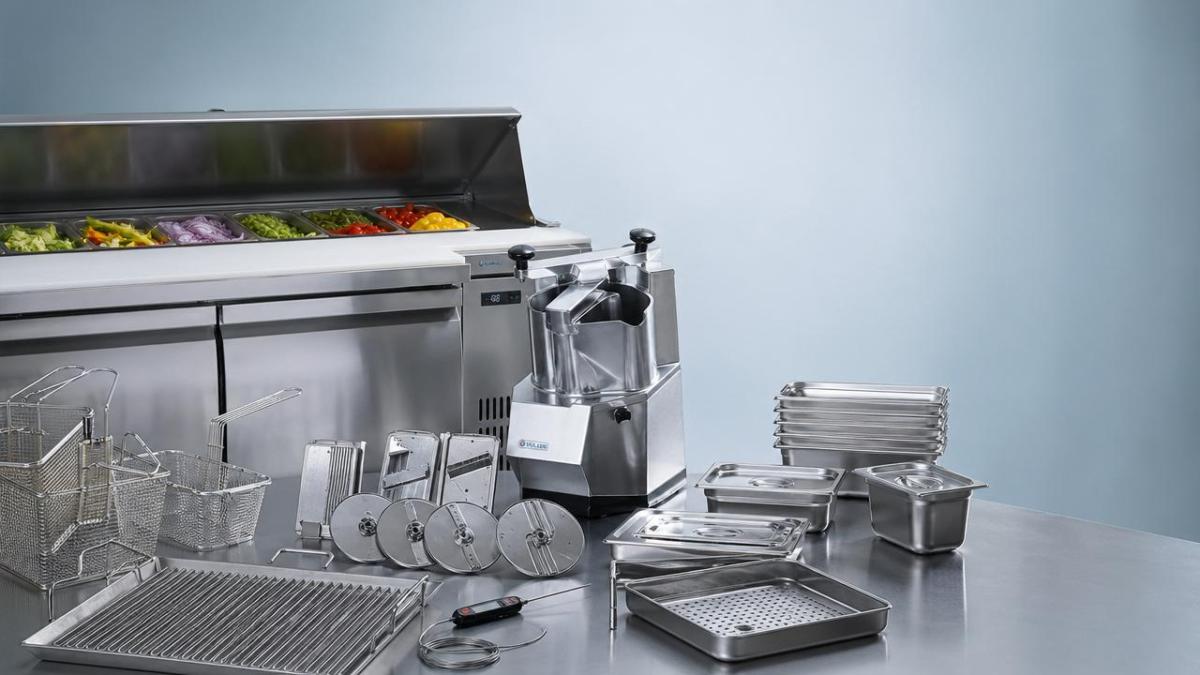
Common Types of Restaurant Kitchen Equipment Accessories
Not every accessory has the same purpose. Some are designed to improve production speed, while others focus on safety, organization, or maintenance. For operators, understanding these categories helps identify where the real bottlenecks are.
This classification shows that restaurant kitchen equipment accessories support more than one part of the operation. A strong accessory strategy usually includes items from multiple categories rather than focusing only on cooking tools.
Where Accessories Deliver the Most Value
The highest value usually appears where the kitchen experiences repeated pressure points. In prep areas, accessories improve speed and reduce manual effort. In cook lines, they help maintain steady output during service. In cold storage, they make inventory easier to manage. In wash areas, they simplify cleaning and turnover. In mobile or flexible kitchens, they support quick reconfiguration.
For restaurants with limited floor space, compact accessories can be especially useful. Stackable inserts, under-shelf systems, and multi-use holders help teams use vertical space effectively. In high-turnover kitchens, accessories that reduce training complexity are equally important. Standardized trays, color-coded containers, and easy-fit attachments make it easier for new staff to work correctly from the start.
Hotels, central kitchens, and food processing sites may use a broader range of commercial kitchen accessories, but the principle stays the same: each accessory should solve a defined operational problem. If it does not improve flow, quality, safety, or maintenance, it may not be worth the space or handling time it requires.
How to Evaluate Accessories Before Use
Choosing restaurant kitchen equipment accessories should begin with workflow observation rather than catalog browsing. Operators should look at where delays happen, where staff repeat unnecessary motions, and where food quality becomes inconsistent. Accessories are most effective when selected to address those specific gaps.
Compatibility is the first practical checkpoint. Accessories must fit the equipment model, production volume, and available space. An attachment that works well in one kitchen may create congestion in another. Materials also matter. Stainless steel, food-grade plastics, heat-resistant components, and easy-clean surfaces are common requirements in demanding commercial settings.
Durability should be balanced with ease of handling. Heavy-duty accessories are valuable, but if they are difficult to remove, clean, or store, staff may stop using them correctly. In many cases, the best accessory is the one that becomes part of normal behavior because it is simple, reliable, and clearly useful during service.
Practical Considerations for Daily Operators
From the operator’s point of view, accessories should support the rhythm of the shift. That means they need to be available where needed, easy to sanitize, and quick to replace if damaged. Labeling, storage planning, and maintenance routines are just as important as the accessory itself. A high-performance probe or cutter is less helpful if staff cannot find it quickly or if it is often left uncleaned after use.
Training is another essential factor. Even the best restaurant kitchen equipment accessories can fail to improve output if staff do not understand the correct use case. Short, practical instruction works better than complex manuals. Teams should know what each accessory is for, when to use it, how to clean it, and when to report wear or malfunction.
It is also useful to review accessory performance regularly. Kitchens change menus, adjust service formats, and face seasonal demand shifts. An accessory that was ideal for one production pattern may become less useful later. Periodic review helps operators keep only the tools that actively support the current workflow.
Typical Accessory Priorities by Work Area
The Link Between Accessories, Smart Kitchens, and Efficiency Trends
As the kitchen equipment industry moves toward intelligent systems and energy-efficient solutions, accessories are also becoming more advanced. Digital probes, sensor-compatible holders, modular inserts, and workflow-based storage systems are helping kitchens connect people, equipment, and process more effectively.
This reflects a larger industry shift. Smart kitchens are not built only through major appliances or software platforms. They also depend on smaller components that support data accuracy, product consistency, and operator convenience. Restaurant kitchen equipment accessories that improve monitoring, reduce waste, or simplify repeatable tasks fit naturally into this direction.
Energy efficiency is another growing area. Accessories such as well-fitted lids, correct racks, proper seals, and filtration components can help equipment work more efficiently. While these items may seem minor, they can contribute to lower utility use, steadier performance, and reduced wear over time.
Practical Steps for Building a More Productive Accessory Setup
A productive approach starts with identifying the top three output problems in the kitchen. These may include prep delays, slow turnover, inconsistent cooking, crowded storage, or frequent cleaning interruptions. Then match restaurant kitchen equipment accessories to those specific issues rather than trying to upgrade everything at once.
Next, test accessories in real operating conditions. Observe whether they reduce movement, improve timing, or lower the chance of mistakes. Involve the staff who actually use the equipment. Their feedback often reveals whether an accessory supports the workflow or only looks good in theory. Finally, build basic routines for placement, cleaning, inspection, and replacement so the accessory continues to deliver value.
For restaurants aiming to improve output without major structural changes, accessories often provide one of the most practical starting points. They are close to the daily work, visible in their impact, and flexible enough to adapt as service needs change. When chosen thoughtfully, restaurant kitchen equipment accessories help transform equipment from functional to truly efficient.
Conclusion
Restaurant kitchen equipment accessories play a direct role in productivity, safety, consistency, and maintenance across modern foodservice operations. In an industry moving toward smarter, cleaner, and more efficient kitchens, these supporting components deserve more attention from operators and managers alike. By focusing on real workflow needs, selecting compatible accessories, and using them consistently, kitchen teams can achieve meaningful output improvements without unnecessary complexity. If your goal is a more reliable and efficient kitchen, the right accessories are often one of the smartest places to begin.
Popular Tags
Kitchen Industry Research Team
Dedicated to analyzing emerging trends and technological shifts in the global hospitality and foodservice infrastructure sector.
Industry Insights
Join 15,000+ industry professionals. Get the latest market trends and tech news delivered weekly.
No spam. Unsubscribe anytime.
Contact With us
Contact:
Anne Yin (Ceramics Dinnerware/Glassware)
Lucky Zhai(Flatware)