
Meat Grinder Cleaning Issues That Affect Food Safety
In professional kitchen equipment environments, Meat Grinder cleaning issues can quickly turn into serious food safety risks, affecting product quality, compliance, and daily operations. For restaurants, food processors, and technical buyers, understanding how poor sanitation impacts hygiene, equipment performance, and overall commercial kitchen design is essential. This article explores the hidden hazards, common mistakes, and practical solutions that help maintain safer, more efficient food preparation systems.
When a meat grinder is not cleaned correctly, the problem is not just visible residue. The real risk is bacterial growth in hard-to-reach areas, cross-contamination between batches, shorter equipment life, and higher compliance exposure. For operators, this means unsafe food and rework. For technical evaluators and decision-makers, it means rising sanitation costs, inspection risk, and avoidable downtime. The key issue is simple: cleaning quality directly affects food safety, machine reliability, and operational efficiency.
Why Meat Grinder Cleaning Problems Become Serious Food Safety Risks
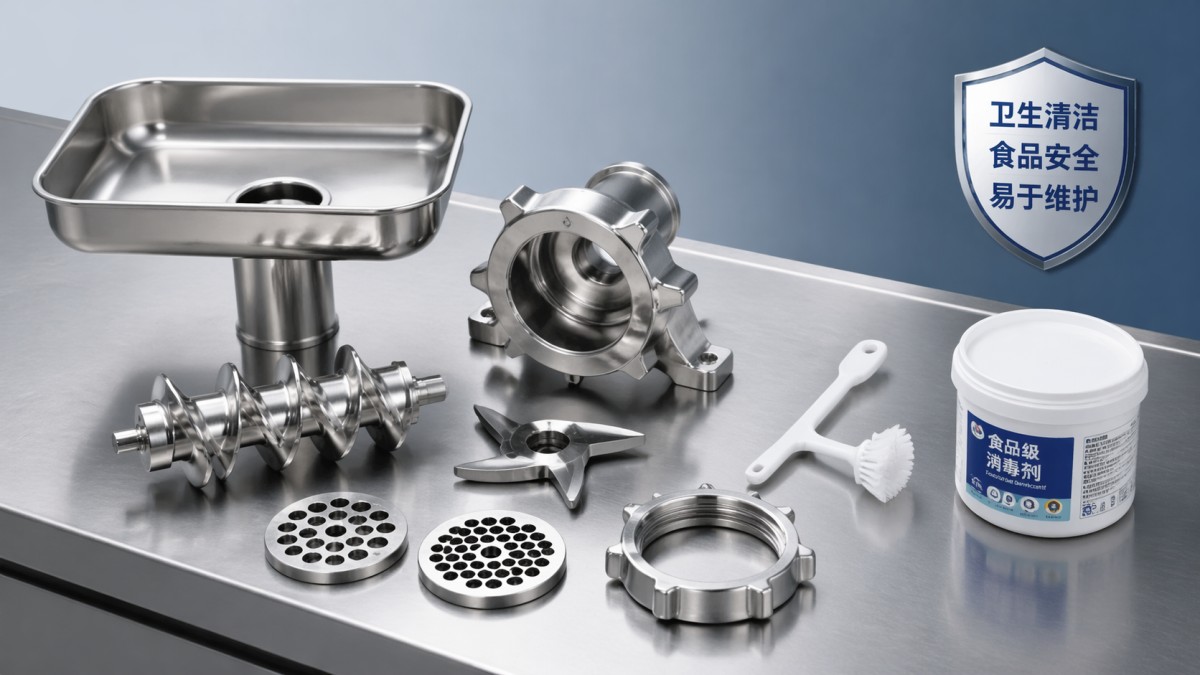
Meat grinders process raw protein, fat, and moisture, which create an ideal environment for microbial growth if cleaning is incomplete. Even a small amount of trapped meat in the feed screw, blade housing, plate openings, hopper corners, or discharge area can support the growth of pathogens such as Salmonella, Listeria, and E. coli. In commercial settings, this risk increases when equipment is used continuously across multiple shifts.
Poor sanitation also causes cross-contamination. If a grinder handles different meat types, allergen-sensitive products, or multiple production lots, residue from a previous batch can carry over into the next one. This is especially important for food processors and central kitchens that must maintain strict product separation and traceability.
Beyond hygiene, cleaning failures can affect equipment performance. Fat and protein buildup can harden over time, reducing grinding efficiency, increasing motor strain, and accelerating wear on plates, knives, and seals. What begins as a sanitation issue often becomes a maintenance and cost-control issue as well.
What Target Readers Usually Want to Know First
Different readers approach this topic from different angles, but their concerns often overlap:
- Operators and kitchen staff want to know how to clean a meat grinder properly, how often to do it, and which parts are commonly missed.
- Technical evaluators want to assess whether a machine is designed for easy sanitation, fast disassembly, smooth surfaces, and low contamination risk.
- Business decision-makers care about food safety risk reduction, labor efficiency, compliance readiness, downtime, and total cost of ownership.
- Researchers and buyers often want to compare manual cleaning challenges with sanitation-friendly equipment options.
Because of this, the most useful discussion is not a generic explanation of “cleaning matters.” Readers need clear connections between cleaning issues, contamination pathways, inspection risk, and practical control measures.
Common Meat Grinder Cleaning Mistakes That Cause Contamination
Many food safety failures happen not because teams ignore cleaning entirely, but because they assume a quick rinse is enough. In reality, several recurring mistakes create the biggest problems:
- Incomplete disassembly: Internal parts such as the auger, blade, plate, retaining ring, and seals may remain dirty if not fully removed.
- Cleaning only visible surfaces: Internal contact points often hold more residue than exterior surfaces.
- Using the wrong water temperature: Very hot water can cook protein onto surfaces, making residue harder to remove.
- Insufficient drying: Moisture left on parts supports microbial growth and can also contribute to corrosion.
- Irregular cleaning schedules: Waiting until the end of a long shift may allow residue to harden and biofilms to begin forming.
- Poor tool selection: Brushes that do not reach plate holes or corners leave contamination behind.
- No sanitation verification: If there is no ATP testing, visual standard, or supervisor check, cleaning quality becomes inconsistent.
These mistakes are especially costly in high-volume kitchens and food processing lines, where a single sanitation gap can affect a large amount of product.
How to Tell Whether Cleaning Problems Are Already Affecting Safety and Performance
Not all sanitation problems are immediately obvious. Businesses should watch for warning signs that indicate the grinder cleaning process is not effective enough:
- Persistent odors after cleaning
- Greasy film on internal components
- Darkened residue in screw channels or plate holes
- Frequent product quality inconsistency
- Higher-than-normal microbial test results
- Increased time needed for startup or product changeover
- Unusual wear on cutting parts
- Repeated sanitation corrections during audits or inspections
If these issues appear regularly, the problem may not only be staff behavior. It may also point to equipment design limitations, poor workflow planning, or inadequate sanitation protocols.
Best Practices for Cleaning a Meat Grinder Safely and Effectively
For most commercial users, the safest approach is to establish a repeatable cleaning procedure that balances hygiene, labor efficiency, and equipment protection. A strong process usually includes the following steps:
- Shut down and isolate power before any cleaning or disassembly begins.
- Disassemble all food-contact parts according to the manufacturer’s instructions.
- Pre-rinse with appropriate water temperature to remove loose debris without setting proteins.
- Wash with approved detergent using dedicated brushes for plates, blades, feed tubes, and corners.
- Rinse thoroughly to remove detergent and loosened residue.
- Apply food-safe sanitizer with the correct concentration and contact time.
- Air dry completely or use approved drying methods before reassembly.
- Inspect parts carefully for residue, wear, cracks, or damage.
- Reassemble and document the cleaning if required by the facility’s food safety system.
In higher-risk environments, verification should not rely only on visual inspection. ATP swab testing, microbial spot checks, and sanitation records provide stronger evidence that cleaning is actually effective.
What to Look for in a Sanitation-Friendly Meat Grinder
For technical buyers and equipment decision-makers, one of the smartest ways to reduce food safety risk is to choose a grinder that is easier to clean correctly. Sanitary design can significantly lower labor time and improve cleaning consistency.
Important evaluation points include:
- Smooth, non-porous food-contact surfaces
- Minimal crevices, joints, and hidden retention points
- Fast, tool-free or simplified disassembly
- Easy access to blades, plates, augers, and housings
- Durable stainless steel construction
- Compatibility with commercial sanitation procedures
- Clear cleaning instructions from the manufacturer
- Replaceable wear parts that do not trap residue when damaged
In many cases, a lower-priced grinder can become more expensive over time if it requires excessive cleaning labor, causes longer downtime, or introduces greater inspection risk. Sanitation-friendly design is not just a technical preference; it is a business value factor.
Why Cleaning Protocols Matter as Much as Equipment Quality
Even well-designed kitchen equipment can become a food safety problem if cleaning protocols are weak. Effective food safety management depends on the combination of machine design, staff training, frequency standards, supervision, and verification.
Facilities with better sanitation outcomes usually have:
- Standard operating procedures for each cleaning cycle
- Clear responsibility by shift or role
- Training on disassembly and reassembly
- Defined cleaning frequency based on product risk and usage volume
- Routine inspection and documentation
- Preventive maintenance to replace worn parts before they become sanitation hazards
This matters especially in restaurants, butcher operations, hotels, central kitchens, and food processing plants where speed often competes with hygiene discipline. A documented system helps protect both product safety and business continuity.
The Business Impact of Poor Meat Grinder Sanitation
From a management perspective, meat grinder cleaning issues should be evaluated as an operational risk, not just a housekeeping problem. Poor sanitation can lead to:
- Food contamination incidents
- Customer complaints and brand damage
- Regulatory non-compliance
- Product waste and recall exposure
- Unplanned downtime for re-cleaning or repairs
- Higher labor costs due to inefficient cleaning routines
- Reduced equipment lifespan
For companies investing in modern commercial kitchen equipment or food processing machinery, sanitation performance should be part of procurement and operational planning. The best decision is rarely based on output capacity alone. Cleanability, verification, and maintenance burden are equally important.
Conclusion
Meat grinder cleaning issues affect far more than appearance. They directly influence food safety, product consistency, equipment reliability, and compliance outcomes. For operators, the priority is disciplined cleaning and verification. For technical evaluators, the focus should be sanitary design and maintainability. For business leaders, the real value lies in reducing contamination risk, labor inefficiency, and avoidable operational losses.
In practice, the safest and most cost-effective approach is to combine easy-to-clean meat grinder equipment with clear sanitation procedures, proper staff training, and regular verification. When cleaning is treated as a core part of food safety management rather than a routine afterthought, kitchens and processing facilities become safer, more efficient, and more resilient.
Popular Tags
Kitchen Industry Research Team
Dedicated to analyzing emerging trends and technological shifts in the global hospitality and foodservice infrastructure sector.
Industry Insights
Join 15,000+ industry professionals. Get the latest market trends and tech news delivered weekly.
No spam. Unsubscribe anytime.

Contact With us
Contact:
Anne Yin (Ceramics Dinnerware/Glassware)
Lucky Zhai(Flatware)