
Kitchen design cost overruns often start with utilities
Kitchen design cost overruns rarely start with countertops, finishes, or equipment branding. In many projects, the real budget problem begins earlier—inside walls, under floors, and above ceilings—where electrical capacity, gas lines, water supply, drainage, grease management, and ventilation systems must support the kitchen’s actual workflow. For buyers evaluating commercial restaurant supplies, stainless steel restaurant supplies, or a restaurant supplies manufacturer, utility planning is not a technical side issue. It is a cost, safety, and performance decision that affects equipment selection, installation timelines, compliance, and long-term operating efficiency.
Whether the project involves kitchen design for hotels, schools, hospitals, central kitchens, or food processing environments, the same rule applies: when utilities are planned too late, the kitchen design cost rises fast. Relocating drains, upgrading power, resizing exhaust, or correcting gas distribution after layout approval can disrupt procurement and delay opening. By contrast, early coordination creates a stronger foundation for energy efficient kitchen design, smarter sourcing, and better return on investment.
Why utility planning is where many kitchen budgets first go off track
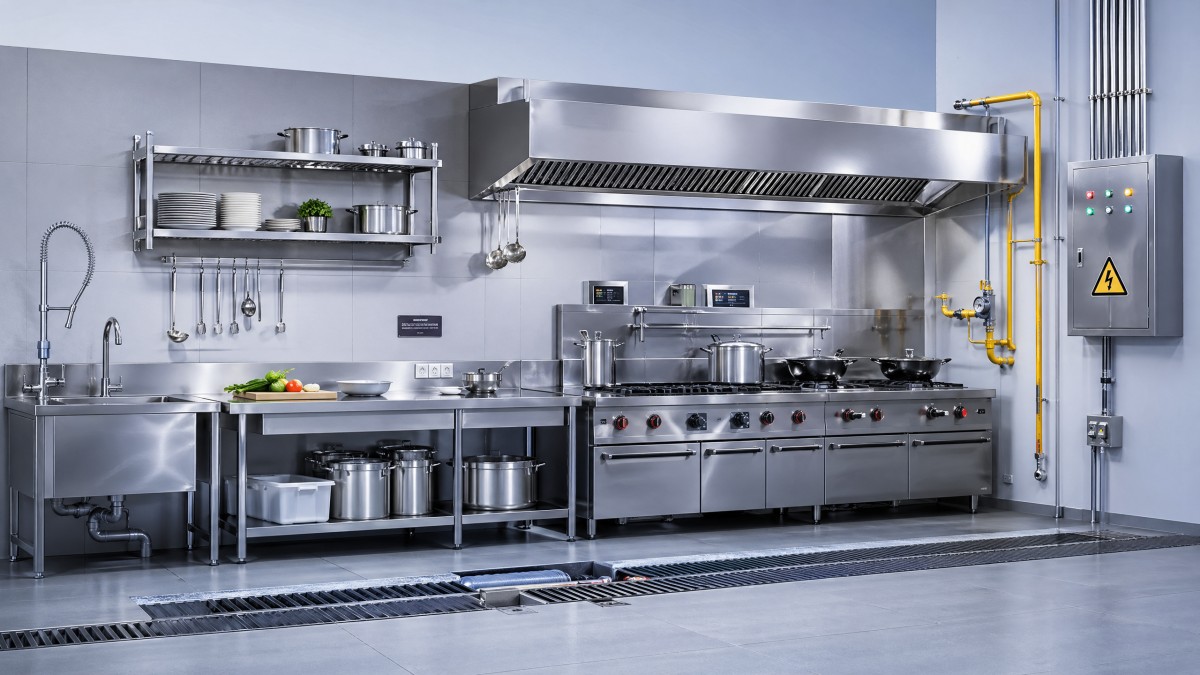
Most cost overruns happen because the kitchen layout and the utility infrastructure are designed in separate conversations. Teams may approve equipment lists and stainless steel worktables before confirming whether the building can support the required power load, ventilation volume, water pressure, or drainage slope. At that point, the “kitchen” looks complete on paper, but the hidden systems are not ready for the equipment that will actually be used.
For commercial kitchens, utility mismatches are expensive because they affect multiple trades at once. A single change in equipment position may require updates to:
- Electrical circuits and panel capacity
- Gas piping routes and shut-off locations
- Water supply and hot water recovery
- Floor drains, waste lines, and grease traps
- Exhaust hoods and make-up air systems
- Fire suppression integration
That is why kitchen design cost overruns often start with utilities instead of visible fixtures. Once wall construction, slab work, or ceiling coordination has progressed, every late change becomes more disruptive and more expensive.
What buyers, operators, and decision-makers usually care about most
Although target readers come from different roles, their key concerns are closely linked.
Information researchers want to understand why similar kitchen projects can have very different final costs. They are typically comparing options and trying to identify what drives hidden expense.
Users and operators care about whether the kitchen will work smoothly in real conditions. They want enough outlets, correct equipment placement, reliable drainage, comfortable ventilation, and safe workflows.
Purchasers focus on matching equipment specifications with installation realities. They need to know whether a lower purchase price could lead to higher installation cost or compatibility issues.
Business decision-makers are concerned with total project risk: budget control, opening schedule, compliance, service life, energy consumption, maintenance burden, and long-term operational efficiency.
The most useful content for all of them is practical guidance on how to spot utility-related risk before procurement is finalized.
Which utility decisions have the biggest impact on kitchen design cost
Not every utility issue carries the same financial weight. The biggest cost drivers are usually the ones that involve structural limitations, code compliance, or major system resizing.
1. Electrical capacity and distribution
Modern commercial kitchen equipment often requires more power than existing buildings can deliver, especially in renovations. Combi ovens, induction systems, refrigeration lines, dishwashing equipment, and food processing machinery can quickly exceed available panel capacity.
Common cost triggers include:
- Adding new panels or upgrading service capacity
- Long cable runs due to poor equipment placement
- Separate dedicated circuits for high-load appliances
- Mismatch between imported equipment standards and local electrical requirements
2. Ventilation and make-up air
Ventilation is one of the most underestimated cost items in kitchen design for hotels, hospitals, and large restaurant operations. Buyers may compare cooking equipment prices without accounting for the hood, duct routing, fan sizing, roof penetrations, and balanced make-up air needed to support that equipment.
Choosing one high-heat appliance can increase ventilation requirements across the entire line. That affects both capital cost and energy use.
3. Water supply, drainage, and grease handling
Dishwash areas, prep sinks, ice machines, steam equipment, and food processing lines all create drainage demands. If floor slopes, drain positions, or grease management are not planned early, teams may need to break finished surfaces or redesign work zones.
This is especially important in institutional kitchen design where hygiene and drainage performance directly affect compliance and cleaning efficiency.
4. Gas routing and safety controls
Gas equipment can be efficient and familiar for many operators, but it requires proper line sizing, shut-off access, pressure stability, and ventilation coordination. Late-stage changes to gas appliances often create both cost and approval delays.
How poor utility coordination affects equipment purchasing decisions
Utility planning and equipment procurement should never be treated as separate tasks. A purchasing team may identify attractive commercial restaurant supplies from a competitive vendor, but if those products require utility conditions the site cannot easily support, the apparent savings disappear.
For example:
- A lower-cost oven may require higher power input, increasing electrical upgrade costs.
- A gas appliance may be affordable upfront but expensive to install in a site without suitable gas distribution.
- A high-performance dishwasher may create drainage or hot water demand beyond current capacity.
- Imported stainless steel restaurant supplies may fit physically but not align with local service clearances or utility connections.
This is why experienced buyers do not evaluate equipment by product price alone. They compare total installed cost, operating efficiency, maintenance practicality, and utility compatibility.
How to reduce kitchen design cost overruns before construction starts
The most effective way to control kitchen design cost is to make utility validation part of early planning, not a correction step later. A practical pre-procurement review should include the following:
Confirm the menu and workflow first
Utility demand comes from operational reality. If the production volume, cooking method, service speed, and cleaning load are unclear, the utility plan will be based on assumptions. That leads to rework.
Build the equipment schedule with utility data included
Every major item should be listed with electrical load, gas demand, water requirement, drainage need, ventilation category, and installation clearance. This allows procurement, engineering, and operations teams to make aligned decisions.
Review the site’s existing infrastructure honestly
In retrofit projects, existing utilities are often treated too optimistically. Conducting a proper site survey helps reveal whether current systems can actually support the proposed kitchen.
Prioritize total lifecycle value, not only initial price
Energy efficient kitchen design can reduce long-term operating cost, but only if the chosen systems fit the building and the usage profile. Equipment with lower energy consumption, easier maintenance access, and better utility efficiency can justify a higher upfront price.
Involve the right parties early
Kitchen consultants, MEP engineers, operators, installers, and the restaurant supplies manufacturer or distributor should align before orders are locked. This reduces the risk of specification gaps and incompatible assumptions.
What to ask a restaurant supplies manufacturer or supplier before buying
Suppliers play a critical role in preventing hidden project costs. The right questions can reveal whether a product is suitable not just for kitchen operations, but also for the site’s technical conditions.
Key questions include:
- What exact utility requirements does this equipment need?
- Are there regional compliance or certification considerations?
- What ventilation category applies to this equipment?
- What installation clearances and service access are required?
- Can the supplier provide utility drawings or technical support?
- Does this model help support energy efficient kitchen design goals?
- What maintenance issues typically arise after installation?
For procurement teams, these questions help compare suppliers more meaningfully. A reliable vendor is not only a source of products, but also a source of technical clarity that reduces project risk.
Why this matters across hotels, schools, hospitals, and foodservice facilities
Utility planning has universal importance, but the consequences vary by application.
- Hotels need flexibility, speed, and premium service consistency, making ventilation, hot water, and equipment reliability critical.
- Schools often work within fixed budgets and older buildings, so utility upgrades can quickly consume funds meant for equipment.
- Hospitals require strict hygiene, dependable workflow, and uninterrupted service, increasing the importance of drainage, redundancy, and compliance.
- Food processing sites and central kitchens must align utilities with throughput, sanitation, and automation requirements.
In each case, poor utility planning does more than increase installation cost. It can reduce productivity, raise energy use, complicate maintenance, and limit future expansion.
Final takeaway: hidden systems shape visible kitchen results
When kitchen projects exceed budget, the problem often starts before equipment is delivered and long before operations begin. Power, gas, drainage, and ventilation decisions shape whether a kitchen design is efficient, compliant, scalable, and cost-effective. For anyone sourcing commercial restaurant supplies, specifying stainless steel restaurant supplies, or evaluating a restaurant supplies manufacturer, utility readiness should be part of the purchasing decision from day one.
The clearest way to control kitchen design cost is simple: validate utilities early, connect procurement with technical planning, and judge equipment by total project value rather than product price alone. That approach leads to safer installations, fewer changes, stronger operational performance, and a more reliable return on investment.
- commercial kitchen equipment
- cooking equipment
- central kitchen
- kitchen design
- restaurant supplies
- Stainless Steel Worktable
- kitchen equipment
- kitchen design for hotels
- energy efficient kitchen design
- kitchen design cost
- commercial restaurant supplies
- restaurant supplies manufacturer
- stainless steel restaurant supplies
Popular Tags
Kitchen Industry Research Team
Dedicated to analyzing emerging trends and technological shifts in the global hospitality and foodservice infrastructure sector.
Industry Insights
Join 15,000+ industry professionals. Get the latest market trends and tech news delivered weekly.
No spam. Unsubscribe anytime.
Contact With us
Contact:
Anne Yin (Ceramics Dinnerware/Glassware)
Lucky Zhai(Flatware)