
Why kitchen design for food processing fails hygiene checks
When kitchen design for food processing fails hygiene checks, the consequences go far beyond non-compliance. For quality control and safety managers, poor layout, hard-to-clean surfaces, and cross-contamination risks can quickly undermine product safety and audit performance. Understanding why these design flaws happen is the first step toward building cleaner, safer, and more efficient food processing environments.
What kitchen design for food processing really means
In food manufacturing and prepared food operations, kitchen design for food processing is not simply about placing equipment where it fits. It is the structured planning of rooms, work zones, material flow, utilities, drainage, surfaces, ventilation, and sanitation access so that food can be processed safely, consistently, and efficiently. A hygienic design must support cleaning, prevent contamination, and help teams maintain control under real production pressure.
For quality control personnel and safety managers, this topic matters because hygiene checks are rarely failed by one obvious defect alone. More often, audits reveal patterns: raw and cooked areas too close together, poorly sloped floors that trap water, hollow equipment frames, hard-to-access pipe routes, or staff movement that crosses clean and dirty paths. These are design issues, not merely operational mistakes.
As the kitchen equipment industry moves toward automation, smart monitoring, and integrated systems, expectations for hygienic performance are also rising. Modern food processing environments must combine equipment efficiency with sanitary engineering. If kitchen design for food processing is treated as a secondary issue after capacity and output, hygiene failures become much more likely.
Why the industry is paying closer attention
Across restaurants, central kitchens, hotels, and food processing facilities, food safety standards have become stricter and more visible. Internal audits, customer inspections, third-party certifications, and regulatory checks now examine not only final products but also the built environment. A facility may have strong SOPs, trained staff, and good intentions, yet still struggle if the layout itself creates recurring hygiene risks.
This is especially relevant in an industry shaped by higher output demands, shorter turnaround times, and growing use of automated food processing machinery. Equipment upgrades can improve productivity, but they also add complexity. More conveyors, mixers, cutting stations, chillers, and utility lines mean more surfaces, joints, niches, and drainage points to inspect. Without a design strategy that prioritizes hygienic zoning and cleanability, every efficiency gain may introduce sanitation burdens.
For safety managers, failed hygiene checks affect more than compliance scores. They can trigger rework, line stoppages, customer complaints, product holds, or worse, recall events. Poor kitchen design for food processing therefore becomes a business risk tied directly to brand protection, audit readiness, and operational stability.
The most common reasons hygiene checks fail
The root causes of hygiene failures usually fall into a few repeatable categories. Understanding them helps quality and safety teams evaluate whether a problem is procedural, equipment-related, or embedded in the facility design.
One of the biggest failures in kitchen design for food processing is assuming that sanitation can compensate for poor architecture. In reality, cleaning becomes inconsistent when workers must move equipment to reach corners, wash around exposed cables, or sanitize splash zones caused by badly positioned sinks and drains. Hygiene checks often expose these design compromises because they create repeat deviations rather than one-time errors.
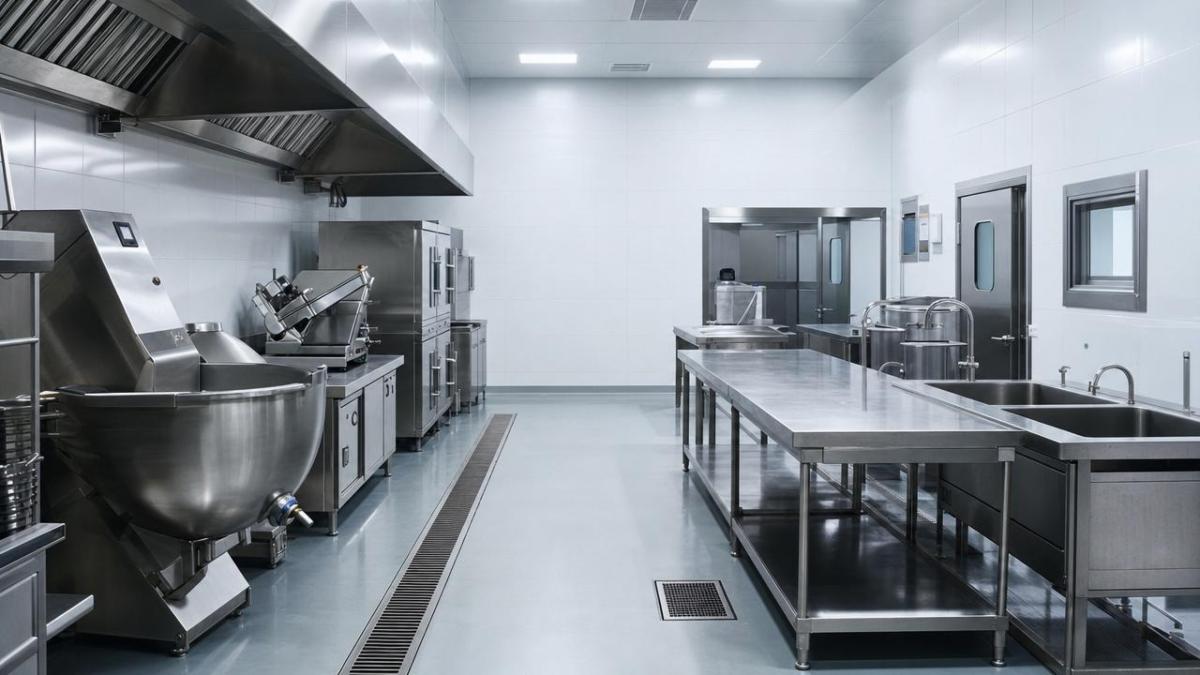
Key design elements that influence hygiene performance
A hygienic processing kitchen depends on how multiple design elements work together. The first is zoning. Raw receiving, washing, cutting, thermal processing, cooling, packing, and storage should be arranged to support a one-way flow wherever possible. This reduces backtracking and limits opportunities for raw product, waste, tools, and finished goods to intersect.
The second is surface and structural selection. Floors should be durable, non-slip, easy to sanitize, and properly sloped toward drains. Wall and ceiling finishes should resist moisture, prevent flaking, and avoid harboring dirt. Stainless steel remains common for food-contact and splash areas, but specification quality and weld finishing matter. A low-grade material or rough weld can become a hygiene defect even when the overall equipment looks modern.
The third is cleanability around equipment. Commercial kitchen equipment and food processing machinery should not be installed only for production convenience. There must be enough access for inspection, maintenance, and validated cleaning. Hollow legs, unsealed joints, overlapping panels, and unprotected fasteners often become hidden contamination points. Quality managers should assess these details before installation, not after a failed swab result.
Utilities also affect hygiene. Water lines, compressed air, electrical conduits, and ventilation systems should be routed to minimize dust collection and moisture accumulation. Condensation control is especially important in chilled or high-humidity zones. Poorly managed airflow can carry particulates from lower-risk areas into higher-care spaces, undermining otherwise strong kitchen design for food processing.
Where design failures are most visible in practice
Not all food operations face the same hygiene pressure. However, certain environments reveal design weaknesses faster because of moisture, allergen complexity, temperature sensitivity, or product exposure time. The table below shows how risks differ by application.
In each of these settings, kitchen design for food processing must support the actual product risk profile. A layout that works in a dry bakery may fail badly in a wet protein environment. That is why standardized design principles should always be adapted to product type, cleaning method, and contamination sensitivity.
Why projects still repeat the same mistakes
Many hygiene failures begin long before an audit. They start during planning, when design decisions are led mainly by output goals, budget limits, or available space. Food safety teams are sometimes consulted too late, after equipment has already been specified or utilities have been fixed. By then, correcting drainage, access spacing, or room flow becomes expensive.
Another common problem is treating hygienic design as an equipment issue only. In reality, even high-quality commercial kitchen equipment cannot compensate for a poor room layout. A well-built mixer placed too close to a wall is still difficult to clean. An intelligent cooking system installed in a congested processing cell still creates inspection blind spots. Smart kitchen technologies improve visibility and control, but they do not replace sound hygienic design principles.
There is also a gap between design drawings and operational reality. On paper, routes may appear separate; in practice, staff carrying bins, tools, and ingredients may use the shortest path available. This is why kitchen design for food processing should be validated against real workflows, sanitation routines, maintenance access, waste handling, and peak production conditions.
Practical evaluation points for quality and safety managers
For teams responsible for audit readiness, a practical review framework is more useful than broad design theory. Start by mapping contamination pathways. Ask where raw materials enter, where waste exits, where utensils are washed, where employees change zones, and where finished products are exposed. If lines cross, document the control measure and assess whether it is reliable or merely procedural.
Next, inspect cleanability. Can every food-contact and splash area be accessed without dismantling major components? Are there horizontal ledges, hollow structures, cracked seals, or dead ends in piping? Does drainage pull water away from processing instead of spreading it? Many hygiene check failures arise because cleaning can be performed, but not verified effectively.
Review materials and finishes against actual cleaning chemistry, temperature, and wear. Surfaces that degrade under repeated sanitation lose their hygienic value quickly. It is also important to align equipment purchasing with facility sanitation strategy. In a sector increasingly shaped by automation and energy-efficient solutions, buyers should compare not only performance and energy use, but also hygienic accessibility, disassembly time, and surface integrity.
Finally, involve cross-functional teams early. Engineering, production, sanitation, maintenance, and QA often see different risks. The strongest kitchen design for food processing emerges when these perspectives are combined before installation, expansion, or retrofit work begins.
Turning better design into better audit outcomes
Improving hygiene performance does not always require a full rebuild. Many facilities can reduce audit findings through targeted redesign: separating handwash and utensil wash points, improving floor slopes, replacing porous surfaces, lifting equipment for access, simplifying pipe runs, or redefining traffic routes. Small physical changes often remove repeated sanitation failures that training alone cannot solve.
For organizations planning new lines or capacity expansion, hygienic design should be treated as a core project requirement equal to throughput and cost. This is increasingly important as global foodservice and food processing operations adopt integrated kitchen systems, automated production cells, and digital monitoring tools. The most resilient facilities are those where equipment innovation and hygiene engineering develop together.
If your team is reviewing a new build, retrofit, or equipment upgrade, now is the time to assess whether the current kitchen design for food processing truly supports sanitation, zoning, and inspection. A proactive design review can prevent recurring hygiene failures, strengthen certification readiness, and protect both product safety and operational performance over the long term.
Popular Tags
Kitchen Industry Research Team
Dedicated to analyzing emerging trends and technological shifts in the global hospitality and foodservice infrastructure sector.
Industry Insights
Join 15,000+ industry professionals. Get the latest market trends and tech news delivered weekly.
No spam. Unsubscribe anytime.
Contact With us
Contact:
Anne Yin (Ceramics Dinnerware/Glassware)
Lucky Zhai(Flatware)