
Kitchen tools for small spaces without losing workflow
In compact kitchens, every inch matters—but efficiency should never be sacrificed. Choosing the right kitchen tools for small spaces can help operators streamline prep, reduce clutter, and maintain a smooth workflow even in limited environments. From multifunctional utensils to space-saving storage solutions, smart tool selection is becoming essential for modern kitchens that demand speed, organization, and consistent performance.
Understanding kitchen tools for small spaces
Kitchen tools for small spaces are not simply smaller versions of standard equipment. In practical terms, they are tools, accessories, and support items designed to preserve movement, preparation speed, hygiene, and consistency where counter area, storage volume, and operator circulation are limited. For kitchen users and operators, the goal is not only to save room, but to keep the workflow intact from receiving and prep to cooking, plating, cleaning, and restocking.
This topic matters across the kitchen equipment industry because modern foodservice and residential environments are changing. Urban restaurants often work with tight back-of-house layouts. Hotels may need compact service kitchens on different floors. Food processing support zones may require organized tool stations in controlled areas. Even home kitchens increasingly demand professional-style performance in smaller footprints. As a result, kitchen tools for small spaces have become part of a larger industry shift toward smarter, more integrated, and more efficient kitchen systems.
A well-planned compact kitchen does not depend on one miracle product. It depends on the relationship between tools, storage, work zones, cleaning routines, and operator habits. When these elements support one another, a small kitchen can feel fast, reliable, and safe rather than crowded and reactive.
Why the industry is paying closer attention
The kitchen equipment sector is evolving toward automation, intelligence, and energy efficiency, but these trends do not remove the need for thoughtful manual workflow. In fact, compact environments make workflow design even more important. Operators may have access to advanced appliances, digital kitchen systems, and energy-saving devices, yet poor tool selection can still slow production, increase cross-traffic, and create unnecessary fatigue.
Several industry factors are driving interest in kitchen tools for small spaces. First, rising real estate costs push many kitchens to operate in smaller units. Second, labor efficiency has become a priority, which means each movement must add value. Third, food safety standards require cleaner organization and clearer separation of tasks. Fourth, multi-format operations such as ghost kitchens, convenience food counters, café kitchens, and micro-bakeries need adaptable tools that perform well without occupying too much room.
The result is a broader market demand for multifunctional utensils, nesting containers, foldable prep supports, slim storage systems, compact measuring tools, and modular accessories that work with both manual and semi-automated kitchen processes. In many cases, these tools are low-cost compared with major appliances, yet they have a disproportionate impact on daily productivity.
Core value for operators and daily users
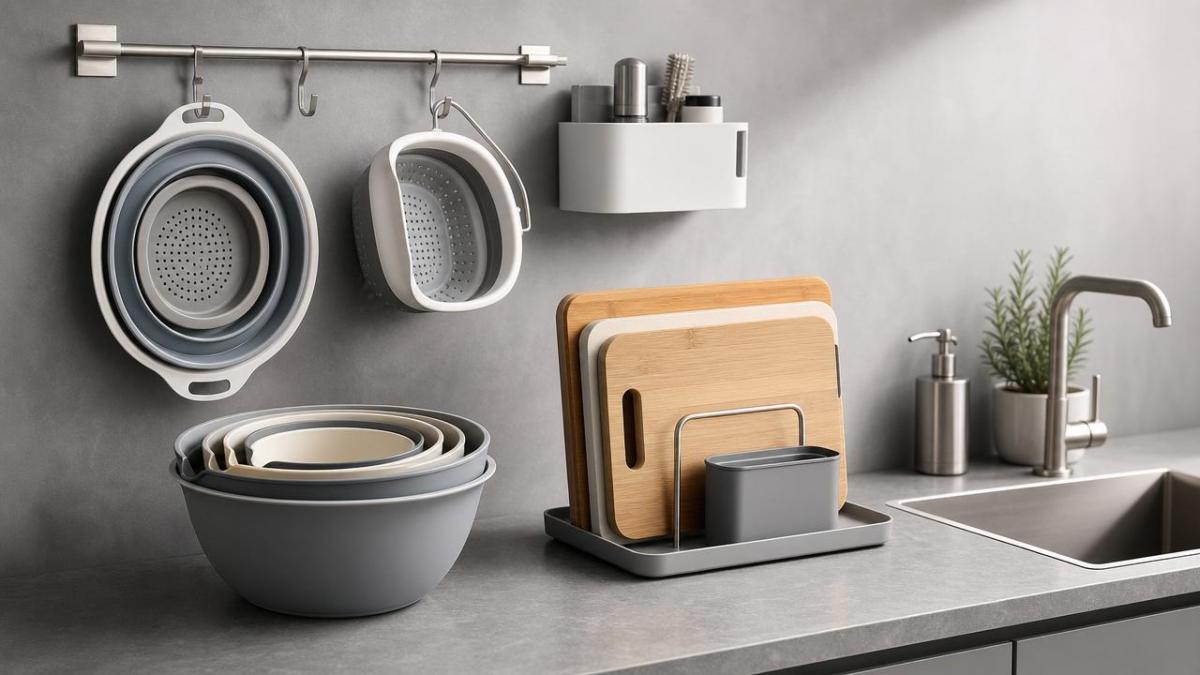
For users and operators, the main value of kitchen tools for small spaces is workflow preservation. In a limited area, delays usually come from searching, stacking, moving, and clearing rather than from the task itself. The right tools reduce those interruptions. A mixing bowl set that nests neatly, a cutting board with integrated waste collection, or a wall-mounted utensil rail can remove repeated motions that slow down service.
Compact tool strategy also supports safety. Overcrowded counters increase the chance of spills, knife accidents, hot-surface contact, and contamination between raw and ready-to-eat foods. Space-efficient tools improve line of sight and make cleaning easier. This matters in every environment, from restaurant prep lines to hotel room-service kitchens and shared production stations.
Another advantage is consistency. When tools have clear storage positions and multiple functions, operators can repeat tasks with fewer errors. This is especially useful in kitchens with shift changes, part-time staff, or mixed skill levels. Standardized compact setups help teams maintain output quality, even when the workspace is small.
What defines an effective compact-tool setup
An effective setup usually combines five characteristics. First, tools should have a high use-to-size ratio, meaning they earn the space they occupy. Second, they should support more than one task where possible, without creating quality trade-offs. Third, they should store vertically, stack cleanly, or fold flat. Fourth, they must be easy to clean and durable under repeated handling. Fifth, they should fit naturally into the sequence of work rather than simply looking efficient on a shelf.
This is why kitchen tools for small spaces should be evaluated in context. A compact slicer may be ideal for a café sandwich station but unnecessary in a bakery prep zone. A collapsible colander may be excellent in a residential kitchen but less suitable in heavy commercial rotation. Practical fit is always more important than novelty.
Industry overview: where compact kitchen tools create value
Different sectors use kitchen tools for small spaces in different ways, but the underlying need is similar: protect speed and order when square footage is limited. The following table shows how this value appears across common kitchen environments.
Common categories of kitchen tools for small spaces
In most kitchens, compact efficiency is created by a combination of categories rather than one type of tool. Understanding these categories helps operators build a more balanced setup.
Multifunctional prep tools
Examples include shears that cut herbs and open packaging, measuring jugs that also mix, cutting boards with trays, and handheld tools that peel, slice, and grate. These are useful when they reduce tool switching without lowering output quality.
Stackable and nesting items
Bowls, containers, measuring cups, strainers, and trays that fit into one another help reclaim storage volume. In both commercial and home settings, these items are among the most effective kitchen tools for small spaces because they solve organization and access problems at the same time.
Vertical storage accessories
Hooks, magnetic strips, wall rails, hanging baskets, and under-shelf supports move frequently used tools off the counter. This approach is especially valuable in kitchens where horizontal space is the main limitation.
Compact cleaning and sanitation tools
Slim brushes, drain organizers, collapsible drying racks, and designated wipe holders support hygiene without creating visual or physical clutter. Cleanability should never be ignored in compact kitchen planning.
How compact tools support workflow instead of interrupting it
Workflow in a small kitchen depends on sequence. The most effective kitchen tools for small spaces are placed where the task begins, not where extra room happens to exist. Prep tools should stay near receiving and washing zones. Cutting and portioning tools should remain close to ingredient access. Service tools should be within immediate reach of plating or packing stations. Cleaning tools should be easy to grab at the point of use.
Operators should also think in terms of frequency. Daily-use items deserve prime access. Weekly-use items can move higher, lower, or farther away. This simple rule prevents premium space from being occupied by low-value tools. In many kitchens, clutter is not caused by too few shelves, but by poor ranking of what deserves to stay within reach.
Another important factor is handoff. In small teams, one station often supports another. If compact tools are standardized and visible, the next operator can continue the task without searching or resetting. That continuity is what keeps workflow smooth during busy periods.
Practical selection criteria for operators
When choosing kitchen tools for small spaces, operators should begin with task mapping rather than catalog browsing. Identify which tasks happen most often, where congestion occurs, and which tools are repeatedly moved out of the way. This reveals whether the problem is size, quantity, placement, or duplication.
Next, assess the tool against five practical questions: Does it reduce movement? Does it free up storage or work surface? Is it easy to sanitize? Can multiple staff use it consistently? Will it last under actual workload conditions? These questions help filter out products that appear space-saving but create friction in real use.
Material choice also matters. Stainless steel, food-grade silicone, reinforced plastics, and durable composites each have strengths depending on temperature, cleaning intensity, and frequency of use. A compact tool that bends, stains, or traps residue quickly becomes an operational liability. Space efficiency should always be matched with performance and hygiene reliability.
Common mistakes to avoid in compact kitchens
One common mistake is buying too many specialized items. Even in larger kitchens, excessive specialization can fragment workflow. In smaller spaces, it can overwhelm storage and create decision fatigue. Another mistake is focusing only on storage without considering speed of retrieval. A tool hidden too well is often almost as disruptive as a tool left on the counter.
Operators should also avoid ignoring maintenance access. Foldable or modular kitchen tools for small spaces are useful only if they can be cleaned thoroughly and inspected easily. Finally, teams should not treat compact organization as a one-time setup. Menus, service volume, and staffing patterns change, so tool layouts should be reviewed regularly.
A practical path forward
As the kitchen equipment industry continues moving toward smarter, more energy-efficient, and integrated systems, compact tool planning remains a basic but powerful advantage. Kitchen tools for small spaces help bridge the gap between limited physical layouts and the growing demand for speed, safety, consistency, and better use of labor.
For operators, the most effective next step is simple: review the current workflow, identify where space creates delays, and replace clutter with tools that truly support the job. A small kitchen does not have to mean small capability. With the right combination of multifunctional tools, organized storage, and task-based placement, limited space can still deliver a professional, reliable, and efficient kitchen operation.
Popular Tags
Kitchen Industry Research Team
Dedicated to analyzing emerging trends and technological shifts in the global hospitality and foodservice infrastructure sector.
Industry Insights
Join 15,000+ industry professionals. Get the latest market trends and tech news delivered weekly.
No spam. Unsubscribe anytime.

Contact With us
Contact:
Anne Yin (Ceramics Dinnerware/Glassware)
Lucky Zhai(Flatware)