
Kitchen tools for baking that improve consistency batch after batch
Reliable results in baking depend on precision, repeatability, and the right setup. Choosing the right kitchen tools for baking can reduce variation from one batch to the next, improve workflow, and help operators maintain consistent texture, shape, and baking performance. This guide explores practical tools that support accuracy, efficiency, and quality in everyday kitchen production.
Why do kitchen tools for baking matter so much for consistency?
Consistency in baking is rarely the result of talent alone. It comes from controlling variables: ingredient weight, dough temperature, mixing time, portion size, pan condition, and oven behavior. For operators in commercial kitchens, foodservice businesses, bakery sections, and even high-output home kitchens, the right kitchen tools for baking turn these variables into manageable standards.
When batches vary, the usual symptoms are easy to spot: cookies spread differently, cakes rise unevenly, bread crumb becomes inconsistent, and finishing times drift. Many teams try to solve these issues by changing recipes first, but recipe adjustments do not fix poor measuring habits or unreliable equipment. In practice, repeatable outcomes depend on a system of accurate baking tools working together.
This is why operators increasingly focus on baking tools that support food safety, production efficiency, and stable quality. In a broader kitchen equipment environment that is moving toward smarter and more energy-efficient solutions, even simple manual tools still play a critical role. A digital scale, a probe thermometer, or a reliable timer can have as much impact on product uniformity as a major equipment upgrade.
Which kitchen tools for baking have the biggest impact on batch-to-batch results?
Not every tool affects quality equally. Some tools directly control the measurements and conditions that determine structure, moisture, and bake performance. If consistency is the main goal, operators should prioritize the following categories first.
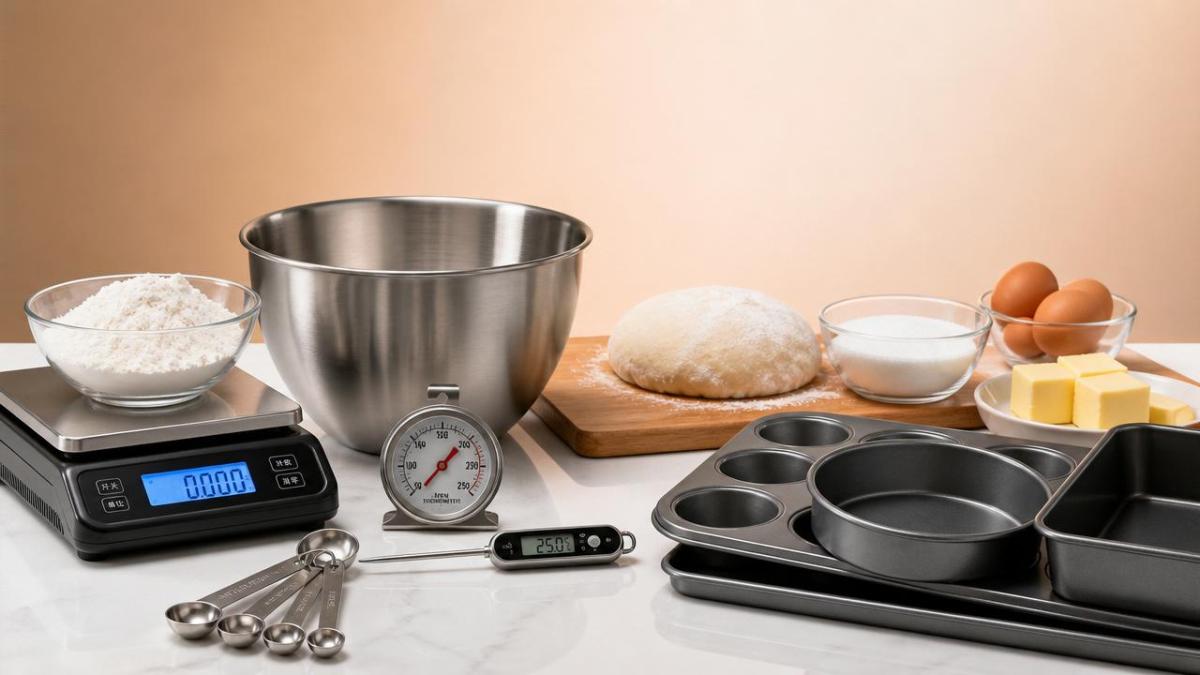
1. Digital kitchen scale. This is the single most important tool for accurate baking. Measuring flour, sugar, butter, yeast, and inclusions by weight removes the inconsistency of volume-based methods. A scale with fine resolution is especially useful for salt, leavening agents, and small-batch adjustments.
2. Oven thermometer. Many ovens do not match their displayed temperature. An independent thermometer helps operators verify the real chamber temperature and identify hot spots or recovery issues during peak production.
3. Probe thermometer. Internal temperature matters for breads, custards, cheesecakes, and enriched dough products. This tool reduces guesswork and helps prevent underbaking or drying out.
4. Portioning tools. Scoops, dough dividers, portion scales, and piping guides keep units uniform. This improves not only appearance but also baking time and tray utilization.
5. Mixing bowls and spatulas with clear process use. Dedicated bowls and scrapers reduce waste and support standardized handling. Flexible spatulas help fully incorporate ingredients so one batch does not hold more fat or dry mix than another.
6. Baking pans and mats. Pan material, thickness, coating, and shape all affect browning and heat transfer. Using matched pans instead of mixed replacements is a basic but often overlooked control point.
How should operators choose kitchen tools for baking based on their production scenario?
The best kitchen tools for baking depend on output volume, recipe type, operator skill level, and how often products change. A pastry station in a hotel kitchen has different needs from a central kitchen, café, or home-based baking business. The goal is not to buy the most tools, but to choose the tools that control the biggest risks in your process.
For small-batch and mixed-menu environments, flexibility matters most. Operators often switch between muffins, cookies, sponge cakes, and laminated doughs, so they benefit from versatile digital scales, stackable mixing bowls, standard sheet pans, timers, and silicone mats. These tools improve changeover speed without adding complexity.
For medium- to high-volume production, durability and standardization become more important. Repeated use demands heavy-duty pans, accurate thermometers, easy-clean scrapers, and portion control tools that can maintain the same output all day. In these settings, even small measurement drift can scale into significant waste, rework, or customer complaints.
For teams with multiple operators, choose tools that make correct execution easier. Clear measurement markings, color-coded containers, calibrated scales, and standardized pan sets reduce training time and help different staff members produce the same result. In other words, good baking tools support not just product quality, but process management.
What should you compare before buying baking tools for accuracy and efficiency?
When evaluating kitchen tools for baking, buyers often focus too much on price and too little on performance under daily use. A low-cost tool can become expensive if it causes waste, slows production, or fails calibration. Before purchasing, compare tools across the criteria below.
A useful buying rule is simple: if a tool affects weight, temperature, time, or portion size, it deserves higher scrutiny. Those are the variables most likely to change one batch from the next. In professional kitchen equipment selection, this kind of functional comparison is often more valuable than brand preference alone.
What are the most common mistakes when using kitchen tools for baking?
Even the best kitchen tools for baking cannot deliver consistency if they are used carelessly or maintained poorly. One common mistake is mixing measuring systems. Teams may weigh some ingredients but use cups for others, which introduces unnecessary variation. Standardizing all core ingredients by weight is usually the first improvement step.
Another mistake is failing to calibrate or verify tools regularly. Scales can drift, thermometers can lose accuracy, and ovens can perform differently over time. Operators should schedule quick checks as part of routine kitchen management, especially in commercial environments with frequent use.
Pan inconsistency is also a major issue. Using old, warped, darkened, or mixed-material pans often changes browning and bake time. Replacing damaged pans and grouping similar pans by product line can improve results immediately. Likewise, overused parchment or damaged silicone mats may affect release and surface texture.
A final mistake is assuming tools solve process problems on their own. Accurate baking tools work best when paired with documented procedures: target dough temperature, fill weight, bake duration ranges, cooling time, and visual checkpoints. Tools provide the data, but operators still need a repeatable method.
How can teams build a more reliable baking workflow with these tools?
To improve batch-after-batch consistency, treat kitchen tools for baking as part of a controlled workflow rather than isolated items. Start by mapping the points where variation usually appears. For most baking operations, these points include scaling, mixing, portioning, proofing or resting, baking, and cooling.
At the scaling stage, use one approved recipe sheet and one measurement method. At the mixing stage, define mixing time and ingredient order. During portioning, use scoops or scales to maintain exact weights. In the baking stage, verify oven temperature independently and rotate trays only when needed by product behavior rather than habit. During cooling, keep timing and rack placement consistent so texture sets properly.
This structured approach aligns with broader industry trends in intelligent kitchen systems and operational efficiency. While large-scale automation may not be necessary for every site, standard tools and measurable checkpoints create a similar benefit: less variation, less waste, and more dependable output. For operators, that means fewer corrections and smoother production. For managers, it means better labor efficiency and customer confidence.
Which kitchen tools for baking are worth upgrading first if budget is limited?
If budget only allows a few improvements, prioritize tools that produce immediate measurable gains. First, upgrade to a reliable digital scale if you do not already use one for every batch. Second, add both an oven thermometer and a probe thermometer to confirm external and internal baking conditions. Third, standardize pans and portioning tools for the products that sell most often.
These upgrades typically cost far less than replacing major equipment, yet they often deliver faster returns through lower waste, reduced remake rates, and more predictable product quality. In many kitchens, consistency problems are not caused by missing machinery but by weak control over basic variables. Strong foundational baking tools solve that problem efficiently.
What should you confirm before selecting tools, suppliers, or a baking setup plan?
Before making a final decision, confirm a few practical points. What products are made most often, and what defects occur most frequently? How many operators use the tools, and how much training do they have? Do current pans, scales, or thermometers create variation? How often are tools cleaned, replaced, or checked for accuracy? Are there food safety, durability, or energy-efficiency priorities that should influence selection?
These questions help turn a general search for kitchen tools for baking into a more effective purchasing and workflow decision. For kitchens seeking better consistency batch after batch, the right answer is usually not a single product but a coordinated set of tools matched to production volume, recipe style, and operator habits.
If you need to confirm a more specific plan, parameters, sourcing direction, replacement cycle, quotation range, or cooperation model, start by discussing recipe types, daily output, current pain points, cleaning requirements, material preferences, and the level of accuracy your process demands. Those details make it much easier to choose kitchen tools for baking that truly improve consistency rather than simply add more items to the shelf.
Popular Tags
Kitchen Industry Research Team
Dedicated to analyzing emerging trends and technological shifts in the global hospitality and foodservice infrastructure sector.
Industry Insights
Join 15,000+ industry professionals. Get the latest market trends and tech news delivered weekly.
No spam. Unsubscribe anytime.
Contact With us
Contact:
Anne Yin (Ceramics Dinnerware/Glassware)
Lucky Zhai(Flatware)