
Restaurant Kitchen Equipment Cost vs Long-Term Operating Value
When evaluating restaurant kitchen equipment cost, business decision-makers need to look beyond upfront pricing and focus on long-term operating value. The right equipment can reduce energy use, labor pressure, maintenance costs, and food waste while improving consistency and kitchen efficiency. Understanding this balance is essential for restaurants and foodservice businesses aiming to make smarter, more profitable investment decisions.
Why decision-makers should use a checklist before comparing prices
A list-based approach works better than a simple price comparison because restaurant kitchen equipment cost is rarely limited to the invoice amount. In commercial kitchens, the real financial impact comes from years of electricity consumption, water usage, labor requirements, repair frequency, production speed, downtime risk, and replacement cycles. A lower initial purchase price may look attractive during budgeting, but it can create hidden operating burdens that reduce margins over time.
For enterprise buyers, especially those managing multi-unit restaurants, hotels, central kitchens, or foodservice groups, the priority is not just purchasing equipment. The priority is selecting assets that support output quality, safety compliance, staffing stability, and predictable operating cost. That is why restaurant kitchen equipment cost should be assessed as a total value decision rather than a procurement line item.
The first checklist: what to confirm before requesting quotations
Before comparing brands or models, decision-makers should clarify the operating context. This reduces quotation noise and helps suppliers recommend equipment with stronger long-term value.
- Confirm daily meal volume, peak-hour demand, and production rhythm. Equipment that is too small creates delays and labor pressure; equipment that is too large wastes energy and floor space.
- Define menu structure and cooking methods. Frying, steaming, baking, grilling, chilling, and prep-intensive operations require different configurations and affect restaurant kitchen equipment cost in different ways.
- Review utility conditions, including gas, power load, ventilation, drainage, and water quality. Installation constraints can change equipment choice and total project cost.
- Identify labor challenges. If turnover is high or skilled cooks are limited, automated or programmable equipment may create stronger long-term operating value.
- Set expected service life and replacement strategy. A five-year plan and a ten-year plan lead to different purchase decisions.
- Align safety, sanitation, and regulatory requirements early. Certification, cleanability, and food safety design should not be treated as optional extras.
This first checklist is critical because it prevents one of the most common buying mistakes: selecting equipment based on list price without verifying whether it fits the operational model.
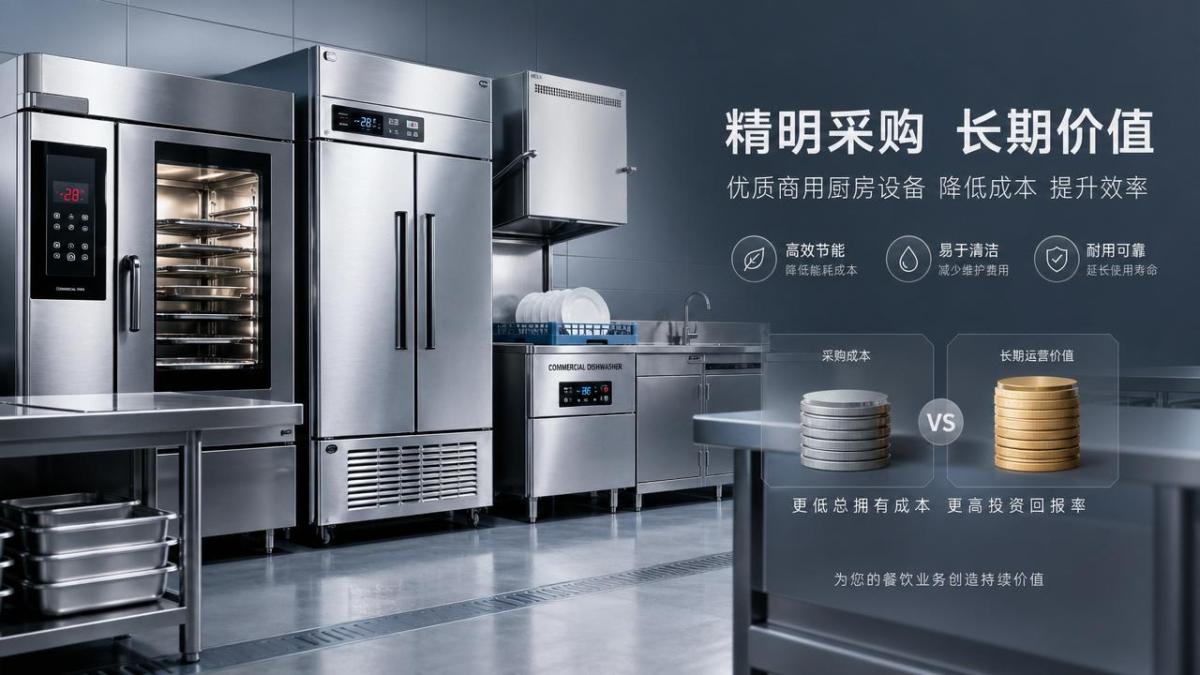
Core evaluation checklist for restaurant kitchen equipment cost vs operating value
Once operating requirements are clear, the next step is to compare options through practical decision criteria. The following areas should be reviewed together, not in isolation.
1. Upfront purchase price
The initial capital cost still matters, especially for new openings or expansion projects. However, buyers should compare what is actually included: accessories, digital controls, training, delivery, installation support, warranty length, and spare parts package. A cheaper quote may exclude items that later increase total spend.
2. Energy and utility efficiency
Energy-efficient kitchen solutions often carry a higher purchase price, but they may significantly reduce utility bills over several years. For equipment with long daily operating hours, such as refrigerators, freezers, combi ovens, dishwashers, and ventilation-linked appliances, this factor has a direct impact on long-term operating value. Buyers should request estimated annual consumption data rather than accepting general efficiency claims.
3. Labor savings and ease of operation
Restaurant kitchen equipment cost should also be judged against labor economics. Equipment with programmable settings, faster heat recovery, simpler cleaning routines, and semi-automated functions can reduce staffing pressure and training time. In markets facing wage inflation or labor shortages, this may deliver better returns than choosing the lowest-cost machine.
4. Output consistency and food quality
Inconsistent cooking performance creates hidden cost through customer complaints, remakes, waste, and brand damage. Reliable temperature control, humidity management, batch repeatability, and stable holding functions improve food quality and help standardize operations across locations.
5. Maintenance frequency and service access
A realistic equipment decision must include preventive maintenance needs, access to local technicians, spare part availability, and expected downtime. For high-volume kitchens, even short breakdowns can disrupt service and revenue. Buyers should ask how quickly service can be provided and whether key parts are stocked locally.
6. Cleaning time and hygiene design
Smooth surfaces, removable components, easy-drain structures, and hygienic design reduce daily cleaning labor and support food safety management. In practice, easier cleaning means lower labor hours, stronger compliance, and less performance degradation over time.
7. Scalability and digital integration
Smart kitchen technologies can improve monitoring, recipe control, preventive maintenance alerts, and data visibility. For growing restaurant groups, connected equipment may strengthen operational control and support standardization. This is especially valuable when expanding to multiple sites or managing central kitchen operations.
A practical comparison table for enterprise buyers
The table below shows how to judge restaurant kitchen equipment cost beyond the purchase price.
Different operating scenarios require different cost priorities
Not every buyer should weigh restaurant kitchen equipment cost in the same way. The best-value option depends on the operating model.
Independent restaurants
Smaller businesses often need capital discipline, but they should be careful not to underinvest in core production equipment. Priority should go to reliability, energy efficiency in high-use appliances, and versatile machines that support multiple menu tasks.
Multi-unit restaurant groups
These buyers benefit from standardization, bulk procurement leverage, and digital control. Long-term operating value often comes from consistent training, common spare parts, centralized maintenance planning, and data-driven kitchen management.
Hotels and institutional kitchens
In these environments, production flexibility and continuous service matter more than simple price. Equipment must handle diverse menus, high hygiene expectations, and varied demand cycles. Durability and service access become especially important.
Central kitchens and food processing operations
For larger-scale operations, automation, throughput, traceability, and sanitation design can outweigh initial equipment cost. Integrated kitchen systems and automated food processing solutions may deliver stronger value through labor reduction, yield improvement, and standardized output.
Common blind spots that distort equipment value calculations
Many procurement teams underestimate total cost because they miss several operational details. These blind spots can turn a seemingly affordable purchase into a weak long-term investment.
- Ignoring installation adjustments such as ventilation upgrades, water treatment, electrical changes, or floor drainage.
- Failing to calculate downtime cost when equipment breaks during peak trading periods.
- Underestimating cleaning labor and sanitation-related productivity loss.
- Choosing advanced equipment without evaluating staff capability and training requirements.
- Comparing machines by specification sheets only, without testing real workflow performance.
- Focusing on unit price instead of output per hour, usable capacity, and food yield.
Execution guide: how to make a better buying decision
A strong purchasing process should move in stages. First, rank equipment by operational importance: cooking line, refrigeration, warewashing, preparation, and holding. Second, calculate which items run the longest hours or create the highest downtime risk. Third, request structured quotations that include operating data, warranty terms, service response commitments, and estimated maintenance intervals.
Next, compare options using a weighted scorecard rather than a price-only sheet. For example, decision-makers can assign scores for energy use, labor savings, reliability, cleaning convenience, digital features, and local service support. This makes restaurant kitchen equipment cost easier to evaluate against long-term business outcomes.
Whenever possible, ask for demonstrations, site references, or trial data from similar kitchens. Enterprise buyers should also review whether the supplier can support future expansion, replacement parts planning, and integration with smart kitchen systems. In a market moving toward automation, intelligence, and energy efficiency, supplier capability increasingly matters alongside product quality.
Final decision checklist for moving forward
Before final approval, decision-makers should confirm five points: whether the equipment matches actual output demand, whether operating savings are documented, whether service support is dependable, whether staff can use the equipment effectively, and whether the solution supports future business growth. If any of these points remain unclear, the restaurant kitchen equipment cost evaluation is incomplete.
If your business is preparing to compare equipment options, the most useful next step is to gather menu data, expected volume, utility conditions, layout constraints, staffing assumptions, and budget range. Then discuss with suppliers the parameters that most affect long-term value: energy performance, maintenance cycle, ease of cleaning, spare parts access, automation level, and installation requirements. Clear answers to these questions will help turn restaurant kitchen equipment cost from a purchasing concern into a smarter operating investment.
Popular Tags
Kitchen Industry Research Team
Dedicated to analyzing emerging trends and technological shifts in the global hospitality and foodservice infrastructure sector.
Industry Insights
Join 15,000+ industry professionals. Get the latest market trends and tech news delivered weekly.
No spam. Unsubscribe anytime.
Contact With us
Contact:
Anne Yin (Ceramics Dinnerware/Glassware)
Lucky Zhai(Flatware)