
Restaurant supplies for schools and the hygiene checks missed
Choosing the right restaurant supplies for schools is about far more than cost or convenience—it directly affects hygiene control, inspection readiness, and student safety. For quality control and safety managers, overlooked cleaning points, poorly designed equipment, and hidden contamination risks can turn routine operations into compliance issues. This article highlights the hygiene checks schools often miss and what to review before problems escalate.
Why are restaurant supplies for schools inspected more closely than standard foodservice equipment?
Restaurant supplies for schools operate in a higher-risk environment because they support meals served to children, often at large volume and under tight schedules. A minor design weakness in a prep table, storage rack, sink area, or holding cabinet can become a repeated hygiene failure when hundreds of trays are produced daily. Unlike many commercial sites that serve adults with wider menu flexibility, schools must maintain strict allergen control, predictable sanitation routines, and consistent temperature management with limited downtime.
For quality control and safety managers, this means that restaurant supplies for schools should be evaluated not only for durability and output, but also for cleanability, drainage, material safety, and inspection visibility. Equipment that looks acceptable during installation may still create hidden contamination points if hinges trap residue, seals crack under repeated washing, or undersides cannot be reached without disassembly. School kitchens also face seasonal staffing changes and varying operator skill levels, so equipment must support safe routines even when users are rushed or less experienced.
In practice, inspectors and internal auditors tend to focus on whether the supply setup makes correct hygiene behavior easy. If school staff must improvise cleaning methods, store utensils in awkward locations, or bypass proper flow because equipment placement is poor, the risk increases. That is why procurement decisions for restaurant supplies for schools should be aligned with sanitation design, not just purchasing budgets.
Which hygiene checks are most often missed when selecting restaurant supplies for schools?
The most commonly missed checks are not always dramatic failures. More often, they are small design and maintenance details that slowly weaken hygiene performance. These issues frequently pass unnoticed during purchasing because the focus stays on price, size, and basic function.
Commonly overlooked hygiene checks include:
- Whether joints, corners, and welds are smooth and sealed rather than rough or open.
- Whether door gaskets, handles, and control panels can be cleaned without trapping moisture or grease.
- Whether shelving and storage bins allow airflow and full wipe-down access.
- Whether food-contact surfaces resist scratching, corrosion, and staining after repeated school use.
- Whether caster wheels, feet, and undersides can be inspected and sanitized easily.
- Whether drainage paths prevent standing water around sinks, dishwashing zones, and ice-related equipment.
- Whether hot holding, cold storage, and transport units provide visible temperature verification.
Another missed area is compatibility with the actual cleaning process used in the school. Some restaurant supplies for schools are sold as hygienic, yet they rely on cleaning chemicals, disassembly time, or drying conditions that the site cannot realistically maintain. If the sanitation protocol on paper does not match operational reality, the hygiene control system becomes weak despite good intentions.
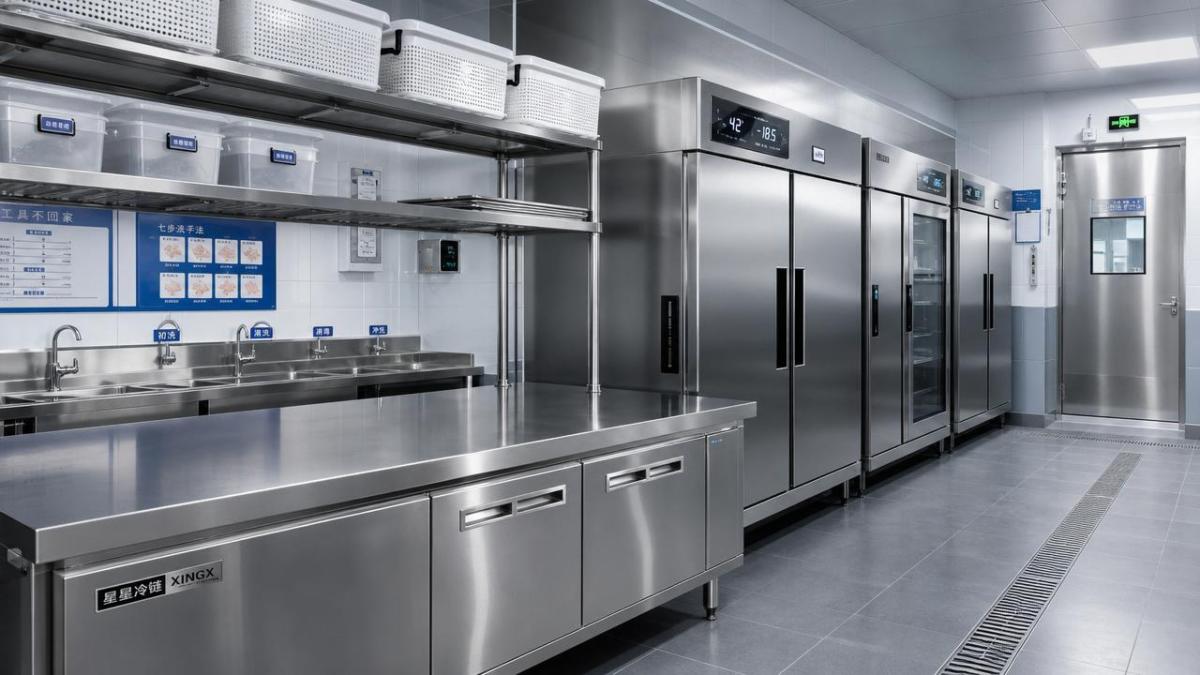
How can safety managers tell if equipment design creates hidden contamination risk?
A practical way to assess restaurant supplies for schools is to follow the path of food, water, hands, and waste. Hidden contamination risk usually appears where these paths cross or where cleaning cannot fully interrupt buildup. For example, a food prep surface may be compliant in material, but if nearby utensil storage sits below splash level from a sink, recontamination becomes likely. Similarly, a refrigerator may hold temperature well, yet still fail hygiene expectations if condensate collects around seals or if shelves are difficult to remove and sanitize.
Safety managers should inspect beyond the visible front surface. Look under benches, behind splashbacks, around fasteners, inside hollow frames, under cutting stations, and beneath transport carts. These are the areas where food debris, moisture, and pests can gain a foothold. Equipment used in schools should minimize inaccessible voids and favor simple structures with fewer contamination traps.
It is also important to check whether routine wear will expose hygiene weaknesses. A unit may be easy to clean when new, but after frequent opening, impact from trays, or aggressive washing, cracked seals and loosened trims can appear. The best restaurant supplies for schools are designed for sustained sanitation performance, not just initial presentation.
Quick hygiene assessment table for school kitchen supplies
What should buyers compare before purchasing restaurant supplies for schools?
When comparing restaurant supplies for schools, buyers should move beyond product brochures and ask how each item performs under school-specific conditions. The first comparison point is sanitation efficiency: how long does proper cleaning take, how many steps are required, and can staff complete them consistently during the school day? A lower-priced item that requires partial dismantling or special tools may become more expensive in labor, downtime, and inspection risk.
The second comparison point is safety integration. School kitchens must often manage allergen separation, varied age-group meal service, and strict delivery timing. Supplies should support zoning, labeling, safe storage, and clear distinction between raw, ready-to-eat, and cleaning-related items. Storage systems, transport carts, ingredient bins, and serving counters should all be reviewed as part of one hygiene chain, not as isolated purchases.
The third factor is maintainability. Ask whether replacement seals, trays, racks, casters, and controls are easy to source. If maintenance delays leave damaged equipment in use, hygiene standards fall quickly. Reliable after-sales support is especially relevant in the kitchen equipment industry, where operational continuity affects both food safety and service output.
Finally, compare documentation quality. Good suppliers of restaurant supplies for schools should provide cleaning instructions, material details, maintenance recommendations, and usable training references. For quality personnel, documentation helps standardize inspections and supports corrective action when issues appear.
What are the most common mistakes schools make after installation?
One common mistake is assuming that compliant equipment guarantees compliant operation. In reality, restaurant supplies for schools can fail in practice when layout changes, staffing pressure, or poor cleaning discipline weaken the original setup. A sink may be installed correctly, but if nearby racks block access, handwashing use may decline. A cold unit may be high quality, but overloading and poor shelf organization can compromise air circulation and temperature consistency.
Another mistake is not reviewing high-touch and low-visibility areas with equal attention. Handles, latches, push plates, control knobs, and cart grips often receive more hand contact than main food-contact surfaces, yet they are missed during rushed sanitation rounds. At the same time, wheels, wall junctions, underside braces, and rear ventilation areas may escape inspection because they are inconvenient to access.
Schools also underestimate the impact of mixed-use storage. If cleaning chemicals, spare utensils, dry goods, allergen-sensitive ingredients, and service tools are stored without clear separation, the risk extends beyond simple clutter. Restaurant supplies for schools should support visual organization and controlled storage logic, particularly in compact kitchens where every shelf is heavily used.
A final error is failing to revalidate the setup after several months of operation. Equipment settles into real-life use patterns, and those patterns may reveal splash zones, dust accumulation points, or handling shortcuts that were not obvious at commissioning. Periodic review is essential.
How often should hygiene performance be reviewed, and what should the review include?
For restaurant supplies for schools, hygiene review should not wait for an external inspection or complaint. A practical approach is to combine daily visual checks, weekly deep-clean verification, monthly equipment condition review, and periodic cross-functional audits involving kitchen operations, maintenance, and safety staff. The goal is to catch design-related sanitation failures before they become recurring nonconformities.
The review should include four core areas. First, verify cleanability: can staff still reach all required surfaces, and are any residues repeatedly found in the same locations? Second, verify integrity: are seals, coatings, welds, shelving, and moving parts still intact? Third, verify control performance: are temperatures, drainage, and storage conditions stable and documented? Fourth, verify behavior fit: are operators using the equipment as intended, or have unofficial workarounds appeared?
For safety managers, trend tracking matters. If the same corrective action repeats around a cart base, refrigerator gasket, or serving line corner, the issue may be equipment design rather than staff negligence. In that case, changing procedures alone will not solve the hygiene problem. The smarter response may be redesign, replacement, or specification upgrade.
What should quality teams ask suppliers before approving restaurant supplies for schools?
Before approval, quality teams should ask questions that connect product claims with school operating reality. Start with materials: what food-contact materials are used, how do they tolerate repeated sanitation, and where are the vulnerable wear points? Then ask about cleaning access: which parts are removable, how long does full sanitation take, and what areas typically require special attention?
Next, confirm service and lifecycle support. How quickly can replacement components be supplied? Are maintenance intervals clearly defined? Does the supplier provide practical hygiene guidance, not just technical specifications? In the kitchen equipment sector, support quality can strongly influence long-term compliance because damaged or poorly maintained units often become hygiene weak points.
It is also wise to ask for use-case references relevant to schools, central kitchens, or institutional meal service. Restaurant supplies for schools should be proven in environments where throughput, repeated cleaning, and safety accountability are all high. A product successful in a low-volume café may not perform equally well in a school feeding program.
What is the best practical takeaway for preventing missed hygiene checks?
The best approach is to treat restaurant supplies for schools as part of a preventive safety system rather than a simple purchasing category. Every table, sink, cabinet, trolley, holding unit, and storage accessory should be judged by one question: does this make safe cleaning, safe handling, and safe inspection easier every day? If the answer is uncertain, the risk is usually higher than it first appears.
For quality control and safety managers, the strongest results come from combining specification review, site observation, staff feedback, and repeat inspection data. Look at hidden surfaces, not just visible finishes. Check how the equipment behaves after months of school use, not only at delivery. And make sure purchasing, operations, and hygiene teams share the same approval criteria.
If you need to confirm a more specific solution for restaurant supplies for schools, the first topics to discuss with suppliers or internal stakeholders should be cleaning access, material durability, temperature control, storage separation, maintenance response time, and the exact workflow of the school kitchen. Those questions will reveal far more than a price list and can help prevent the hygiene checks that too many facilities miss until an inspection forces the issue.
Popular Tags
Kitchen Industry Research Team
Dedicated to analyzing emerging trends and technological shifts in the global hospitality and foodservice infrastructure sector.
Industry Insights
Join 15,000+ industry professionals. Get the latest market trends and tech news delivered weekly.
No spam. Unsubscribe anytime.

Contact With us
Contact:
Anne Yin (Ceramics Dinnerware/Glassware)
Lucky Zhai(Flatware)