
How to vet a restaurant supplies producer before ordering
Choosing the right restaurant supplies producer can directly affect product quality, delivery reliability, and your long-term purchasing costs. For procurement professionals, careful supplier vetting is essential before placing any order. This guide outlines the key factors to review, from certifications and manufacturing capacity to quality control and after-sales support, helping you reduce risk and build a more dependable supply chain.
What supplier vetting means in the kitchen equipment industry
In the broad kitchen equipment and foodservice support sector, a restaurant supplies producer may manufacture cookware, stainless steel worktables, refrigeration units, food prep tools, storage systems, serving items, cleaning products, or integrated commercial kitchen equipment. Vetting such a supplier is more than checking a catalog and price list. It is a structured assessment of whether the producer can consistently meet your standards for safety, specification accuracy, production stability, and commercial support.
This matters because restaurant operations depend on uninterrupted supply and predictable equipment performance. A weak producer can create hidden costs through delays, inconsistent materials, poor packaging, missing certifications, or limited spare parts support. A capable restaurant supplies producer, by contrast, contributes to smoother operations, lower complaint rates, and stronger long-term procurement efficiency.
Why the market is paying closer attention to producer evaluation
The kitchen equipment industry is evolving quickly. Buyers are no longer sourcing only basic tools; they are increasingly purchasing energy-efficient appliances, automated processing equipment, smart kitchen systems, and products designed to meet strict hygiene expectations. This shift raises the importance of evaluating a restaurant supplies producer not only for cost, but also for engineering capability, compliance discipline, and adaptability.
Global sourcing adds another layer of complexity. Manufacturing hubs such as China, Germany, Italy, and Japan offer different strengths in scale, craftsmanship, technology, and export experience. At the same time, foodservice growth in emerging markets is expanding demand for dependable, export-ready suppliers. Procurement teams therefore need a practical framework to identify which producer fits their market, volume, and quality expectations.
Business value of selecting the right restaurant supplies producer
A strong supplier evaluation process creates value well beyond the first transaction. It supports budget control, brand consistency, and risk management across the supply chain. For procurement professionals, the right restaurant supplies producer can help in several ways:
- Maintaining consistent product quality across repeated orders
- Reducing the likelihood of non-compliant materials or unsafe designs
- Improving on-time delivery for new openings, remodels, or replenishment cycles
- Lowering total cost through fewer defects, returns, and emergency replacements
- Supporting product customization, labeling, and packaging requirements for different channels
- Enabling scalable cooperation as your purchasing volumes increase
For buyers serving restaurant groups, hotels, distributors, central kitchens, or food processing companies, these benefits can have a direct effect on service continuity and profitability.
A practical overview of what to review first
Before going deep into plant audits or trial orders, it helps to organize your review around core risk areas. The table below provides a simple framework for screening a restaurant supplies producer at an early stage.
This type of structured review helps procurement teams compare suppliers on evidence rather than assumptions.
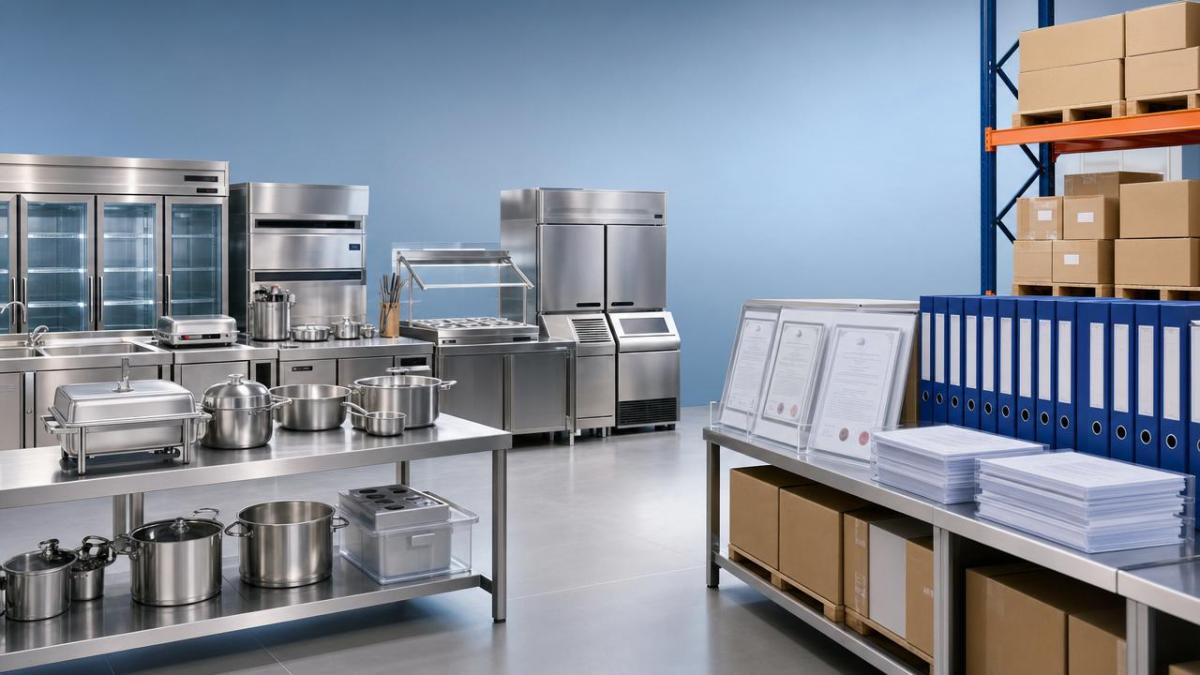
How to assess production capability in a meaningful way
Production capability is often misunderstood as simple factory size. In reality, the best restaurant supplies producer is not always the largest one, but the one whose manufacturing setup matches your product category and order profile. A producer making stainless steel shelving may be reliable for welded fabrication yet unsuitable for complex electrical appliances. Likewise, a factory experienced in hospitality projects may not be efficient for fast-moving distributor replenishment.
Ask for product-line-specific information. Review the equipment used for cutting, welding, polishing, molding, assembly, testing, and packaging. Confirm whether critical processes are done in-house or outsourced. Outsourcing is not necessarily a problem, but it should be transparent because it affects lead time control, traceability, and consistency.
You should also evaluate capacity flexibility. Can the producer handle seasonal spikes? How do they manage raw material shortages? What is their average lead time versus peak-season lead time? A dependable restaurant supplies producer will usually provide realistic capacity data instead of promising impossible delivery dates.
Quality systems, materials, and product consistency
In commercial kitchens, quality failures quickly become operational failures. A weak hinge, poor insulation, thin-gauge stainless steel, unstable thermostat, or low-grade plastic component can disrupt service and increase maintenance costs. That is why quality assessment should go beyond visual inspection.
When reviewing a restaurant supplies producer, request information on raw material sourcing, supplier qualification, and inspection checkpoints. For food-contact items, ask which standards are followed and whether test reports are current. For electrical or mechanical equipment, request performance testing records, safety verification procedures, and sample inspection criteria.
Consistency is especially important for chain operators and distributors. If one shipment differs from the next in finish, dimensions, packaging, or labeling, your receiving, merchandising, and maintenance processes become less efficient. Strong producers document specifications carefully and use version control for drawings, bills of materials, and packaging instructions.
Compliance, certifications, and market access requirements
Certification requirements vary by product type and destination market, so procurement teams should verify relevance rather than just collect logos. For example, food-contact materials may need specific safety documentation, while electrical products may require CE or other regional approvals. A serious restaurant supplies producer should be able to explain which certifications apply to which products and provide supporting files without delay.
It is also wise to check whether certificates belong to the actual producer, whether the documents are current, and whether the tested model matches the item being quoted. Many sourcing problems begin when buyers assume one certificate covers an entire range. Good supplier vetting means validating the exact relationship between document, product, and export market.
Different supplier types and when each may fit
Not every sourcing situation requires the same type of supplier. Understanding the category of restaurant supplies producer helps align expectations with business needs.
This classification is useful because the right choice depends on your buying model. The best restaurant supplies producer for a hotel project may not be the best one for high-frequency distribution.
Commercial reliability beyond the factory floor
A supplier can have acceptable manufacturing capability and still create procurement problems if commercial execution is weak. Review quotation clarity, specification discipline, lead time commitment, and communication quality. Incomplete quotations often lead to misunderstandings about accessories, packaging, voltage, labeling, spare parts, or warranty coverage.
Procurement professionals should watch for how the producer handles detail. Do they confirm technical drawings? Do they explain what is included and excluded? Do they identify cost drivers transparently? A reliable restaurant supplies producer usually shows strong document control, fast follow-up, and realistic answers when risks exist.
Financial stability also matters. While buyers may not gain full access to internal accounts, they can still review export records, customer references, banking consistency, and business continuity indicators. These signals help reduce the risk of interrupted supply or abrupt policy changes during cooperation.
Factory audits, samples, and trial orders
Once a producer passes the document review stage, practical validation becomes essential. A factory audit can confirm whether the production reality matches the sales presentation. During an on-site or remote audit, focus on workflow organization, cleanliness, traceability, storage conditions, testing stations, packaging control, and non-conformance handling.
Samples are equally important, especially for items where finish quality, ergonomics, or dimensional precision affect end use. Evaluate samples against a checklist instead of making a general impression. For equipment, test operation, noise, temperature stability, assembly quality, and user safety. For utensils or tableware-related items, verify material thickness, edge finishing, corrosion resistance, and packaging durability.
A small trial order is often the best final screening tool. It reveals how the restaurant supplies producer manages real production scheduling, documentation, inspection reports, packing marks, and shipping coordination under commercial conditions.
After-sales support and long-term cooperation potential
For many buyers, the relationship does not end at shipment. If you source equipment with electrical, mechanical, or refrigeration elements, after-sales response becomes part of the product value. Confirm warranty terms, spare parts availability, technical manuals, troubleshooting procedures, and escalation contacts. A strong restaurant supplies producer should have a clear process for handling field complaints, replacement decisions, and root-cause analysis.
Long-term fit also depends on whether the producer can evolve with your needs. Can they support new product development, upgraded energy-efficiency targets, smart kitchen integration, or packaging changes for e-commerce and distribution? In a market moving toward intelligent and sustainable kitchen solutions, adaptability is becoming a meaningful selection criterion.
A practical checklist for procurement teams
Before placing your first formal order, make sure your review covers the following points:
- Verify business registration, manufacturing scope, and export experience
- Match certifications to the exact product and destination market
- Confirm in-house versus outsourced processes
- Review material specifications and testing records
- Assess lead times for both normal and peak demand periods
- Check sample quality against written standards
- Clarify packaging, labeling, accessories, and spare parts
- Test responsiveness during quotation and issue resolution
- Use a pilot order before scaling volume
Final perspective
Selecting a restaurant supplies producer is not just a sourcing step; it is a supply chain decision that influences operational stability, compliance exposure, and long-term cost. In a kitchen equipment market shaped by automation, food safety expectations, and energy-efficient innovation, procurement teams need a balanced evaluation approach that covers technical, commercial, and service factors.
The most effective strategy is to move from broad understanding to evidence-based validation: understand the producer’s role, assess their fit within today’s industry demands, compare supplier types, verify production and quality systems, and confirm performance through audits, samples, and trial orders. By doing so, you can identify a restaurant supplies producer that supports not only your next purchase, but also a more resilient and dependable procurement program.
Popular Tags
Kitchen Industry Research Team
Dedicated to analyzing emerging trends and technological shifts in the global hospitality and foodservice infrastructure sector.
Industry Insights
Join 15,000+ industry professionals. Get the latest market trends and tech news delivered weekly.
No spam. Unsubscribe anytime.

Contact With us
Contact:
Anne Yin (Ceramics Dinnerware/Glassware)
Lucky Zhai(Flatware)