
How to Vet Commercial Kitchen Equipment Manufacturers
Choosing the right commercial kitchen equipment manufacturers can directly affect food safety, workflow efficiency, and long-term operating costs. Whether you are sourcing industrial food equipment, comparing catering equipment suppliers, or reviewing kitchen equipment manufacturers in China and other major export markets, the key is not simply finding the lowest quote. The best manufacturer is the one that can consistently deliver compliant, durable, serviceable equipment that fits your kitchen layout, production volume, and business model. For buyers, operators, and decision-makers, effective vetting means looking at product quality, certifications, customization ability, after-sales support, and total cost of ownership before placing an order.
What buyers are really trying to verify before choosing a manufacturer
When people search for how to vet commercial kitchen equipment manufacturers, they usually want to reduce risk. They are not only looking for a supplier list. They want to know how to tell whether a manufacturer is reliable, whether the equipment will meet local standards, and whether the purchase will create hidden costs later.
For most target readers, the top concerns are practical:
- Will the equipment meet food safety and electrical or gas compliance requirements?
- Can the manufacturer deliver consistent quality at the promised specification?
- Will the equipment fit the actual commercial kitchen layout and workflow?
- How responsive is the supplier if parts fail, maintenance is needed, or installation issues appear?
- Is the lower upfront price offset by higher energy use, downtime, or replacement costs?
This means a useful evaluation process should focus less on marketing claims and more on verification. A manufacturer should be judged by factory capability, quality systems, documentation, communication, lead times, and service support.
Start with your own operational requirements before comparing suppliers
A common mistake is evaluating manufacturers before clarifying internal needs. If your team does not define the application clearly, even a strong supplier may look suitable on paper but fail in real operation.
Before contacting commercial kitchen equipment manufacturers, define the following:
- Kitchen type: restaurant, hotel, central kitchen, bakery, canteen, food processing line, or catering facility
- Daily output: expected meal volume, batch size, service peaks, and operating hours
- Utilities: gas type, voltage, water supply, drainage, ventilation, and space limitations
- Hygiene requirements: cleanability, stainless steel grade, drainage design, and food-contact material standards
- Workflow needs: cooking sequence, cold chain, prep zones, holding capacity, and labor efficiency goals
- Budget model: purchase budget, installation cost, maintenance allowance, and lifecycle expectations
This step matters because the right manufacturer for a quick-service restaurant may not be the right partner for a food factory or institutional kitchen. Vetting becomes more accurate when the supplier is measured against a real operational brief instead of a generic product category.
Check whether the manufacturer has real production capability
Not every company presenting itself as a manufacturer is a true factory. Some are trading companies, assemblers, or intermediaries. That does not automatically make them bad partners, but buyers should know exactly who is making the equipment and controlling quality.
Ask for evidence of actual manufacturing capability, such as:
- Factory address and business registration
- Production line photos or videos
- Details on sheet metal fabrication, welding, polishing, assembly, and testing processes
- Information about engineering staff and technical teams
- OEM or ODM capability for custom projects
- Export experience in your target market
If possible, request a live factory video call or third-party factory audit. For larger purchases, an on-site inspection is often worthwhile. A real manufacturer should be able to explain how products are built, how materials are sourced, and how quality is controlled across batches.
This is especially important when evaluating kitchen equipment manufacturers in China or other major export hubs, where both strong factories and pure trading firms are active in the market. Transparency is usually a good early signal of reliability.
Review certifications, compliance, and food safety standards carefully
Commercial kitchen equipment is closely tied to food safety, fire risk, sanitation, and utility compliance. A manufacturer may offer attractive pricing, but if the equipment lacks the right certification for your region, the purchase can create serious delays, failed inspections, or legal exposure.
Depending on the product and destination market, check for relevant standards and documentation such as:
- CE, UL, ETL, NSF, or other regional product certifications
- ISO 9001 quality management certification
- Food-contact material declarations
- Gas and electrical safety documentation
- Energy efficiency information
- User manuals, wiring diagrams, exploded parts lists, and maintenance instructions
Do not just ask whether the equipment is certified. Ask for the certificate number, issuing body, model coverage, and whether the certification applies to the exact unit you plan to buy. Some suppliers show documents that apply only to selected models or outdated product versions.
For procurement teams and business decision-makers, this is one of the fastest ways to filter risk. A compliant machine is not only safer; it is easier to install, insure, operate, and maintain.
Evaluate product quality beyond the brochure
Brochures often highlight stainless steel construction, advanced controls, and modern design, but buyers need to verify build quality in practical terms. Poorly built food equipment may look acceptable at delivery and fail under real service pressure.
Key indicators to review include:
- Material grade: confirm whether stainless steel is 304, 201, or another grade, especially on food-contact surfaces
- Welding and finishing: inspect smoothness, sealed joints, and polish consistency to support hygiene and durability
- Component brands: ask about burners, thermostats, compressors, control panels, motors, and switches
- Structural strength: review frame stability, door hinges, caster quality, shelf load limits, and insulation thickness
- Testing process: ask whether units are tested for temperature accuracy, leakage, electrical safety, and continuous operation
If you are sourcing industrial food equipment or high-usage catering equipment, request sample test data, production QC records, or a pre-shipment inspection checklist. For critical equipment categories such as ovens, refrigeration, fryers, mixers, dishwashers, and food prep machines, quality variation can affect both output consistency and operator safety.
Ask how the equipment fits your kitchen layout and workflow
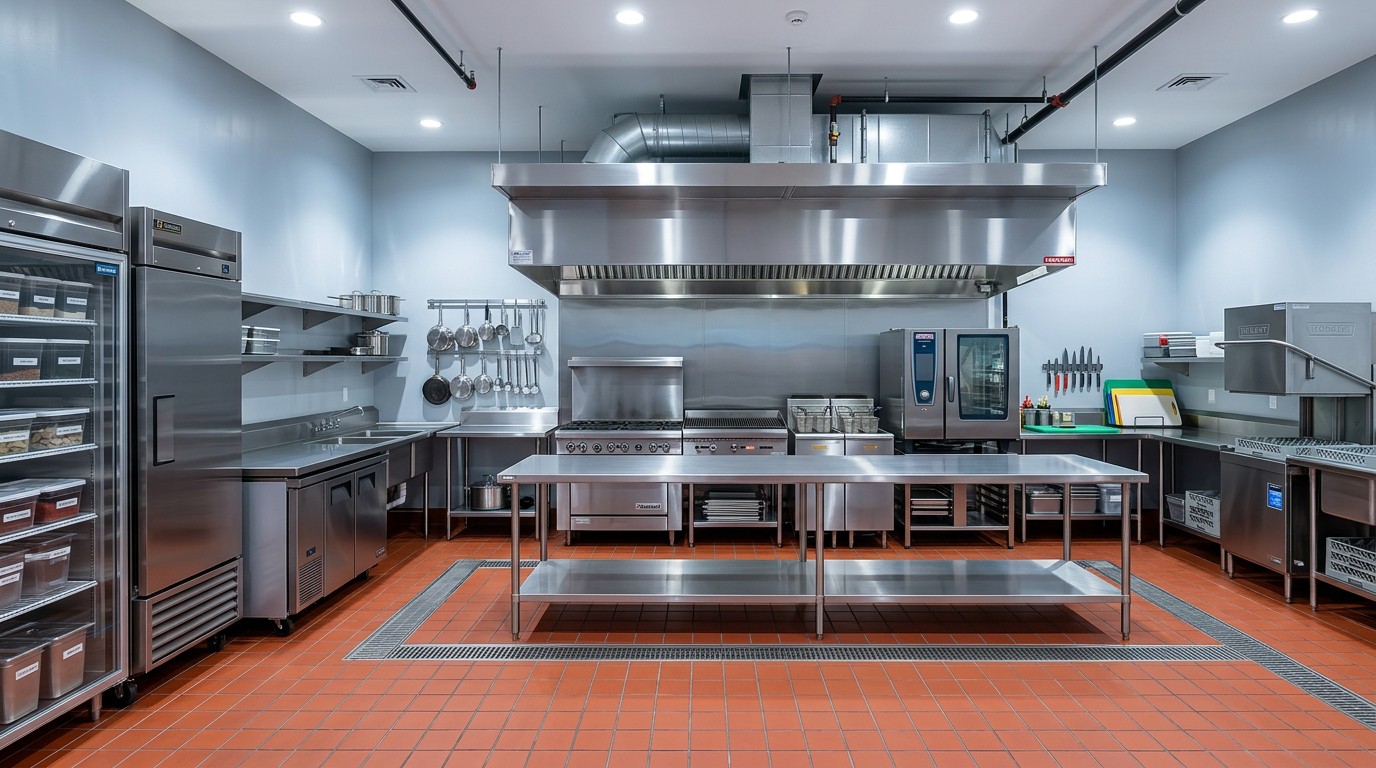
Even high-quality equipment can become a poor investment if it does not fit the actual kitchen process. Buyers often focus on machine specifications but overlook movement paths, prep sequence, ventilation, cleaning access, and operator ergonomics.
A capable manufacturer or supplier should be able to discuss:
- Equipment dimensions and clearance needs
- Heat output and ventilation compatibility
- Workflow integration with prep, cooking, holding, washing, and storage zones
- Left- or right-hand configurations
- Utility connection points and installation requirements
- Custom fabrication for unusual space constraints
This is particularly relevant in commercial kitchen layout planning, where poor equipment selection can slow staff movement, increase contamination risk, and reduce service efficiency. Operators and managers should involve chefs, maintenance staff, and installation teams early in the vetting process to avoid expensive layout corrections later.
Compare total cost of ownership, not just purchase price
Low-priced quotes can be appealing, especially when comparing multiple catering equipment suppliers, but the real cost of equipment includes much more than the invoice value. Decision-makers should assess total cost of ownership over the expected service life.
Important cost factors include:
- Energy and water consumption
- Installation and commissioning costs
- Spare parts pricing and availability
- Expected maintenance frequency
- Warranty coverage and exclusions
- Downtime risk and lost production impact
- Expected lifespan and resale or replacement cycle
For example, an energy-efficient oven or refrigeration system may cost more upfront but produce savings over years of operation. Likewise, a machine built with standard, easy-to-source components can be more economical than a cheaper unit requiring difficult or delayed replacement parts.
For procurement managers and executives, this is where business value becomes clearer. Good vetting should connect equipment choice to operating margin, service continuity, and labor productivity.
Test the manufacturer’s communication and after-sales support
One of the strongest indicators of a good manufacturer is how they communicate before the sale. If they are slow, vague, or inconsistent while trying to win your business, service may be worse after payment.
Evaluate support quality by checking:
- Response speed and technical accuracy
- Ability to answer detailed product questions clearly
- Availability of installation guidance and operating manuals
- Warranty terms and claim process
- Spare parts lead times
- Remote troubleshooting options
- Local distributor or service partner network
Ask specific scenarios: What happens if a thermostat fails within six months? How quickly can replacement parts be shipped? Is there video support for installation? Can they provide maintenance training for operators?
These questions help buyers move beyond product claims and assess the practical partnership. In commercial kitchens, downtime during peak periods can be far more expensive than the original equipment discount.
Use references, case studies, and sample orders to validate claims
Reliable manufacturers should be able to show real project history. This is valuable because commercial kitchen equipment performs differently in theory and in a busy kitchen environment.
Useful validation sources include:
- Customer references in similar applications
- Case studies from restaurants, hotels, schools, hospitals, or food factories
- Export records in your market
- Repeat-order customers
- Third-party inspection reports
- Sample units or pilot orders
When speaking with references, ask practical questions rather than general satisfaction questions. For example: Was delivery on time? Did the specification match the final product? How has the equipment held up after one year? How responsive was the supplier when issues arose?
If the project size allows, a sample order can reveal a great deal about packaging quality, documentation, build consistency, and communication discipline.
Watch for red flags during supplier evaluation
Some warning signs appear early and should not be ignored. While no supplier is perfect, recurring issues in transparency or professionalism often indicate deeper problems.
Common red flags include:
- Unclear company identity or inconsistent factory information
- Reluctance to share certifications or technical documents
- Quotes with major specification gaps
- Unusually low pricing without explanation
- No quality control process described
- Poor English communication for export projects
- Vague warranty promises not stated in writing
- No spare parts list or service plan
For international sourcing, also be cautious if the supplier avoids discussion of packaging, shipping terms, customs documentation, or voltage and gas adaptation. These details matter in real-world procurement and often reveal whether the supplier truly understands overseas projects.
A practical vetting checklist for procurement teams and operators
To make supplier comparison easier, use a structured checklist. This helps align procurement staff, operators, technical reviewers, and management around the same decision criteria.
- Confirmed production application and kitchen requirements
- Verified manufacturer identity and factory capability
- Reviewed certifications and compliance documents
- Checked material grade and component brand details
- Evaluated product testing and QC procedures
- Confirmed fit with commercial kitchen layout and utilities
- Compared warranty, spare parts, and technical support terms
- Estimated total cost of ownership
- Reviewed customer references or case studies
- Completed sample order, audit, or third-party inspection if needed
This approach is useful whether you are buying a single appliance or evaluating multiple commercial kitchen equipment manufacturers for a large facility rollout.
Conclusion: choose the manufacturer that reduces operational risk, not just the quote total
Vetting commercial kitchen equipment manufacturers is ultimately about protecting your operation. The right supplier should deliver more than equipment. They should provide confidence in compliance, consistency in quality, practical support, and a product fit that improves kitchen performance over time.
For information researchers, operators, buyers, and company leaders, the smartest approach is to compare manufacturers through a risk-and-value lens. Verify factory capability, check certifications, inspect quality details, test service responsiveness, and measure lifetime operating impact. When you do that, you are far more likely to choose a commercial kitchen equipment partner that supports food safety, efficiency, and long-term business results.
Popular Tags
Kitchen Industry Research Team
Dedicated to analyzing emerging trends and technological shifts in the global hospitality and foodservice infrastructure sector.
Industry Insights
Join 15,000+ industry professionals. Get the latest market trends and tech news delivered weekly.
No spam. Unsubscribe anytime.
Contact With us
Contact:
Anne Yin (Ceramics Dinnerware/Glassware)
Lucky Zhai(Flatware)